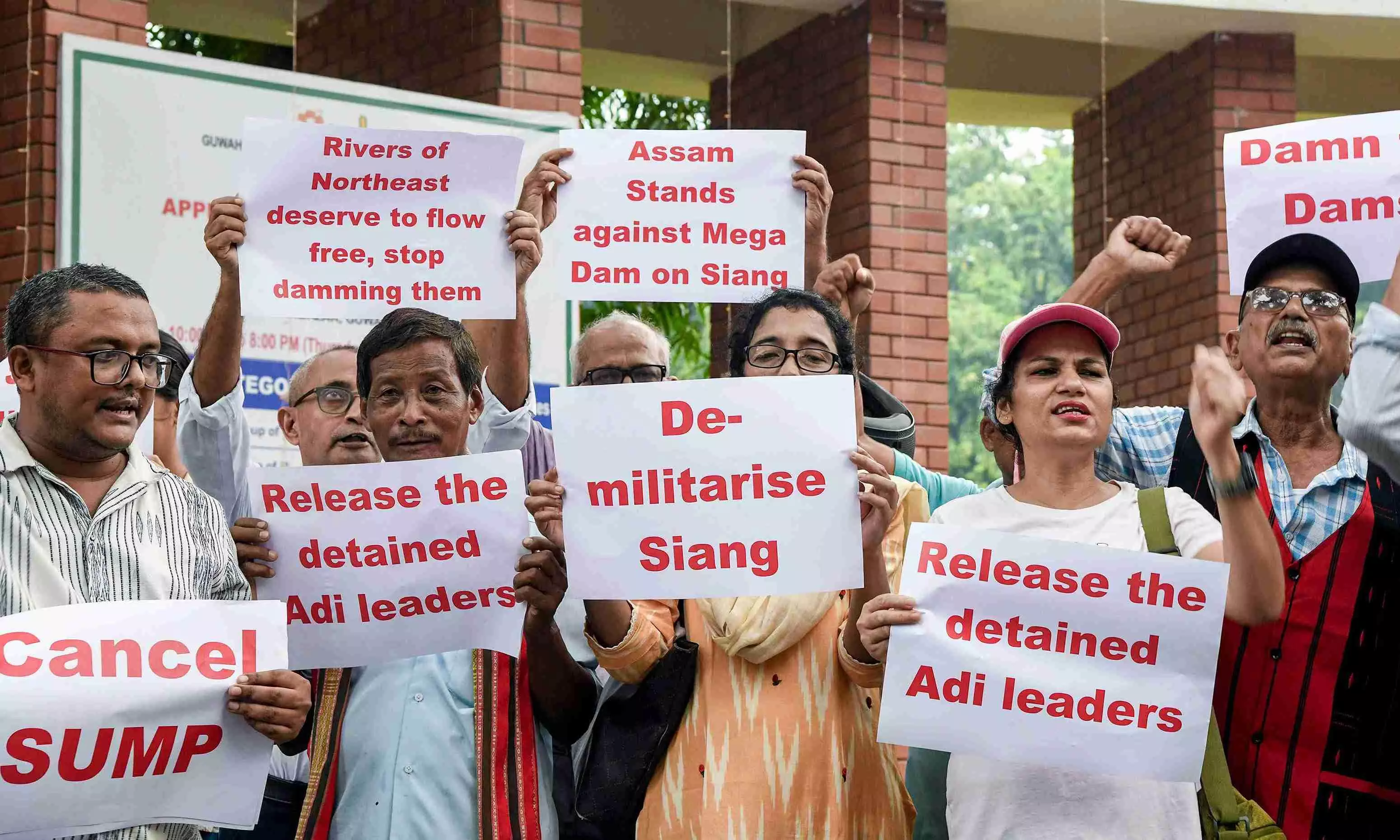
Members of various citizens' initiatives, environmental groups, and student bodies raise slogans and hold placards during a demonstration in solidarity with the escalating anti-dam movement in Arunachal Pradesh, in Guwahati, Assam on Friday (October 30). | PTI
Siang dam protests put BJP’s political hold on 7 Arunachal seats under scrutiny
Opposition to the Siang Upper Multipurpose Project is intensifying over displacement fears, loss of ancestral land and cultural heritage, exposing unease within the BJP and its allies

The growing agitation against the Siang Upper Multipurpose Project (SUMP) has put the BJP’s political standing in eastern Arunachal Pradesh under scrutiny, with seven Assembly constituencies emerging as the focus of a potentially wider political contest.
The controversy centres on Chief Minister Pema Khandu’s 2024 Assembly election assurance that no dam would be built in Siang against the people’s wishes. Sections of the Adi community now accuse the government of proceeding with Pre-Feasibility Report (PFR) activities without respecting their right to Free, Prior and Informed Consent (FPIC).
Since September 2026, demonstrations have intensified against the PFR-related activities being carried out by government authorities. Indigenous organisations have demanded an immediate halt to the exercises and recognition of the community's right to reject the project.
Also read: 'Siang dam project won’t be imposed on residents', says Arunachal CM Pema Khandu
Opposition to the proposed dam has been building since the project was first proposed in 2017. Community organisations allege that, instead of engaging in constructive dialogue, the government has resorted to threats, intimidation, detention of activists and deployment of security forces to suppress opposition.
Seven seats at stake
The three districts at at the centre of the agitation — Siang, East Siang and Upper Siang — account for seven Assembly constituencies, all of which the BJP and its allies won in the 2024 Assembly elections.
The BJP won the Pangin seat with Ojing Tasing, Pasighat West with Ninong Ering and Nari-Koyu with Tojir Kadu as its candidates. Its allies, the National People’s Party (NPP) and the People’s Party of Arunachal (PPA), won the Mariyang-Geku seat with Oni Panyang, Pasighat East with Tapi Darang and Mebo with Oken Tayeng as their candidates. The BJP also won the Tuting-Yingkiong seat with Alo Libang as its candidate.
Ojing Tasing is now a minister in Khandu's Cabinet. The political implications of the agitation are particularly significant for the ruling alliance because the movement cuts across constituencies represented by different parties.
Displacement fears deepen
The October 23 violence in Pasighat, including attacks on the residences of BJP state president Kaling Moyong and Pasighat West MLA Ninong Ering, has brought the confrontation into the political arena. The subsequent deployment of additional security personnel and arrests have further intensified the controversy.
Also read: Arunachal dam row escalates as police target accused, anti-dam protests spread
The government has maintained that SUMP has strategic importance in view of China's proposed hydropower development on the Yarlung Tsangpo. Khandu has also held meetings with legislators and indigenous organisations, calling for transparency and dialogue.
However, the concerns raised by the Adi community go beyond environmental clearances and power generation. They centre on ancestral land, displacement, destruction of agricultural resources, cultural identity and the future of traditional institutions.
According to the Siang Indigenous Farmers' Forum (SIFF), 27 villages could be completely submerged, while another 40–50 villages could be affected.
Dissent within BJP
The growing unease within the BJP's own ranks is also emerging as a significant concern. Tago Jijong, general secretary of the party's Upper Siang district unit, has publicly acknowledged the dilemma facing local leaders and workers.
“We can’t speak freely about the dam because we are associated with the BJP and need to follow what comes from above. But if you see, we are also from the same villages, this same land. This office we are sitting in will also go underwater after the dam is built. Nobody wants that. But our hands are tied,” Jijong told the media. He said the state BJP leadership had directed local workers to campaign in support of SUMP, describing it as a matter of national importance.
Also read: Arunachal anti-dam fury spreads, NHPC office vandalised as violence erupts again
Another BJP worker, speaking on condition of anonymity, said the additional deployment of security forces had deepened public anger and widened the disconnect between the party and local communities. “This is a democracy. Now protests have happened in Itanagar, and it will happen in Delhi too. We don’t even have to go there. People of the Northeast and Arunachal, and students, are there. They will come out,” the worker said.
The worker added that the deployment of additional forces had aggravated tensions and created a rift between BJP workers and their own people.
Congress alleges misuse of funds
Arunachal Pradesh Congress Committee (APCC) president Bosiram Siram has accused the Khandu-led BJP government of misusing Rs 350 crore granted by the NHPC for livelihood promotion among poor families in the Siang belt.
Siram alleged that the government paid Rs 2.5 lakh to individuals and families who signed MoUs or issued no-objection certificates for conducting PFR activities, while depriving genuinely poor and needy families of the benefits.
He further alleged that the payments were made in violation of Adi customary laws, under which beneficiaries should be selected through village-level meetings at community halls in the presence of gaon burahs (village elders) and panchayat representatives.
Siram said the Adi community isn’t opposing development but objects to the construction of a mega dam in its area.
Threat to land and heritage
He claimed that nearly 1.5 lakh people from 27 villages along the Siang River feared displacement if the project was implemented. The consequences, he said, would extend beyond the loss of homes and agricultural land to the destruction of the community's cultural identity.
Also read: Arunachal erupts over Siang mega dam; BJP leaders’ homes attacked, NHPC office torched
Among the areas facing possible submergence, he identified Yingkiong, the headquarters of Upper Siang district, along with several other important settlements. Cropland and orchards could also be destroyed, he said.
The Congress leader listed the possible loss of community, clan-based and private land, including areas rich in natural resources. Burial grounds, historical monuments and water rice cultivation (WRC) fields could also be affected, he added.
He said the loss of traditional settlements and community-owned land could leave people facing an identity crisis and the prospect of becoming refugees in their own homeland.
Siram called for the involvement of scientists, experts and other knowledgeable people to assess the project's social and cultural consequences and engage with affected villagers before any decision is taken.
Differences within BJP over dam
He also pointed to what he described as contradictory positions within the BJP leadership. While MP Tapir Gao has advocated construction of the dam, Khandu has maintained that the project may not be taken forward if the PFR finds it unfeasible.
Siram also questioned the feasibility of relocating towns and villages, arguing that the region had little vacant land and that boundaries between community-owned lands of different villages were clearly demarcated.
The APCC has taken a formal position against the mega dam. Siram said the party had passed a resolution opposing the project last year and forwarded its report to Leader of Opposition in the Lok Sabha Rahul Gandhi, Congress president Mallikarjun Kharge and Rajya Sabha MP and AICC general secretary KC Venugopal.
Rahul Gandhi had maintained that jal, jangal and jamin belonged to tribal communities and should not be acquired by the government without their consent, Siram said.
The Congress has also raised concerns over the proposed project's location in a fragile Himalayan ecosystem and a high seismic zone.
Congress expands its base
Seeking to turn the agitation into a wider political issue, the APCC has also highlighted its organisational expansion in the state.
Siram said the Congress currently had one MLA, Kumar Wai, representing the 8th Bameng Assembly constituency in East Kameng district. In the 2024 panchayat elections, the party won 200 Gram Panchayat Constituency seats, including chairman posts, he claimed.
Also read: Kishau Project: Six CMs sign agreement in presence of Amit Shah
Since taking charge as APCC president on June 18, 2025, Siram said the party had attracted more than 20,000 new members, including former senior BJP leaders, retired government officials and workers who had left the ruling party. He said the APCC had reconstituted its state-level and district committees and strengthened its frontal organisations, including the Arunachal Pradesh Youth Congress, Arunachal Pradesh Mahila Congress and Seva Dal. The party had also reorganised its cells, morchas and committees at block, village and booth levels and appointed booth-level agents.
Siram said he had toured all 27 districts as part of the membership drive. During a recent visit to Upper Siang district, more than 2,000 people joined the Congress at Yingkiong, Simong Komkar, Gegu and Parong, he claimed.
He attributed the influx to growing dissatisfaction with the BJP government's policies and what he described as its failure to uphold secularism and protect citizens' rights.
Political fallout uncertain
The immediate political challenge for the BJP, however, remains the growing discontent over SUMP among sections of the Adi community. The October 23 violence and the subsequent security response have added to the unease.
Whether the agitation translates into electoral discontent remains to be seen. But with all seven constituencies in the Siang political belt having gone to the BJP and its allies in 2024, the controversy has placed the ruling alliance's relationship with indigenous communities under an unusually sharp spotlight.