



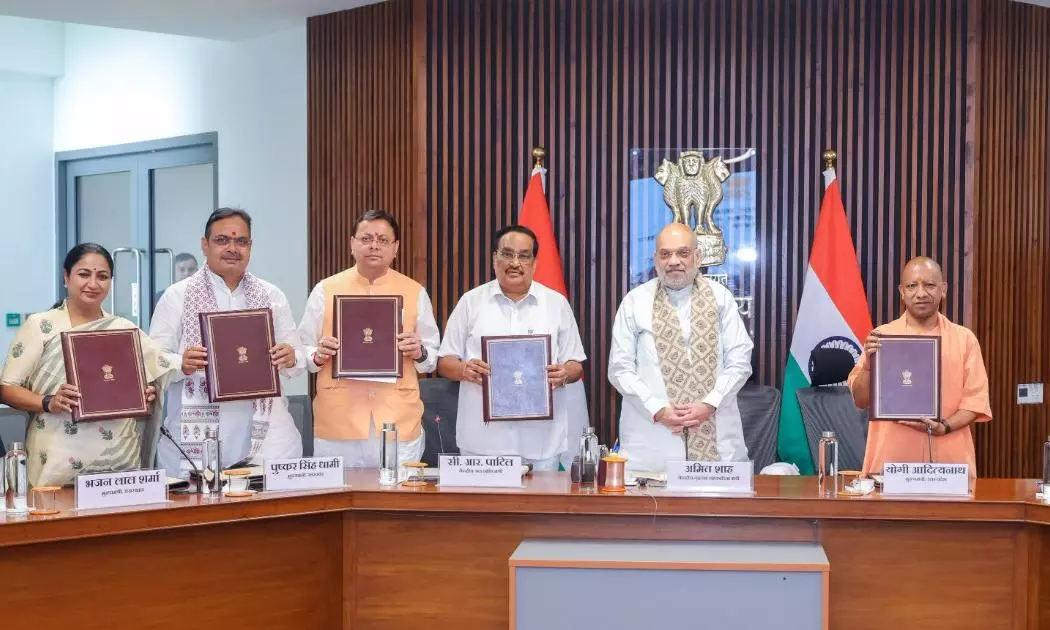
The chief ministers of Uttar Pradesh, Uttarakhand, Himachal Pradesh, Rajasthan, Delhi and Haryana – Yogi Adityanath, Pushkar Singh Dhami, Sukhvinder Singh Sukhu, Bhajanlal Sharma, Rekha Gupta and Nayab Singh Saini – signed the Kishau Multipurpose Project in the presence of Shah and Jal Shakti Minister CR Patil. Photo: X/@AmitShah
Kishau Project: Six CMs sign agreement in presence of Amit Shah
The Kishau project envisages the construction of a 232.6-metre-high concrete gravity dam on the Tons River, which flows along the Uttarakhand-Himachal Pradesh border, with a water storage capacity of 1,562 million cubic metres

New Delhi, Sep 15 (PTI) The agreement for the long-pending Kishau Multipurpose Project was signed on Tuesday, marking the resolution of the 10th water dispute since Narendra Modi became prime minister, Union Home Minister Amit Shah said, describing the pact as a "historic agreement".
The chief ministers of Uttar Pradesh, Uttarakhand, Himachal Pradesh, Rajasthan, Delhi and Haryana – Yogi Adityanath, Pushkar Singh Dhami, Sukhvinder Singh Sukhu, Bhajanlal Sharma, Rekha Gupta and Nayab Singh Saini – signed the agreement in the presence of Shah and Jal Shakti Minister C R Patil, an official statement said.
Shah said the agreement would benefit all six states in one way or another and congratulated their chief ministers and Patil for playing an important role in bringing the project to this stage.
He said the Government of India and the chief ministers of the six Yamuna basin states were committed to completing the project at the earliest.
The Kishau project envisages the construction of a 232.6-metre-high concrete gravity dam on the Tons River, which flows along the Uttarakhand-Himachal Pradesh border, with a water storage capacity of 1,562 million cubic metres.
The project will irrigate 97,000 hectares of land and generate 1,476 million units of clean hydropower, Shah said, adding that Delhi would be the biggest beneficiary.
The pact comes after the six states agreed in June to sign an MoU on the 422-MW project, paving the way for its consideration by the Union Cabinet. The project was earlier estimated to cost around Rs 15,000 crore and had been pending for more than eight years.
Under the Kishau Multipurpose Project, the Centre will bear approximately 90 per cent of the financial burden, while the remaining 10 per cent will be borne by the participating states in accordance with the 1994 agreement, Shah said.
He said an agreement reached on May 12, 1994, provided that separate agreements would be entered into for each storage project coming up in the basin.
Shah said that after disputes concerning the Lakhwar and Renukaji projects were resolved, work on Kishau moved forward and a formal agreement on the project was reached on June 16 this year.
He said the Ministry of Jal Shakti took the matter forward after securing the consent of all the states and considering the technical and economic aspects while safeguarding their interests.
Shah said that since Modi became prime minister, initiatives had been undertaken to resolve serious disputes that had continued for decades and this project will be the "tenth water dispute that is now set to be resolved." He cited agreements relating to the Lakhwar Multipurpose Project, Shahpur Kandi Dam Project, Renukaji Multipurpose Dam Project, Ken-Betwa Link Project and other water-related disputes.
He said the period from 2018 to 2026 under Modi's leadership would be remembered as one in which almost all water disputes, from Kashmir to Uttar Pradesh, were resolved.
On the Yamuna, Shah said that when its waters were allocated, the environmental flow of the river was not calculated and all available water was distributed among the states, leaving no water for the river itself.
He said 25 per cent of the water would become available through the Kishau agreement, which would benefit both Delhi and the Yamuna and contribute to environmental conservation.
Shah said continuous work was underway to clean the Yamuna and expressed confidence that the goal of a clean Yamuna would be achieved by 2029.
He said cleaning the Yamuna was essential for fulfilling the dream of a clean Ganga as the Yamuna merges with the Ganga at Prayagraj. PTI