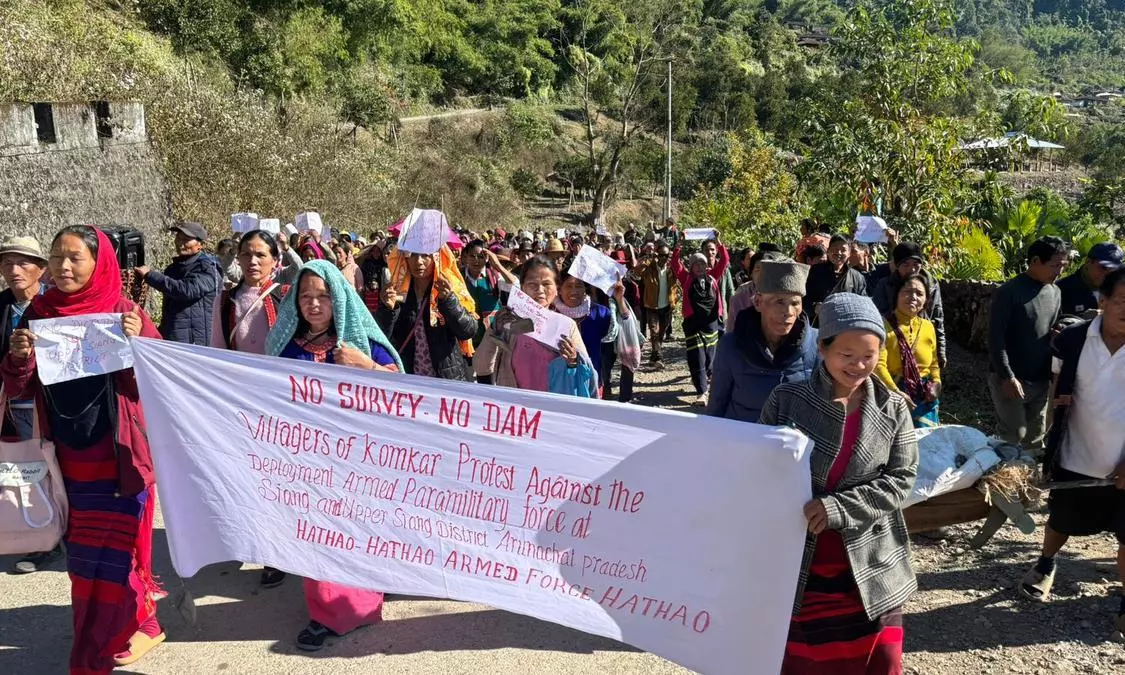
More than 1,000 people gathered at Indira Gandhi Park in Itanagar on Thursday for a rally against Siang Upper Multipurpose Project (SUMP) and the Subansiri Upper Hydroelectric Project.
Arunachal dam row escalates as police target accused, anti-dam protests spread
Police seek search warrants against journalist Tongam Rina and lawyer Sunny Tayeng over October 23 violence, as over 1,000 people rally in Itanagar against the proposed mega dam

Arunachal Pradesh police have approached a court in Pasighat for search warrants against four persons accused in the October 23 violence linked to protests against the proposed Siang Upper Multipurpose Project (SUMP), including journalist Tongam Rina and lawyer Sunny Tayeng.
The move comes amid mounting opposition to the proposed mega dam, with a solidarity rally in Itanagar on Thursday (October 29) drawing more than 1,000 people demanding the withdrawal of armed forces, release of detainees and protection of indigenous land and river rights.
In a petition filed on October 27 before the Chief Judicial Magistrate, East Siang district, investigating officer SI Kodak Dagium of Pasighat Police Station sought warrants to search the premises of the accused in connection with case No. PSGT/PS/C/No. 114/2026.
Also read: ITBP Arunachal row: Face-offs on unmarked border not unusual, says China expert
Rina is the associate editor of The Arunachal Times, while Tayeng represents environmental activists Ebo Milli, Otul Jerang and Tajong Talom in court.
Police seek search warrants
The police petition refers to alleged mob violence, vandalism and assaults on security personnel during the October 23 unrest. It states that protesters allegedly pelted stones, set police vehicles on fire and attacked Pasighat Police Station and an NHPC building. The residences of several MLAs and political representatives were allegedly ransacked and burnt, while the central office of Adi Baane Kebang (ABK) was also set on fire, the petition said.
Police told the court that searches were necessary to establish the individual roles of the accused and recover evidence, including clothing allegedly worn during the incident, mobile phones, digital devices containing photographs or videos, and other case-related material.
The petition seeks warrants under Section 96 of the Bharatiya Nagarik Suraksha Sanhita (BNSS), 2023, or other applicable provisions. It lists offences under several sections of the BNSS and Section 3 of the Prevention of Damage to Public Property Act.
As many as 69 people have been detained in connection with the violence, and the investigation is underway.
Criticism of armed deployment
Rina has been a vocal critic of the deployment of central and state armed police in the Siang valley, describing it as state-sponsored militarisation intended to intimidate communities opposing the proposed project.
In her column, “Siang: Heavy cost of border politics”, she argued that the deployment was spreading “panic, fear, and physical violence” among communities resisting the dam plan.
Also read: Siang Valley on edge as arrests, CAPF deployment fail to deter anti-dam protesters
In another article, “Not guns, what Siang needs is dialogue on the 11,000 MW hydropower project”, she questioned the need for armed security personnel and late-night investigations, arguing that such measures could aggravate tensions instead of resolving the dispute.
Rina has also questioned the government’s position that the pre-feasibility report (PFR) is merely a study. “Why militarise and terrorise the communities? It is not just a study, and the people know it,” she wrote.
On October 26, she posted on X: “If the indigenous community is not ready to move despite the threat of China’s water bomb, and is ready to die, what is the logic behind the Indian state forcing an 11,000 MW project on the people? Explain it to me.”
She has called for direct engagement with the Siang Indigenous Farmers’ Forum (SIFF), which she says represents communities opposing the project, and demanded the withdrawal of armed forces and respect for the rights of residents over their land and homes.
Anti-dam protests gain momentum
Meanwhile, more than 1,000 people gathered at Indira Gandhi Park in Itanagar on Thursday for a rally against SUMP and the Subansiri Upper Hydroelectric Project.
Organised under the banner “Say No to Mega Dam” by Youth for Change, Arunachal Pradesh, along with the Cockroach Janta Party (CJP)’s Arunachal unit and other groups, the demonstration began at Akashdeep Complex. It proceeded to IG Park under the theme “One Arunachal. One People. One Voice.”
Participants, including members of the SIFF, student bodies, community organisations and Gen Z groups, raised slogans such as “No PFR, No Dam” and “Protect Our Land, Save the Siang.”
Also read: Arunachal erupts over Siang mega dam; BJP leaders’ homes attacked, NHPC office torched
The protesters voiced concerns over displacement, loss of ancestral land, threats to livelihoods and the impact of the projects on indigenous identity and the environment. They demanded the release of all detainees, withdrawal of armed forces deployed during the agitation and greater accountability from the government.
The rally reflected the widening opposition to SUMP, which has a proposed capacity of around 11,000 MW to 12,500 MW. Protesters fear the project could submerge villages and disrupt the traditional way of life of the Adi community.
The demonstration came amid continuing tension in Siang, Upper Siang and East Siang districts over the pre-feasibility survey, arrests linked to the agitation and the deployment of central forces.
Can SUMP counter China’s dam?
The Centre has argued that the proposed 11,200-MW Siang Upper Multipurpose Project (SUMP) could counter China’s Medog dam by creating a strategic water-storage buffer on the Siang. SUMP is projected to have 9.2 billion cubic metres of live storage, against an estimated 5.5 billion cubic metres for China’s project.
However, Himanshu Thakkar, coordinator of the South Asia Network on Dams, questioned the premise, saying India was claiming the project could counter China without knowing the Chinese dam’s basic dimensions or operating procedures. He said New Delhi should seek public details from Beijing, adding that downstream countries have a right to such information. He also stressed that SUMP could not proceed without the full cooperation of local communities.
Also read: Arunachal anti-dam fury spreads, NHPC office vandalised as violence erupts again
Sumit Vij, an assistant professor at Wageningen University who has worked on the Brahmaputra basin, said the project might serve more as a marker of India’s claims over the river than as effective protection against China’s upstream dam.
Flood control vs power generation
Experts have also flagged a fundamental conflict between flood control and hydropower generation. While flood-control reservoirs need substantial empty storage space to absorb surges, hydropower projects are more productive when reservoirs remain relatively full. Maintaining a large buffer could therefore reduce power generation and affect the project’s economic viability.
The Siang valley’s narrow geography could further limit the reservoir’s flood-cushioning capacity.
Experts have also warned that the short distance between China’s Medog project and the proposed Siang dam could leave downstream authorities with only tens of minutes to respond to a major upstream structural failure, making the safe release of large volumes of water extremely difficult.