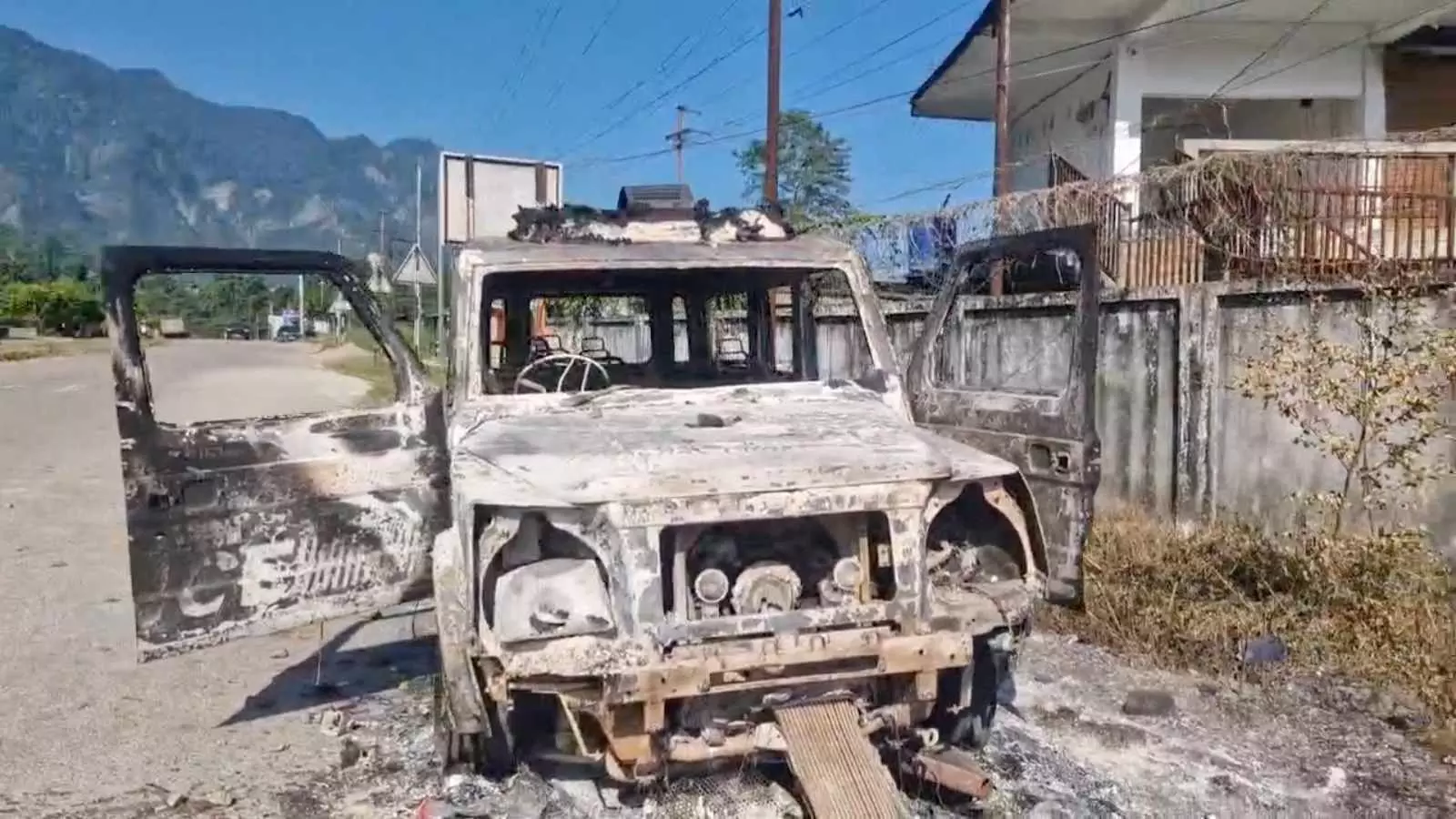
The violence continued until around 3.30 am on October 24, following a 12-hour bandh on Friday across Siang, Upper Siang and East Siang districts.
Arunachal erupts over Siang mega dam; BJP leaders’ homes attacked, NHPC office torched
Protests against the hydropower project escalated after a bandh, with protesters seeking the release of detained activists, withdrawal of forces and an immediate halt to survey work

Arunachal Pradesh witnessed overnight violence during protests against the proposed Siang Upper Multipurpose Project (SUMP), with demonstrators allegedly vandalising the residences of senior BJP leaders, setting an NHPC office and a police station on fire, and torching seven police vehicles in Pasighat.
The residence of former Union Minister and sitting BJP MLA Ninong Ering was vandalised on Saturday (October 24). The houses of local MLA Oni Panyang and state BJP president Kaling Moyong were also reportedly targeted, with incidents of looting and theft reported. A journalist sustained injuries during the unrest.
Overnight violence follows 12-hour bandh
The violence continued until around 3.30 am on October 24, following a 12-hour bandh on Friday (October 23) across Siang, Upper Siang and East Siang districts. The shutdown was called by organisations opposing the proposed mega dam and demanding the release of detained activists, the withdrawal of Central Armed Police Forces (CAPF) personnel and an immediate halt to survey work.
Also Read: ITBP Arunachal row: Face-offs on unmarked border not unusual, says China expert
Arunachal Pradesh Chief Minister Pema Khandu described the incidents as regrettable and appealed for peace. He said peaceful protest was a democratic right but must remain within the bounds of the law.
The agitation has intensified over the National Hydroelectric Power Corporation’s (NHPC) pre-feasibility report (PFR) surveys for the proposed project, with indigenous groups raising concerns over ancestral land, displacement, environmental damage and the deployment of security forces.
Clashes reported as police disperse protesters
Clashes were reported at Dite-Dime near Geku on Friday (October 23), where police used tear gas to disperse protesters. At least four women were injured, according to reports.
Siang Superintendent of Police Kamdam Sikom said around 150–200 protesters from Geku and Komkar allegedly attempted to enter Siang district at Dite-Dime around 7 am, carrying machetes, lathis and slingshots. He alleged that they pelted stones, tried to damage barricades and violated prohibitory orders, prompting police action in the presence of an executive magistrate.
Also Read: Congress slams PM Modi on reported Arunachal 'face-offs' with Chinese Army
The bandh was largely peaceful in Siang and Upper Siang districts and Pasighat during the day, but tensions escalated overnight.
The latest unrest has intensified the debate over the proposed 11,000–11,200 MW hydropower and water-storage project on the Siang River, a major tributary of the Brahmaputra. The project has become a flashpoint between the government’s strategic and water-management objectives and indigenous communities’ concerns over land, livelihoods and cultural heritage.
Protesters demand release of activists, halt to surveys
The bandh was jointly called by the Adi Bane Kebang United, the SUMP Affected Area Youth Association (SAAYA), the Siang Indigenous Farmers’ Forum Youth Wing (SIFFYW) and the Adi Galo Welfare Society. The Siang Indigenous Farmers’ Forum (SIFF), representing Adi agriculturists, has been a leading force in the wider movement.
The protesters’ demands include the immediate release of 10 arrested or detained anti-dam activists, withdrawal of security personnel from Siang and Upper Siang, suspension of all PFR surveys and related activities, and withdrawal or quashing of FIRs and legal proceedings linked to the agitation. They have also sought the reinstatement of suspended gaon buras, or village headmen, and compensation for damaged vehicles and medical expenses.
Also Read: Fresh clash erupts between Assam, Arunachal protesters; Himanta appeals for peace
“No dam, no survey,” has been the central slogan of the movement.
Villagers have also expressed resentment over the survey process. “We are deeply hurt that the PFR is being carried out without consulting us. We are Indian citizens; we are Arunachali – the forces must withdraw,” they said.
SIFF president Lamok Padun said, “In reality, we the Adis will lose our ancestral fertile land and the knowledge, self-respect that we have acquired over time.”
Indigenous groups raise land, environmental concerns
The proposed project has faced opposition from sections of local communities who fear the submergence of ancestral Adi lands, displacement and disruption of traditional livelihoods. Opponents have also raised concerns over the ecological risks of constructing a large storage dam in a fragile, biodiversity-rich and seismically active Himalayan region.
Concerns include sediment accumulation, flooding of habitats, forest fragmentation, altered river flows, obstruction of fish migration and damage to downstream habitats and agricultural land. Protesters have also cited the risk of glacial lake outburst floods, referring to the 2023 Teesta disaster in Sikkim and the presence of high-risk glacial lakes across Siang, Upper Siang and East Siang districts.
Also Read: Anti-conversion storm rocks Arunachal as BJP pushes to revive 48-year Act
Community estimates cited in reports suggest that the reservoir could submerge around 27 villages and affect dozens more, with 100,000 to 150,000 indigenous people potentially displaced or severely affected. Another assessment estimates that at least 100,000 residents could be uprooted. However, official figures distinguishing direct displacement from wider social and economic impacts were not available.
The immediate flashpoint is the PFR survey, which is intended to assess the technical and environmental viability of the proposed dam. Opponents have objected to the survey activities and the deployment of security personnel to facilitate them.
Govt cites water security, China’s upstream dam
The state government has maintained that the project is primarily intended to store and regulate water in the Siang basin, particularly in view of China’s proposed mega dam upstream on the Yarlung Tsangpo, known in India as the Siang. It has cited national water and energy security, flood management in the Siang-Brahmaputra basin and long-term socio-economic development as key considerations.
Also Read: Arunachal Pradesh: Five Army personnel missing after flash flood; 4 killed in landslide
The government has also clarified that the ongoing work is limited to technical and environmental surveys for the PFR and does not constitute approval for construction. It has said the rights, welfare, land security and cultural heritage of local communities and project-affected families will remain central to the evaluation.
Upper Siang Deputy Commissioner and District Magistrate Ashok Tajo said restrictions had been imposed to maintain peace and public order, adding that the situation could develop unpredictably. He said detainees could submit representations to the state government against their detention orders.
Mission Arunachal calls for dialogue
Meanwhile, Mission Arunachal has called for dialogue to resolve the deadlock, stressing the strategic importance of the project in view of China’s hydropower development upstream.
Speaking to the media at the Arunachal Press Club in Itanagar on October 23, Mission Arunachal vice-president T Kilo said the proposed SUMP needed to be assessed in the context of China’s construction of mega dams in the upper reaches of the Siang river, which, he said, posed concerns for downstream areas in Arunachal Pradesh and Assam.
The organisation’s general secretary, Bamang Isac, said the issue required a broader discussion among stakeholders and that law-and-order measures alone would not resolve the impasse.
He said the PFR was a preliminary study intended to facilitate detailed technical, environmental and social assessments and did not amount to approval for dam construction. Referring to statements by Chief Minister Pema Khandu and other leaders, Isac said concerns over the project should be addressed through consultation.
He urged local leaders and community representatives to hold discussions with the Chief Minister and other stakeholders to find a solution.
Khandu offers talks, calls for consensus
Khandu, meanwhile, said the government was willing to discuss the project with organisations, associations and other stakeholders, including its potential benefits, possible adverse impacts and concerns raised by local communities.
“The government’s doors are always open. Any organisation or association that wants to discuss the SUMP project is welcome. People should question the government, discuss the possible benefits and negative aspects of the project, and seek clarification on their concerns,” Khandu said.
He said the government had reached out to stakeholders and invited them to meetings, urging organisations to use the opportunity to raise concerns directly. He offered to meet representatives from the Siang region in Itanagar, Pasighat or any other location convenient to them, and expressed willingness to visit a venue proposed by stakeholders along with officials of the concerned departments.
Reiterating that public consensus would remain central to taking the project forward, Khandu called for round-table discussions to address apprehensions and improve understanding of the proposal.
The latest violence has brought the long-running opposition to the SUMP to a critical point, with protesters demanding an immediate halt to survey work and the withdrawal of security forces, while the government maintains that the project’s viability must first be assessed through technical studies.