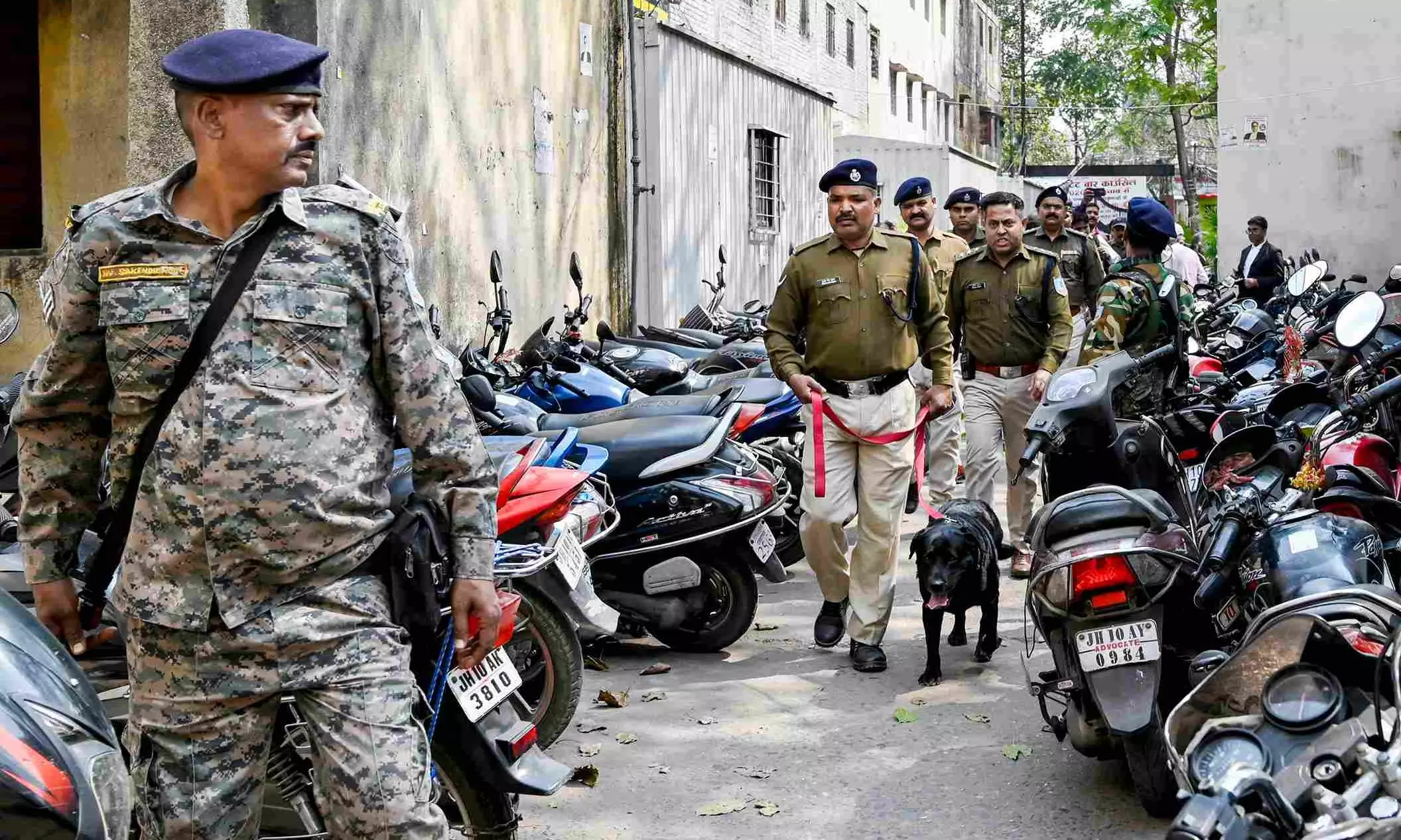
In rare move, EC deploys central forces in Bengal even before poll date announcement
From GPS tracking to area-domination patrols, EC steps up monitoring amid friction with state over deployment pattern

As the Special Intensive Revision (SIR) of electoral rolls in West Bengal enters its last leg ahead of the publication of the “final” voter list on Saturday (February 28), the Election Commission (EC) has shifted focus to what it calls the next critical priority of curbing alleged muscle power and coercion in the run-up to the state assembly elections.
In a departure from past practice, the EC has decided to deploy central armed police forces from March 1, even before the formal announcement of the election schedule.
Also read: West Bengal elections 2026: Congress to go solo after 20 years
Traditionally, central forces are deployed after the poll dates are notified and the model code of conduct comes into force, when the EC assumes supervisory control over the state’s administrative and law-and-order machinery for election purposes.
Deployment of Central Forces
This time, however, 240 companies of central forces will fan out across 23 districts covering 35 police districts and commissionerates from Sunday (March 1), with another 240 companies slated to arrive by March 10, according to official deployment orders.
“The forces will reach by February 28. Wherever deployment has been decided, they will go there. They will not sit idle. They will move across all areas,” state chief electoral officer Manoj Agarwal told reporters.
The first tranche includes 110 companies of the Central Reserve Police Force (CRPF), 55 of the Border Security Force (BSF), 21 of the Central Industrial Security Force (CISF), and 27 each of the Indo-Tibetan Border Police (ITBP) and Sashastra Seema Bal (SSB). Each company will have at least 72 personnel, as mandated by the Union Home Ministry.
Also read: Muslim voters in flux ahead of 2026 Bengal polls as SIR fuels fear
The deployment pattern underscores the Commission’s stated focus on vulnerable and border districts.
North 24-Parganas, which includes three police districts and two commissionerates, will receive the largest allocation of 30 companies. Murshidabad will get 16, while Howrah and South 24-Parganas will each have 15 companies. Fourteen companies each will be stationed in East Midnapore and Hooghly.
Malda and Nadia will receive 12 companies each, while North Dinajpur will get 11 and South Dinajpur 10. In north Bengal, Darjeeling hills and Siliguri combined will see nine companies, as will Cooch Behar.
Smaller allocations range from seven companies in districts such as Bankura and Birbhum to three in Kalimpong.
The deployment pattern reveals that several of the higher allocations are in minority-dominated and Bangladesh-bordering districts, historically viewed as sensitive during elections. An exception is East Midnapore, the home district of Leader of the Opposition Suvendu Adhikari, which will also see a relatively heavy deployment.
Close monitoring of the situation
Beyond numbers, the EC has moved to tighten monitoring. It has appointed retired IPS officer NK Mishra (1988 batch, Sikkim cadre) as special observer to oversee the SIR exercise as well as the poll preparedness in the state.
Officials say his appointment before the announcement of election dates is significant. His presence is seen as a signal that the Commission intends to closely monitor the use and movement of both state police and central forces, even in the pre-notification phase.
Also read: The election is over; Mamata has already won: Monideepa Banerjee
In past elections, although large numbers of central forces were deployed, opposition parties had alleged that they did not see the strong presence of the force on the ground and incidents of unrest continued.
“The challenge is not just deployment on paper but effective utilisation,” said a senior official familiar with the planning process. “The special observer will oversee how police and central forces are actually being used.”
Tightened security
EC officials say the strategy goes beyond static deployment. It includes advanced “area domination” exercises, route marches in vulnerable pockets and booth-level vulnerability mapping based on past incidents of electoral violence and complaints of intimidation.
According to officials, preliminary plans treat virtually all booths as sensitive at this stage, pending further micro-level assessment.
“If there is unrest anywhere, the district magistrate and superintendent of police may use the forces if they deem necessary. However, central forces cannot move on their own,” Agarwal said, adding that they would be used extensively for area-domination patrols before polling.
Also read: Menaka Guruswamy, TMC candidate for Rajya Sabha, poised to be India’s first LGBTQ MP
A senior official familiar with the operational blueprint said GPS tracking devices would be installed in vehicles assigned to the central forces. “The movement of each unit will be monitored centrally to ensure there is no selective diversion or discretionary use at the local level,” the official said on condition of anonymity.
Cameras mounted on vehicles and a proposed central command centre to monitor live feeds are also under consideration. Officials say such systems could help determine whether local police are guiding central forces appropriately if trouble breaks out.
Central vs state friction
One recurring problem, they note, is that central units are often unfamiliar with local roads and terrain, which can delay response times.
The move aimed at addressing allegations by opposition parties that central forces are either under-utilised or deployed too late to prevent violence in sensitive booths.
The ruling Trinamool Congress has in the past accused central forces of highhandedness and bias.
Also read: Amit Shah says BJP will win West Bengal elections, vows to drive out ‘infiltrators’
State government officials have already indicated some unease with aspects of the deployment plan.
A senior home department official said the state had orally conveyed to the chief electoral officer that in certain police districts, the allocation was either lower or higher than required.
“In most of the cases, there is no objection, but in a few districts we feel rationalisation is needed,” the official said.
EC sources stated that central forces will operate under their own command structure, with deployment decisions coordinated with district authorities rather than placed under the unilateral control of the state police.
Some senior officials said the arrangement could become a fresh point of friction with the state government, since law and order formally remains under state control until the election schedule is announced.
Shorter poll schedule
Placing central forces under tighter commission-monitored operational command in the pre-notification phase, they said, could lead to differences over coordination and operational authority, particularly in districts where the state administration has questioned the scale of deployment.
Also read: Final call to be taken on single-phase Tamil Nadu Assembly elections, says CEC
The early deployment sets the stage for a potentially tense run-up to the elections in a state that saw 1,100 companies of central forces deployed during the last assembly polls, held over eight phases. This time, 480 companies have been announced so far.
Early indications from the CEO’s office suggest the 2026 assembly election is unlikely to be stretched over as many phases as in 2021. Officials indicated it could be conducted in three to four phases at most, although a final decision will be taken by the Commission after a comprehensive ground-level assessment.