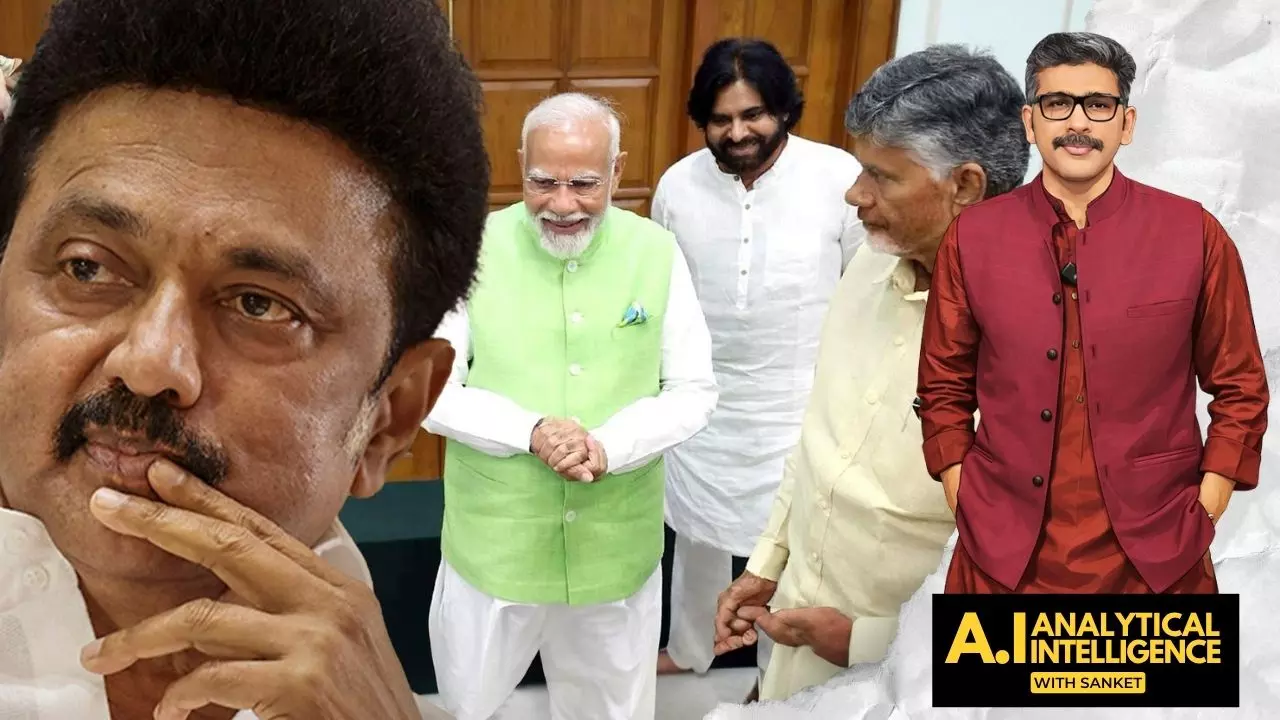
BJP’s delimitation strategy: Is it slicing the Opposition first?
A panel discussion on The Federal explores whether TMC splits and DMK outreach signal a BJP strategy to build parliamentary numbers ahead of delimitation

“The BJP may be preparing for a larger constitutional push on delimitation by first ensuring it has the numbers in place through political realignments and splits in Opposition parties,” senior journalist Javed Ansari said during a panel discussion on The Federal, which also had Javed Ansari, Pramila Krishnan, and Neerja Chaudhuri.
The discussion centred around whether recent political developments—including a reported split in the Trinamool Congress (TMC) and emerging signals of outreach towards the DMK—are part of a larger strategic attempt to reshape parliamentary strength ahead of a possible delimitation exercise.
Salami slicing claim
Senior journalist Javed Ansari raised concerns that the BJP could be pursuing a strategy of what he described as the “salami slicing” of the Opposition to secure numerical advantage in Parliament.
Also Read: Can Mamata Banerjee hold TMC together amid growing rebellion? | Capital Beat
He referred to the possibility of a split in the TMC and shifting loyalties among MPs as part of a “work-in-progress” political realignment.
According to Ansari, such developments could help the BJP ensure that it has sufficient numbers before attempting any major constitutional exercise like delimitation.
Long-term strategy
Ansari argued that the BJP operates with a structured long-term political approach.
He said the party works across “short-term, mid-term, and long-term projects” and is willing to use multiple political tools—including alliances and institutional power—to achieve its objectives.
He further suggested that the expansion of Parliament’s capacity to over 800 MPs and recent political developments could indicate preparation for a larger restructuring of representation.
Opposition concerns
The panel discussion highlighted concerns that delimitation could significantly alter the balance of political power between northern and southern states.
Tamil Nadu and other southern states have long argued that population-based delimitation would penalise states that successfully implemented population control measures.
Also read: DMK boycott clouds INDIA bloc’s future as rift with Congress widens
DMK leaders have previously opposed such proposals and demanded that economic indicators, including GDP and development metrics, also be considered in seat allocation.
DMK position
Pramila Krishnan noted that while there is no official communication of any political realignment involving the DMK, the tone of criticism from the party has appeared less aggressive in recent discussions.
She pointed out that DMK MP Tiruchirappalli recently called for proper consultation on delimitation and warned against injustice to states.
However, she also reiterated that the DMK’s core concern remains unchanged: Delimitation based purely on population would disadvantage southern states significantly.
Political recalibration
The discussion also explored whether there is space for political recalibration between the BJP and DMK.
Neerja Chaudhary suggested that political positions often evolve over time and that informal understandings between parties cannot be ruled out.
Also read: Can the INDIA bloc stay united? Five-point consensus masks fault lines | Capital Beat
She noted that even if formal alliances do not emerge, issue-based cooperation or parliamentary coordination remains a possibility.
According to her, governments often adjust policies to accommodate regional concerns to avoid deeper national polarization, especially on sensitive issues like delimitation.
North-South divide
A key concern raised during the discussion was the possibility of a deepening north-south divide in Indian politics if delimitation is carried out strictly on population.
Neerja Chaudhary warned that such a move could trigger regional polarization, which any government would likely want to avoid.
She suggested that the Centre may be forced to include additional criteria—such as economic performance or development indices—to make the process more acceptable to southern states.
BJP’s possible approach
The panel also discussed whether the BJP could adopt a more accommodating stance to bring regional parties like the DMK into a broader consensus.
It was suggested that the government may initially appear flexible, offering assurances based on earlier census benchmarks such as 1971, while retaining room for future recalibration.
Also Read: DMK announces exit from INDIA bloc, hints at new anti-BJP alliance
However, the panel also noted that no formal announcement or clear policy shift has yet been made in this direction.
Strategic numbers game
Neerja Chaudhary highlighted that even a potential addition of MPs from parties like the TMC or DMK could significantly strengthen the NDA’s position in Parliament.
She suggested that gaining even 20 TMC MPs and 22 DMK MPs could provide a major buffer for the ruling coalition in passing constitutional amendments.
This, she said, would give the NDA greater comfort in managing internal alliance dynamics and future legislative challenges.
DMK’s political calculation
Pramila Krishnan emphasized that any DMK decision would be driven by practical political considerations rather than ideological alignment.
She noted that the party has previously faced difficult electoral periods but has continued to assert its position on federal issues and state rights.
She added that the DMK’s core demand remains a multi-factor delimitation formula that includes population, GST performance, and development indicators.
Opposition fragmentation
The discussion also touched upon the broader fragmentation within the opposition ecosystem, including tensions within the INDIA bloc.
The absence of the DMK from a recent INDIA alliance meeting was highlighted as a sign of shifting political equations.
Also Read: INDIA bloc’s reliance on courts and meetings won’t solve any of India's crises
At the same time, Congress’s decision to align with actor Vijay in Tamil Nadu was also cited as a factor affecting Opposition unity.
The panel concluded that while there is no confirmed political realignment, multiple signals—including shifting rhetoric, Opposition fragmentation, and strategic number-building—are shaping a fluid political landscape ahead of any delimitation exercise.
Whether the DMK considers any form of alignment or coordination with the NDA remains speculative, but the discussion underlined one key theme: Indian coalition politics is increasingly driven by arithmetic as much as ideology.
(The content above has been transcribed from video using a fine-tuned AI model. To ensure accuracy, quality, and editorial integrity, we employ a Human-In-The-Loop (HITL) process. While AI assists in creating the initial draft, our experienced editorial team carefully reviews, edits, and refines the content before publication. At The Federal, we combine the efficiency of AI with the expertise of human editors to deliver reliable and insightful journalism.)