Can Mamata Banerjee hold TMC together amid growing rebellion? | Capital Beat
The deepening split in the Trinamool Congress has sparked questions over leadership, the party's identity and its political future at the state and national levels

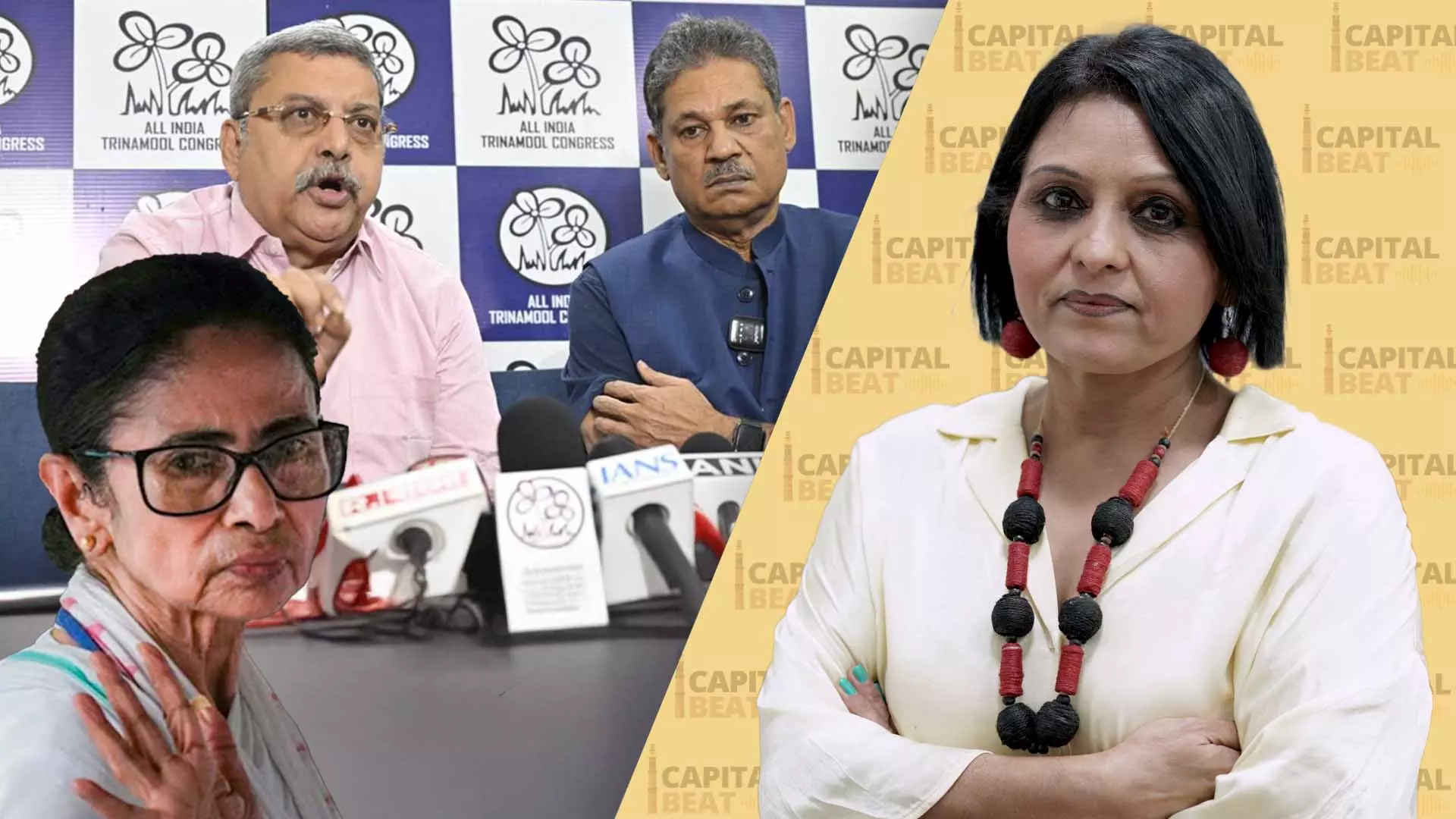
The Trinamool Congress' escalating internal crisis took centre stage on Capital Beat after a group of rebel Lok Sabha MPs formally wrote to Speaker Om Birla seeking alignment with the BJP-led National Democratic Alliance. Led by Kakoli Ghosh Dastidar, the rebellion represents the most direct challenge yet to Mamata Banerjee's leadership. Senior journalist Shikha Mukherjee and Trinamool Congress national spokesperson Shubhankar Bhattacharya discussed the unfolding developments.
Dastidar, who served as TMC's chief whip in the Lok Sabha, announced that nearly 20 of the party's 28 Lok Sabha MPs had written to Speaker Om Birla to formally convey their desire to be part of the NDA. The TMC currently holds 28 seats in the lower house. According to Dastidar, the decision was taken after extensive discussions among fellow MPs. "I remain the chief whip of the TMC in the Lok Sabha and in that capacity I have consulted colleagues before arriving at this decision," she stated.
Also read | TMC's many battles: Rebel MPs form NDA bloc in Parliament as Assembly fight reaches HC
Dastidar's removal as TMC chief whip on May 20 — and her replacement by Kalyan Banerjee — had been a flashpoint. She had publicly described her removal as "arbitrary and unilateral." Reports indicate that 16 MPs had rebelled while 12 remain with the Mamata Banerjee-led faction.
A familiar script unfolds
Speaker Om Birla accepted the letter from the rebel MPs. The development drew immediate comparisons to the Maharashtra model, where the Speaker's recognition of the Eknath Shinde faction as the real Shiv Sena proved decisive. A similar pattern was later repeated when Ajit Pawar's faction of the NCP received official recognition.
Shikha Mukherjee pointed out a key distinction in the Bengal case: "In Maharashtra, BJP was not in power. In West Bengal, BJP is in power with a two-thirds majority. And in the Centre, though it is in a minority, it is still leading the NDA government." She noted that the rebellion was unfolding in a context where BJP holds both state and central power simultaneously.
With the Speaker having accepted the letter, what follows now closely mirrors the Maharashtra trajectory. As Mukherjee observed, "This is exactly what happened in Maharashtra. The speaker said that Eknath Shinde was the real Shiv Sena. He also said that Ajit Pawar's faction of the NCP was the real NCP."
Four fronts, one brand
The rebellion in Parliament runs parallel to a simultaneous split in the West Bengal Assembly, where rebel MLA Ritabrata Banerjee secured the backing of approximately 60 TMC legislators and emerged as Leader of Opposition, overriding Mamata Banerjee's choice. This means the TMC brand is now contested across four fronts: two legislature parties in the state Assembly, and two parliamentary parties in the Lok Sabha and Rajya Sabha.
Mukherjee underlined the legal and political peculiarity this creates. The rebel MPs, she noted, are "elected representatives without an organisation." Mamata Banerjee, by contrast, "has an organisation and she has a few MPs and MLAs who are with her." The rebels have the legislators but not the party structure; Mamata has the structure but has lost the legislative majority.
The battle over the Trinamool brand itself remains unresolved. None of the factions has been willing to relinquish the name. "They're calling themselves new, they're calling themselves original," Mukherjee said, adding that no one is giving up claims to the name or the symbol.
The Maharashtra parallel
Bhattacharya flagged that the rebellion had visible precursors long before the public split. He noted that West Bengal Chief Minister Suvendu Adhikari had, during the election period itself, publicly claimed contact with over 20 TMC MPs who were ready to switch sides. Meetings between rebel MPs and Adhikari, including at Union Minister Bhupendra Yadav's residence in Delhi, were reported on the day Mamata Banerjee was attending an INDIA bloc meeting in the capital.
Bhattacharya drew attention to the loss of long-standing loyalists. He recalled that Dastidar and Sukhendu Sekhar Roy had once publicly described Mamata as the only leader capable of raising the voice of the public, even while being stopped at an airport during a visit to Lakhimpur. "That time they didn't know about any dissent. They had no problem with Abhishek Banerjee. They didn't have any problem with Mamata Banerjee," he said.
Mukherjee added that Dastidar's departure carried personal weight for Mamata, as she had been associated with her since before Trinamool Congress was even founded. She also raised the question of whether all rebel MPs are themselves unblemished. "Does it mean that all the 60 MLAs who have gone with Ritabrata Banerjee and the 19 MPs who have gone with Kakoli Ghosh Dastidar are squeaky clean and have no problems attached to their names? That is not true."
The road ahead for TMC
The immediate test on the ground will come at the municipal and corporation elections due at the end of the year, where the question of who commands voter loyalty will be tested directly. The 2029 Lok Sabha elections represent the longer horizon. As Mukherjee put it, the rebel legislators will have to "come out into the field and figure out whether they are trusted as representatives of the people and who are they and how do they define themselves."
Bhattacharya argued that Mamata Banerjee's path forward lies in rebuilding and restructuring the party organisation, creating a new set of leaders to fill the gap. He maintained that the Trinamool Congress brand remains inseparable from Mamata's personal identity. "If the Trinamool lost in West Bengal, it was Mamata's loss. If the Trinamool won in West Bengal, it was Mamata's victory," he said.
Also read | TMC split buzz grows as party cites anti-defection law amid MP breakaway talk
Mukherjee cautioned that such a rebuilding effort will face serious structural obstacles. "Mamata's capacity to overcome this will depend on how she plays it. It's going to be a very tough fight for her, both physically as well as mentally and in terms of strategy." She also warned of a possible "Mayawati trajectory" — a steady political decline rather than an abrupt end.
Bhattacharya raised a broader democratic concern: that the weakening of the Opposition, whether by absorption into the NDA or by fragmentation, concentrates political power and reduces accountability. "Once these MPs switch sides, it becomes very easier for the BJP to bring up those amendments which shall affect the Constitution at large," he said. He added that dissent would continue to manifest at the street level even if institutional opposition weakened.
The content above has been transcribed from video using a fine-tuned AI model. To ensure accuracy, quality, and editorial integrity, we employ a Human-In-The-Loop (HITL) process. While AI assists in creating the initial draft, our experienced editorial team carefully reviews, edits, and refines the content before publication. At The Federal, we combine the efficiency of AI with the expertise of human editors to deliver reliable and insightful journalism.