Can the INDIA bloc stay united? Five-point consensus masks fault lines | Capital Beat
While Opposition parties agreed on five key issues and regular coordination meetings, the absence of allies and lingering disputes underscored the alliance's challenges

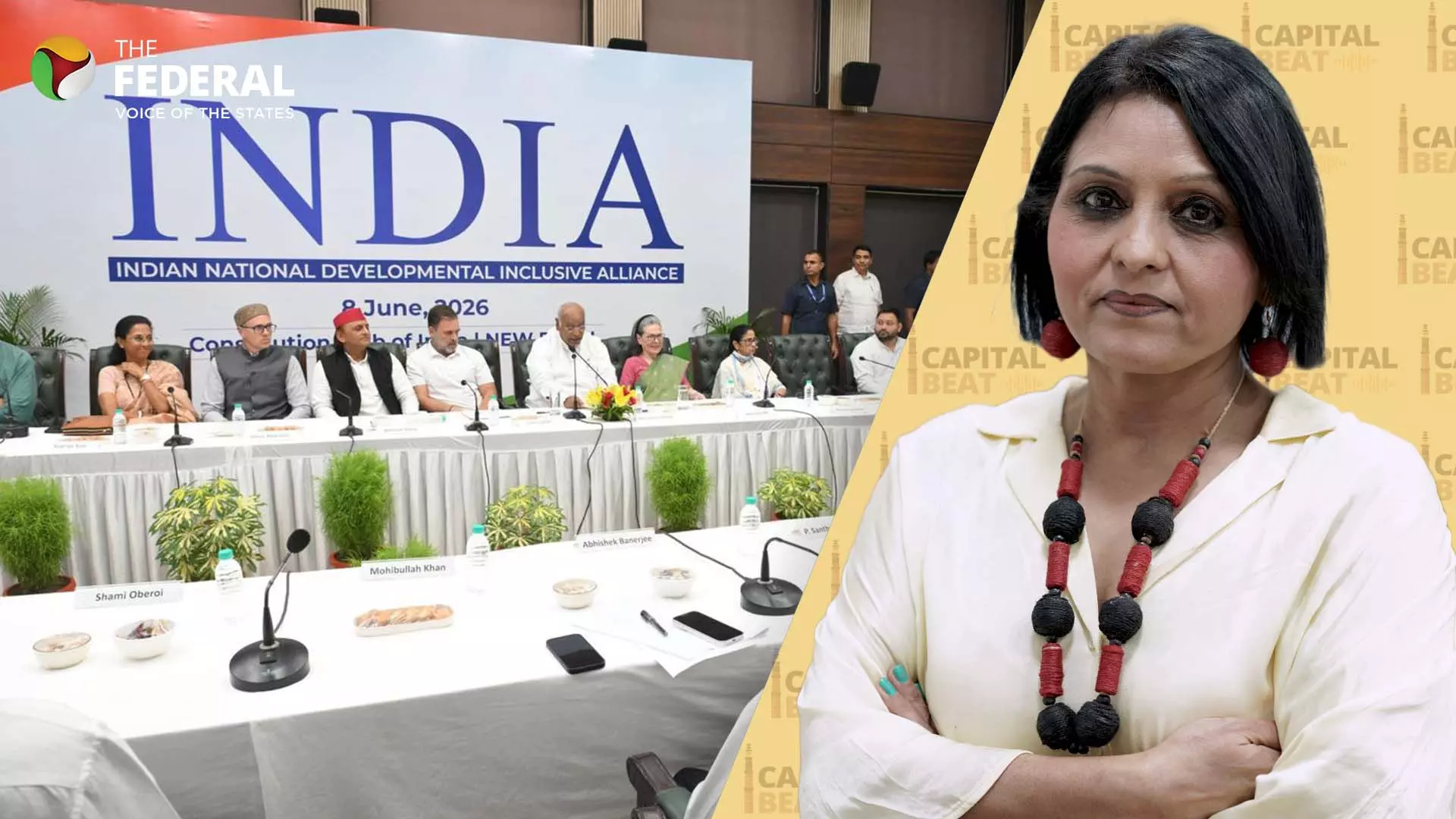
The INDIA bloc's first major reconvening since the 2024 Lok Sabha elections produced a five-point consensus but also laid bare the strains within the alliance. On Capital Beat, The Federal's Political Editor Puneet Nicholas Yadav and senior journalist Javed Ansari unpacked the outcomes of the meeting, which brought together 23 political parties at New Delhi's Constitution Club.
The meeting, chaired by Congress president Mallikarjun Kharge, was notable for who was absent as much as for who attended. The Aam Aadmi Party and the DMK did not participate. AAP had distanced itself from the bloc immediately after the 2024 Lok Sabha elections. The DMK's absence followed Congress's decision to end its alliance with the party after the Tamil Nadu Assembly elections.
Kharge addressed the media after the meeting, announcing the five areas of consensus. He did not take questions.
The five-point consensus
The alliance agreed that leaders would write to the Chief Justice of India over concerns related to the Special Intensive Revision (SIR) of electoral rolls and allegations of voter list manipulation. The second point of consensus was a collective demand for the resignation of Union Education Minister Dharmendra Pradhan over alleged NEET-UG paper leak and the CBSE Class 12 exam fiasco.
Also read | INDIA bloc to write to CJI on SIR, demands Dharmendra Pradhan’s resignation
Third, the bloc resolved to urge Prime Minister Narendra Modi to convene an all-party meeting on the economy, unemployment, price rise, and farm issues. Fourth, the INDIA bloc announced it would meet every two months going forward, with the next meeting scheduled for August in Hyderabad. Fifth, floor leaders of member parties in both Lok Sabha and Rajya Sabha would hold daily coordination meetings during the monsoon session of Parliament.
Puneet Nicholas Yadav, who was present at Constitution Club, noted that the CPI(M)'s John Brittas raised the issue of attacks by senior Congress leaders — including Mallikarjun Kharge, Rahul Gandhi, and Priyanka Gandhi — on Pinarayi Vijayan and the Left, along with allegations that the Left was aligned with the BJP. CPI(M) General Secretary MA Baby had already written to Kharge on the matter prior to the meeting.
Fault lines within the alliance
On the DMK's position, Yadav drew a distinction between formal membership and political alignment. "It's not about joining or exiting. As of now, they have not said that we are supporting the NDA or we are with the BJP. They have said that we continue to oppose everything that the BJP government stands for," he said. He noted that if the DMK continued voting against the BJP on crucial legislation in Parliament, its absence from bloc meetings would not materially alter the Opposition's parliamentary arithmetic.
Yadav also contextualised the low-key nature of the meeting's outcomes. "What was needed right now was for the parties to come together, resolve these differences that have cropped up and then find a way forward," he said. He pointed to public spats between allies over the previous months, including friction between the Trinamool Congress and Congress, and the CPI(M)'s dispute with Congress in Kerala. These tensions, he said, were among the key issues the meeting needed to address.
Javed Ansari identified the core structural challenge facing the bloc. "None of them alone can take on the BJP," he said. "The only chance — and I'm saying chance — they have of making a match of it against the NDA is if they all come together. And if there is one Opposition candidate against the NDA candidate. If that doesn't happen, if they are unwilling or unable to do that, then they can just forget about it."
The question of viability
Ansari acknowledged what the meeting needed to accomplish before evaluating what it fell short of. "They had to demonstrate their existence, their presence, which they have done. They have to demonstrate that they haven't withered away in the wake of desertions, in the wake of splits, in the wake of this string of defeats. And now the larger challenge going forward is to be able to demonstrate their viability. That will come with consistency."
He pointed to seat-sharing as a recurring flashpoint that the alliance has yet to resolve in its most critical state. "The biggest test will come right at a doorstep in Uttar Pradesh. The Congress is asking for a large number of seats, 120 seats to begin with. Everybody knows that the Congress is punching way above the weight," he said. He attributed the difficulty to overlapping voter bases between Congress and regional parties, where Congress's expansion necessarily comes at the cost of its own allies.
On the BJP's likely strategy to weaken the bloc, Ansari said the ruling party would attempt to prise open individual alliance partners — as it has done with other parties in the past — and would try to make inroads into the Samajwadi Party's support base in Uttar Pradesh. "They've already divided the whole Congress. They've divided Shiv Sena. They've split Sharad Pawar's party. So they'll continue to do all that. Only a united INDIA alliance can face this."
The Opposition's narrative problem
On the question of whether the alliance should have announced a joint agitation on NEET/CBSE exam mismanagement, Yadav pushed back against the framing that the parties had been inactive. He stated that Congress alone had held close to 50 protests in the last 20 to 25 days on the alleged NEET paper leak and CBSE exam irregularities at places like Delhi, Haryana, Maharashtra, and Rajasthan. "To say that these parties are not doing anything at all on this issue and they're not showing the aggression that is required is also wrong. It's just that these are protests that are not given any value in terms of media discussions, media space," he said.
Yadav noted that the demand for Dharmendra Pradhan's resignation, which formed part of the five-point consensus, was directly tied to the NEET paper leak controversy, and that further joint campaigning on the issue between meetings remained possible. "Just because they've not announced it today doesn't mean that the issue wasn't discussed at all," he said.
What the alliance needs to do next
Ansari, in his closing remarks on the panel, laid out what would determine whether the reconvening translates into political momentum. "They need joint programmes, joint rallies. They need to share a common platform in every state. Wherever there is a burning issue, there should be an INDIA alliance rally. Pool your resources. There needs to be some mass action. Because seat adjustment alone will now not do the trick."
Also read | Kharge calls for stronger unity in INDIA bloc to take on Modi govt’s ‘misgovernance’
He added that the alliance would need to agree in principle on fielding a single candidate against the NDA in every constituency, and complete seat-sharing negotiations at least six months before the next general election. "Election eve coming together and all will not matter," he said. "They need to come up with an alternative vision."
Anti-INDIA bloc posters appeared in and around Constitution Club on the day of the meeting, featuring quotes from leaders including Mamata Banerjee, Pinarayi Vijayan, and Sharad Pawar critical of Congress. The posters carried a common tagline questioning the bloc's cohesion. Commenting on the development, Ansari said the scale and speed with which the posters appeared suggested BJP involvement, though no official attribution was made.
The content above has been transcribed from video using a fine-tuned AI model. To ensure accuracy, quality, and editorial integrity, we employ a Human-In-The-Loop (HITL) process. While AI assists in creating the initial draft, our experienced editorial team carefully reviews, edits, and refines the content before publication. At The Federal, we combine the efficiency of AI with the expertise of human editors to deliver reliable and insightful journalism.