INDIA bloc’s reliance on courts and meetings won’t solve any of India's crises
By passing the buck to the judiciary and demanding all-party meets, the Opposition abdicates its duty to the public on crucial economic and secular issues

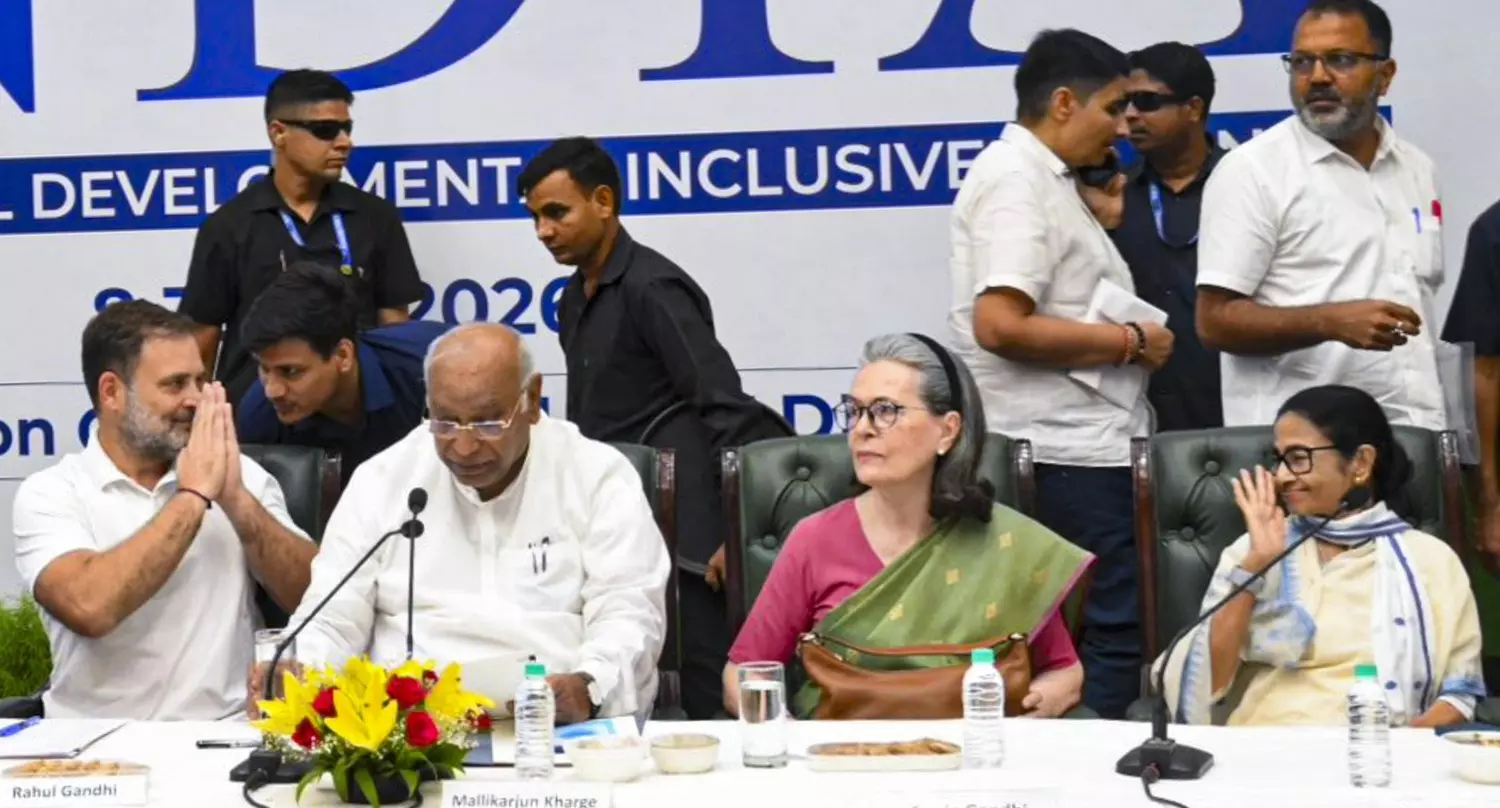
The meeting of INDIA bloc leaders in Delhi on June 8 wasn't just about the survival of Mamata Banerjee’s Trinamool Congress in West Bengal. It points to a much larger crisis.
Today it’s Bengal; tomorrow it could be any other state, or the Centre itself. We’ve already seen allegations of voters' verdicts being manipulated in Maharashtra.
But, as political games play out, real-world crises like exam paper leaks and economic slumps are leaving students and workers desperate. The real question is: who is going to bail them out, and when?
The court is not the answer
The INDIA bloc leaders said yesterday they would write to CJI Surya Kant about the EC's Special Intensive Revision (SIR) and the alleged “vote loot” issue. Writing such a letter and following it up is the task of a lawyer and not of the top leaders of about two dozen national and regional parties with pan-India influence.
Their resolve to meet every two months, beginning with Hyderabad in August, seems to be guided by the knowledge that most matters in courts take quite a bit of time to settle. So, where is the solution expected by the public from public figures?
Also read | Congress emerges as INDIA bloc’s fulcrum amid criticism and fragile unity
When political parties pass the buck to the courts on issues affecting over a billion people, they reduce massive public crises to narrow legal disputes. This isn't just an escape route — it is an abdication of duty that leaves citizens entirely to their own devices.
Is this not an invitation to free-for-all anarchy? What if the court tell them not to waste its time? Has Mamata Banerjee not already been before the court over SIR, with hardly any timely outcome after about half an hour’s polite exchange between her, in lawyer’s robes, and the bench?
All-party meet is no solution either
These are the questions that immediately surface from the two-hour emergency meeting at New Delhi’s Constitution Club. There, on a sultry afternoon, leaders from across the country gathered to confront a grim political and economic reality.
Together, they decided to call upon the Union government to hold an all-party meeting to reveal and discuss the actual state of the economy and the preparedness to deal with it in view of multiple wars and tensions dogging the world.
But it is a fact that the all-party meetings held in the past on crucial issues were seldom briefed by Prime Minister Narendra Modi himself. Instead, a senior minister from his Cabinet was, in most cases, there to do the honours alongside his peers waiting to assist him.
So, even if the government agrees to hold an all-party meeting on the economic situation, is there a possibility of Modi being present to answer questions? After all, clarity and conviction tend to come only with a Prime Minister’s words at such meetings.
This is again a point that perhaps did not cross the minds of INDIA bloc leaders when they demanded an all-party meeting once again on Monday. They put their demands in the public domain through a press conference that followed the meeting.
Opposition’s missing outreach
This is called "touch and go", and the leaders gathered in Delhi for the Opposition meeting after a gap of a year seemed to be content with this. The idea appeared to be to put the ball in the government’s court and wait for its response.
Watch/Read | Is it the end of INDIA Bloc? Akhilesh's dig at Congress triggers debate
There was no talk of reaching out to the public, feeling their pulse and seeking their feedback, educating them and getting educated. Except Rahul Gandhi, hardly any leader, whether from the Congress or other INDIA bloc parties, has ever seriously tried this.
Some of the issues pointed out in Monday’s meeting, particularly those related to elections, deserve to be taken to the people’s court rather than the Supreme Court. But it is a sad fact that there has so far been no joint show in full public view of all the INDIA bloc parties since the alliance’s inception three years ago in Patna.
Mum on communalism
But even more glaring is the fact that there was no word after the meeting about the current overt or covert communal chasm dogging the country. Congress president Mallikarjun Kharge, who briefed the press after the meeting, did not utter a word about this biggest challenge that, among its other fallouts, gives the BJP a cutting edge over its rivals in election after election.
Kharge gave five points for action in future. None of these points directly refers to the deepening communal divide, rampant bigotry and vilification of minorities that have tweaked politics to the detriment of almost every secular party in violation of the Constitution of India.
There has so far been no, or hardly any, response of any worth to the BJP’s strong communal pitch by its rival parties. These parties have only tried to kowtow to the BJP’s parochial ways in a softer form, even though harming India’s religious minorities’ interests is only one side of the outcome of this.
The larger fact is that any dated agenda, however vehemently sold to majority community voters so as to bring them into confrontation with minorities, not only creates bad blood and sectarian strife but also has the potential to push India into the dark ages. Nobody can fight the BJP without calling it out and pointing to its perils. INDIA bloc parties have so far been shy of challenging this in unambiguous terms.
Perils of majoritarianism
The result of this is that today the innocence of the society at large is being lost. The impossibility of justice is becoming a reality. Indians are being rendered incapable of standing together, though they did so in the past amid some of the worst crises, like wars and natural disasters, and in much worse circumstances than now.
The net outcome is that India is changing from a reasoned republic based on the imaginative and well-thought-out ideas of the framers of the Constitution into what may be called a republic of majority sentiments, even as the bulk of the people, cutting across caste and community divides, continue to live in circumstances that can still be said to be wanting.
Also read | Can the INDIA bloc stay united? Five-point consensus masks fault lines | Capital Beat
Equality, caste justice or parity is impossible without secularism. Societies become discriminatory because of a few supremacists sitting at the top. Nothing can be more misplaced than expecting them to do justice to one set of people while punishing another.
If secularism goes out, nothing can stop discrimination at all levels. Exclusion and its beneficiaries do not take long to shut the window for inclusion as much as possible.
Curbing dissent and criticism
This is how the plummeting economic and human development indicators do not rattle today’s rulers as much as they should. These rulers deprive select social groups of their justified share in the economy and employment and, thus, find one justification or the other other for their poor showing.
Also read | Why Rahul Gandhi, flaws and all, remains the Opposition's best bet
But they also have to keep their tracks covered. So, the possibility of criticism, dissent and contrary opinion is kept under sharp watch so as to restrict them as much as possible. This needs a trusted and conforming civil bureaucracy and police, where contamination of important levers of power through sectarian and parochial thoughts or ideology becomes necessary.
The Opposition calls this institutional capture by the rulers to keep it under check, leaving little hope for a level-playing field. The parties repeated this during their Monday meeting. But what the leaders gathered for the conclave did not seem to know is how India is being robbed of its collective wisdom handed down through the ages on the false and misplaced pretext of culture and tradition, which, among other things, is disastrously out of tune with the times.