



Monsoon session: BJP tries to shore up numbers, break Oppn unity to redraw electoral map
Defections in Opposition parties help NDA boost its numbers in Parliament to pass contentious Bills like revised Constitution (131st Amendment) Bill and Delimitation Bill

Stormy sessions of Parliament have been a permanent fixture of the past 12 years of Prime Minister Narendra Modi’s regime. The monsoon session, starting on Monday (July 20), will be no different. What could, however, distinguish the current session from previous ones is the Centre’s aggressive push to break up Opposition unity in its effort to redraw India’s electoral map to the BJP’s advantage well ahead of the 2029 Lok Sabha polls.
Five Bills on agenda
Officially, unlike previous sessions, the Centre has not come up with a heavy legislative agenda for the session that will conclude on August 13. The government has listed only five new Bills – Prevention of Insults to National Honour (Amendment) Bill, 2026, Registration of Births and Deaths (Amendment) Bill, Income Tax (Amendment) Bill, 2026, Supreme Court (Number of Judges) Amendment Bill, 2026 and the Micro, Small and Medium Enterprises Development (Amendment) Bill, 2026 – for the monsoon session.
Also read: Why delimitation Bills appear more ominous than originally thought
Additionally, the Centre will also try to pass the Foreign Contribution (Regulation) Amendment Bill, introduced during the Budget Session, in the current session. The Centre had also listed the Viksit Bharat Shiksha Adhisthan Bill, 2025, currently under consideration of a Joint Committee of Parliament, for passing in the current session. However, with the Joint Committee of Parliament cancelling its meeting scheduled for Monday to finalise its report on the VBSA Bill, which seeks to create a single body to regulate higher education, sources said the Centre could hold off on this legislation for now, considering the already simmering public anger over the rot in the country’s education and examination system.
Opposition readies ammunition
For the Opposition, there is ammunition aplenty to mount a standoff against the Centre. Among the major issues are the massive embezzlement of donations in Ayodhya’s Ram Mandir, examination paper leaks and a wide range of issues that have enmeshed with it, including student suicides as well as the Sonam Wangchuk-Abhijit Dipke-led Cockroach Janata Party protests. The repercussions on India’s energy and economic security of resurging American assaults on Iran, the breaking up of Opposition parties such as the Trinamool Congress, AAP and Shiv Sena-UBT by the BJP and its allies and the ongoing process of mass disenfranchisement of people through the Special Intensive Revision (SIR) of electoral rolls are issues the Opposition hopes to corner the government over.
Also read: ‘Women’s reservation shouldn’t be tied to delimitation’ I Interview
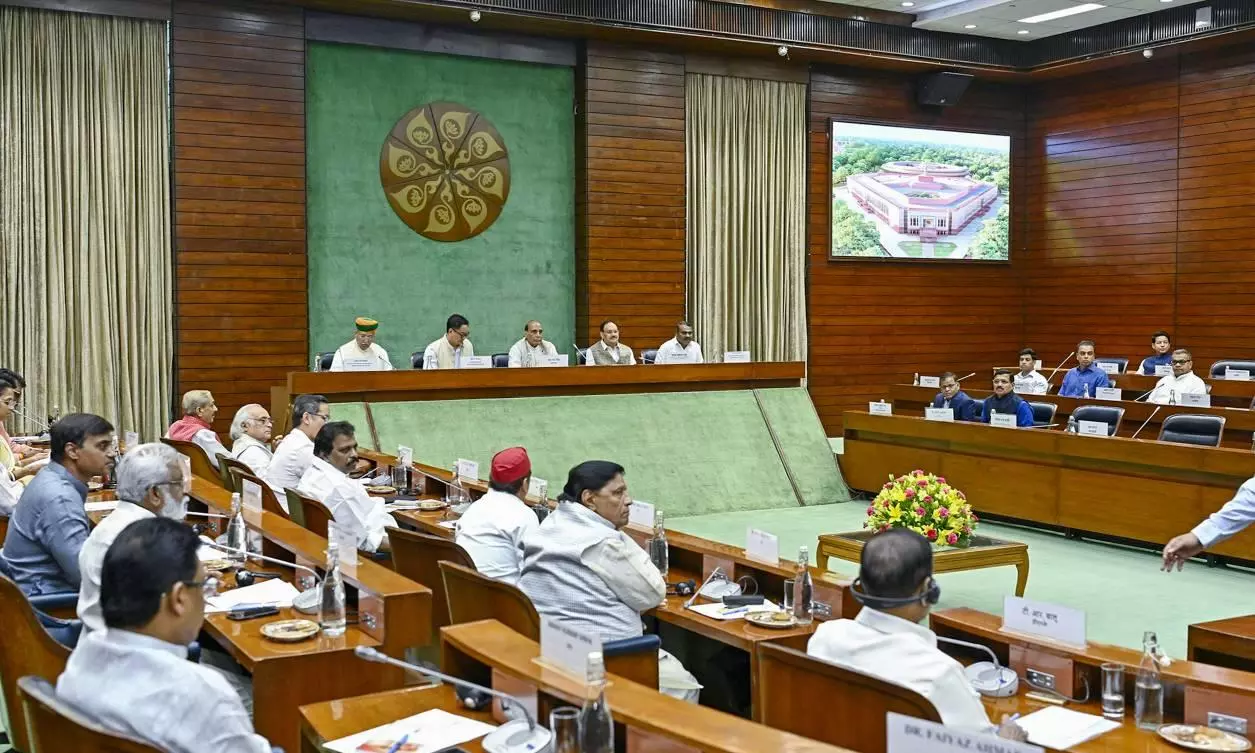
A glimpse of the acrimony that Parliament is due to witness in the coming three weeks was visible on Sunday (July 19) when all INDIA Bloc parties as well as the DMK, which has severed all ties with the Congress, and the AAP staged a brief walk-out of the customary all-party meeting chaired by Union Defence Minister Rajnath Singh. The Opposition parties were protesting against the government inviting the Nationalist Citizens Party of India (NCPI), comprising 20 rebel Trinamool Congress MPs led by Kakoli Ghosh Dastidar and Sudip Bandyopadhyay, to the all-party meeting and also against Lok Sabha Speaker Om Birla’s decision to acknowledge the merger of six rebel Shiv Sena-UBT MPs with Eknath Shinde’s Shiv Sena.
Contentious Bills likely on agenda
It is these mass defections from Mamata Banerjee's Trinamool Congress, Uddhav Thackeray's Shiv Sena-UBT and also Arvind Kejriwal's Aam Aadmi Party, which lost seven of its 10 Rajya Sabha MPs to the BJP in March, that have fuelled speculations about the 'real' legislative agenda of the Centre going far beyond the Bills that the government has actually listed.
With Lok Sabha Speaker Om Birla and Rajya Sabha Chairman CP Radhakrishnan playing willing accomplices, the NDA’s tally has gone up by 26 MPs in Lok Sabha and 10 MPs in Rajya Sabha.
Over the last several sessions, the Modi government has mastered the praxis of introducing controversial legislation by stealth with no prior intimation to the Opposition. At Sunday's all-party meeting, Congress, Samajwadi Party and Left MPs asked the Centre to come clean on whether it would bring a revised Constitution (131st Amendment) Bill and the Delimitation Bill yet again in the current session as was being wildly speculated. There was no response from the Centre, Congress MP Jairam Ramesh said.
The Modi government had faced its first major legislative setback in April when its effort to railroad the Constitution (131st Amendment) Bill, which seeks to increase Lok Sabha's strength from 543 to 850 MPs following a delimitation exercise, failed for want of the required two-thirds majority. In the current session, however, the Centre returns with its strength significantly increased in both Houses of Parliament, though still short of a two-thirds majority in Lok Sabha.
BJP optimistic about two-thirds majority
With Lok Sabha Speaker Om Birla and Rajya Sabha Chairman CP Radhakrishnan playing willing accomplices, the NDA’s tally has gone up by 26 MPs in Lok Sabha and 10 MPs in Rajya Sabha. This comprises the 20 Trinamool rebels who now form the NCPI bloc and the six Shiv Sena (UBT) MPs now aligned to Eknath Shinde's Shiv Sena in Lok Sabha, the seven AAP MPs who merged with the BJP in the Rajya Sabha as well as three MPs of the Trinamool who resigned their seats and have now returned to the Upper House as BJP MPs. Since the enactment of the anti-defection law in 1985, this is by far the first instance of such mass defections across parties to be legitimised by the Speaker and Rajya Sabha Chairman.
Also read: How Modi govt hopes to railroad Constitution 130th Amendment Bill amid hurdles
That this aggressive push to swell the NDA's ranks in Parliament is the BJP's bid to manufacture a two-thirds majority in both Houses and hastily bulldoze deeply contentious amendments to the Constitution is no secret. And this is where the monsoon session assumes a much deeper significance for both the Centre and the Opposition.
The spree of defections and the BJP's ongoing backchannel negotiations with Opposition parties such as the DMK, Sharad Pawar's NCP (SP), Akhilesh Yadav's Samajwadi Party and Hemant Soren's Jharkhand Mukti Morcha are meant to shore up a two-thirds majority that would enable the Centre to pass the Constitution (131st Amendment) Bill after its previously failed attempt of April 17.
The BJP believes if it can sway the DMK (22 MPs) and the NCP (SP) (8 MPs) while also convincing some other Opposition MPs to cross-vote or abstain during a vote on the Bill, it will secure the two-thirds majority needed to enact the constitution amendment in Lok Sabha.
Sources in the government say the BJP is "optimistic about getting the required numbers' this time. However, as reported earlier by The Federal, the Centre will reintroduce the Constitution (131st Amendment) Bill in the current session only if it is certain that Opposition parties it is tapping for support – either by voting in favour of the Bill or by abstaining from the vote – won't back out at the last minute.
BJP’s bid to strip Congress of allies
Sources in the BJP said a less talked about but electorally significant aspect of these ongoing shenanigans is the party's effort to isolate the Congress party from its INDIA Bloc allies. The BJP's biggest electoral setbacks in the 2024 Lok Sabha polls had come from Uttar Pradesh and Maharashtra, where the INDIA Bloc had decisively trumped the saffron alliance.
While the BJP-led Mahayuti comprising Eknath Shinde's Shiv Sena and late Ajit Pawar's NCP regrouped and swept the Maharashtra Assembly polls that were held later that year, the INDIA Bloc has been further weakened in the state over the past two months owing to the defections from Thackeray's Sena (UBT). The BJP is now reportedly working on a plot to neutralize any challenge from Congress ally Sharad Pawar's NCP (SP) too with efforts underway to broker a merger of his party with the Sunetra Pawar-led NCP. If the wily Senior Pawar gives in to the BJP's pressures, the Congress will lose out on a key ally in Maharashtra while its other alliance partner, the Shiv Sena (UBT), struggles to keep its ranks together.
Also read: Three grounds on which delimitation laws may be challenged in court
Likewise, if the BJP manages to secure the support of the Samajwadi Party for the Constitution (131st Amendment) Bill, Akhilesh's equations with the Congress are bound to sour ahead of next year's Uttar Pradesh Assembly polls. BJP leaders, however, concede that the party may have better luck in swaying "some Samajwadi MPs" to cross-vote for the Bill than in securing the support of the Samajwadi Party as a whole.
"As of now, I do not see any possibility of Akhilesh extending support to us on any issue, leave alone this Bill that will alter the map of all Lok Sabha and Assembly constituencies," a senior BJP leader told The Federal.
BJP banks on DMK, NCP(SP), cross-voting
The NDA needs a minimum of 360 MPs voting for the Constitution (131st Amendment) Bill to see it through Lok Sabha. For now, the Centre has the assured support of 324 MPs, which is a significant hike from the 298 votes that the Bill had received in April, but is still well short of the two-thirds mark. The BJP believes if it can sway the DMK (22 MPs) and the NCP (SP) (8 MPs) while also convincing some other Opposition MPs to cross-vote or abstain during a vote on the Bill, it will secure the two-thirds majority needed to enact the constitution amendment in Lok Sabha. The numbers for the NDA in Rajya Sabha are easier to shore up as the ruling coalition already commands a near two-thirds majority there.
Also read: Delimitation Bill: Why Stalin and Akhilesh hold the key to BJP’s gameplan
If these calculations by the BJP floor managers call in place, the government will be able to push through not just a reconfiguration of the Lok Sabha's strength but also the redrawing of Lok Sabha and Assembly constituencies across the country through a handpicked Delimitation Commission ahead of the 2029 General Elections.
The monsoon session, thus, isn't just about pushing the legislative agenda or a slanging match with the Opposition. It may be, if the BJP succeeds in its number game, the session that reimagines India's political map through the eyes and on the whims of Modi and his party.