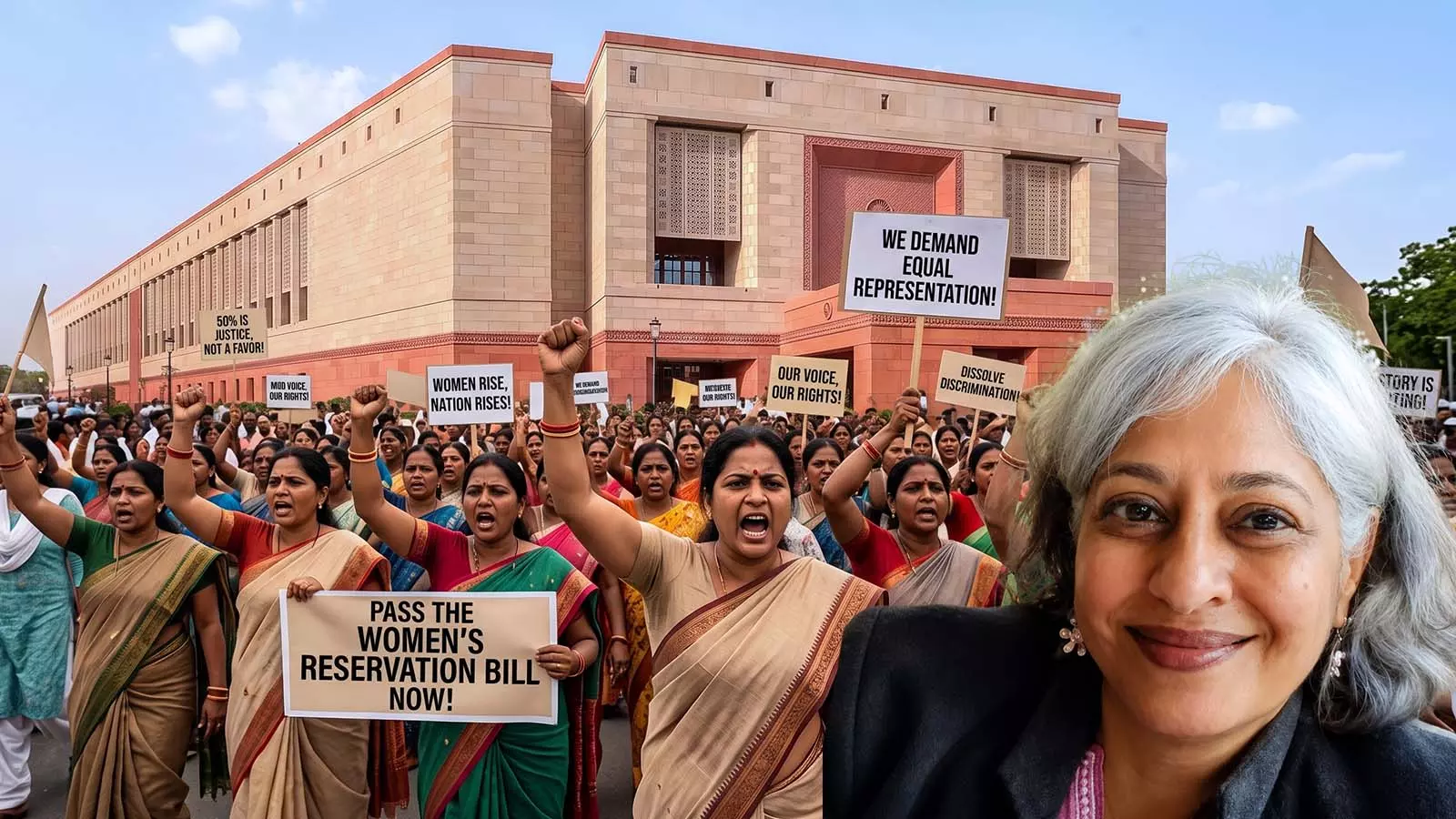
Radha Kumar (inset), author of ‘The Republic Relearnt: Renewing Indian Democracy, 1947-2024’, has been pushing for the implementation of the Women’s Reservation Bill.
‘Women’s reservation shouldn’t be tied to delimitation’ I Interview
Policy analyst Radha Kumar says women's reservation can be implemented immediately without waiting for a Census or redrawing constituencies, and warns that the linkage raises larger constitutional concerns

Writer and policy analyst Radha Kumar has been pushing for the implementation of the Women’s Reservation Bill. She is the author of ‘The Republic Relearnt: Renewing Indian Democracy, 1947-2024’.
Ahead of the Monsoon session of Parliament, The Federal spoke with her about the 131st Amendment Bill, why it shouldn't be linked to delimitation, and the political roadblocks to its implementation.
You, along with several women leaders and activists from all over India, have been campaigning for implementation of the Women’s Reservation Act (NSVA). The Government wants to do just that. Then, what went wrong? Why did the Opposition not support the move?
Despite having campaigned for women’s reservation in the legislature for decades, most women’s groups heaved a sigh of relief when The Constitution (131st Amendment) Bill was defeated by the Opposition in a Special Parliamentary Session between 16-18 April. 2026. Actually, the 131st Amendment Bill has tied women’s reservation to legislative seats’ expansion, the Census and delimitation.
Also read: Women's reservation is finally coming, but the formula carries its own tension
In doing so, it circumvented Constitutional processes for legislature change and delimitation under Articles 81 and 82 that have been followed by Union administrations since Independence. Seat expansion or freeze have thus far been considered only after each decadal Census: the 2021 Census was delayed, and its results are scheduled for December 2027. Delimitation too is conducted only after the latest Census, but the Delimitation Bill that was introduced along with the 131st amendment proposed doing away with the Census for seat expansion and limited the Commission’s mandate to redrawing constituencies.
If you are saying, “Implement the Act now!”, are you in favour of an increase in the number of seats to 850? That would remove all hurdles. Sitting MPs would also support it.
The implications of a massive 50 per cent increase in the Lok and Vidhan Sabhas have yet to be imagined, let alone discussed. The implications of divorcing the Census from determination of seat numbers have not been discussed either. Yet both abandon Constitutional principles that constitute the foundation of our republic: the democratic representation of the people. Surely such change merits a country-wide consultation.
Why are you opposed to the delimitation linkage?
Recent delimitations in Jammu and Kashmir and Assam are similarly controversial. Both have been widely criticised for communal gerrymandering; the Assam delimitation has additionally reflected political gerrymandering.
Also read: Women's Quota Amendment Bill fails: Here are the key takeaways
Should any fresh delimitation, as will soon be forthcoming, be redesigned so that the country does not risk being divided along communal and political affiliation?
You and other women’s groups have been lobbying with MPs from various states. What are the women’s groups lobbying for?
At a flat rate of 33 per cent of total seats, the 131st amendment can be applied to any size of legislature. No redrawing of constituencies is required, since it can be applied to existing constituencies. It need not alter the federal balance, since it can be allocated to states according to their existing seat shares.
Unfortunately, however, the 2023 women’s reservation legislation (The Constitution (106th Amendment) Act) also tied women’s reservation to the Census and mandated a Delimitation Commission for selection of the 33 per cent seats.
Also read: PM Modi sets 2029 deadline for Women’s Reservation Act, calls it landmark decision
While opposing the 131st Amendment Bill, therefore, women’s groups seek to replace it with a new Constitutional amendment that deletes all references to the Census and delimitation in the 106th Amendment Act, to remove the fallacious connection. But deletion of its references to the Census and delimitation raises a further question: how are the 33 per cent women’s seats to be selected if not by a Delimitation Commission?
Do you have a foolproof formula for that?
Yes, one option could be to use a modified version of the Panchayat’s method of selecting 33 per cent women’s seats, commonly known as the ‘lottery system’ because it begins with a draw. The seat drawn becomes the first reserved seat and after that every third seat alphabetically is reserved. But a draw can be rigged; indeed, lotteries commonly are. Discarding the draw and going purely alphabetically might be a safer option, but it may not satisfy the requirement for SC-ST reservation within women’s reservation. Thus, it can at best serve as a first cut which must be reviewed to make sure it conforms with all provisions.
Also read: Women’s reservation a smokescreen for delimitation, warns activist Anjali Bhardwaj
The solution could be to set up Special State Commissions for the task, comprising equal representation of ruling party and Opposition MPs and MLAs, at least one-third of them women. In the currently polarised atmosphere, where the Election Commission is widely regarded as having compromised its impartiality, such joint Commissions to select reserved women’s seats might restore some confidence. They could be headed by two judges, one of whom is nominated by the Opposition. They might even serve as test models for altering the composition and mandate of a new Delimitation Commission when a new delimitation bill is tabled.
Some vexed issues are - maintaining the federal balance in the country, and also ‘quota within quota’ in the Act. Do you have any ideas on these?
The above are not the only changes that a new Amendment Bill to replace the 131st Amendment Bill could make. It could freeze states’ seat shares to total seats, as the Southern states demand, and the Modi administration appears inclined to accept. It could also state that any future reservations in the legislatures would automatically apply, for example, for women from marginalised and vulnerable communities, such as OBCs, de-notified tribes and transgenders, to mention but a few. Demands for such reservations are bound to arise after the ongoing Census, particularly the Caste Census, results are published. Would it not be wise to anticipate and provide for them?
BJP legislators argue that their departure from established Constitutional practice is necessitated by the need for speedy implementation of women’s reservation. But it is their fallacious connection between women’s reservation and delimitation that delayed implementation of the 2023 legislation for three years, and possibly another three to come. Why not learn from that mistake and ensure well-reasoned legislation that will last instead of requiring constant amendment?