Delimitation Bill: Why Stalin and Akhilesh hold the key to BJP’s gameplan
With TMC and Sena defections narrowing the gap, the Centre is banking on DMK and SP support to push through the Constitution (131st Amendment) Bill without a repeat of its April 17 humiliation

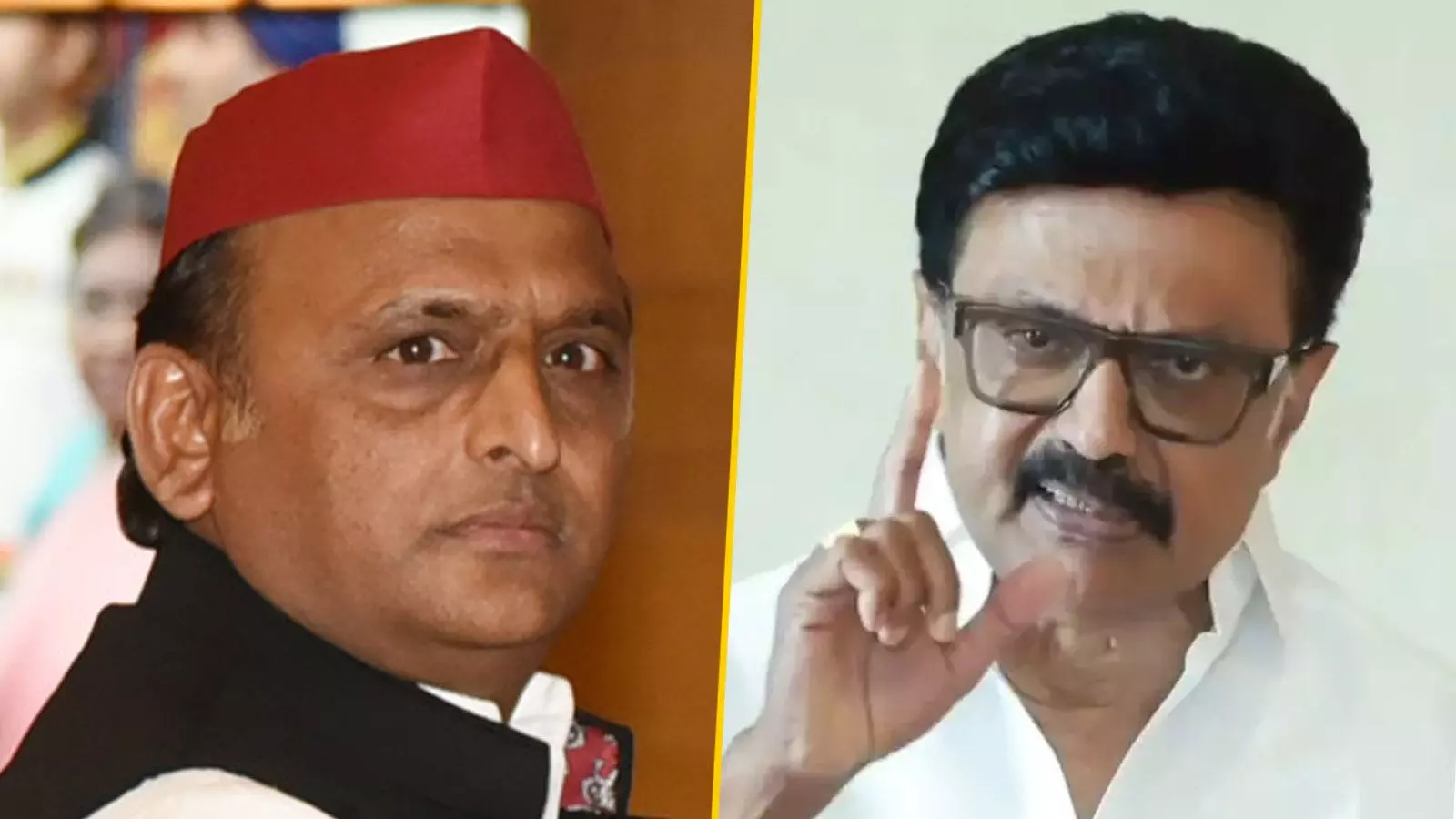
The success of the Centre’s ongoing effort to manufacture a two-thirds majority in Parliament will ultimately depend on the stand taken by two key Opposition leaders—DMK chief MK Stalin and Samajwadi Party chief Akhilesh Yadav.
Sources in the government have told The Federal that the Centre will make a fresh attempt to push a revised Constitution (131st Amendment) Bill in the upcoming Monsoon Session of Parliament only after it is “absolutely certain” of drawing support for the legislation that proposes a drastic change in the Lok Sabha’s composition.
Bid to avoid another setback
The government wants to avoid at all costs the embarrassment that Prime Minister Narendra Modi faced on April 17, when the united INDIA bloc ensured that the Constitution (131st Amendment) Bill was negated in the Lok Sabha for want of a two-thirds majority. The Bill had then received 298 votes in favour, short of the two-thirds majority of 362 votes required to enact amendments to the Constitution.
Also read | TMC split, DMK-Congress divorce: New Delimitation path opens up for BJP
Three months later, however, the Centre believes it is on a much firmer footing to bulldoze the Bill through the Lok Sabha. The recent mass defections from Opposition parties such as Mamata Banerjee’s Trinamool Congress and Uddhav Thackeray’s Shiv Sena-UBT have pushed the NDA’s prospective vote tally to 324, up from the 298 votes cast in favour of the Constitution (131st Amendment) Bill in April.
Sources said ahead of the commencement of the Monsoon Session on July 20, Lok Sabha Speaker Om Birla would formally recognise the 20 MPs who broke away from the Trinamool Congress in June as a separate bloc under the Nationalist Citizens Party of India (NCPI) banner. These MPs, led by Trinamool rebel Kakoli Ghosh Dastidar, have already said they would align with the NDA. Additionally, Birla is also expected to allow the “merger” of six rebel Shiv Sena-UBT MPs with the Eknath Shinde-led Shiv Sena. These anticipated decisions by Birla, although they are likely to be challenged in the Supreme Court by the Trinamool and SS-UBT leadership, will add 26 votes to the NDA’s tally for the time being.
The Centre is aware that despite these developments, the NDA’s tally in the Lok Sabha still remains 36 votes short of the current two-thirds majority mark of 360. As such, the Centre has been involved in backchannel negotiations with various Opposition parties; even expressing a willingness to tweak the proposed constitutional amendment, which envisaged a steep increase in the Lok Sabha’s current strength of 543 MPs to 850 MPs following an extensive exercise of delimitation, to accommodate their concerns.
BJP courts Stalin’s support
Sources in the government said BJP leaders who have been negotiating with the Opposition are “very hopeful” of drawing the support of Stalin’s DMK, which could add 22 MPs to the NDA’s tally in one stroke. To this end, the BJP is leveraging strained ties between Stalin and the Congress leadership, particularly Lok Sabha’s Leader of Opposition Rahul Gandhi. The breakdown of communication between Stalin and Rahul since the Congress dumped the DMK to join Joseph Vijay’s TVK-led alliance to come to power in Tamil Nadu has allowed the BJP to implore the Dravidian party to make a clean cut from the INDIA bloc.
The BJP’s negotiators, however, “have not received a clear assurance of support” from the DMK as yet, said sources. Despite the temptation of slighting Rahul, sources said what weighs heavily on Stalin’s mind is the electoral price DMK may have to pay in the 2029 Lok Sabha polls for being perceived by Tamil voters as a BJP ally, especially considering thatTVK remains politically ascendant.
The electoral calculations for 2029 also complicate the other option offered to the DMK by the BJP: abstaining from voting on the Bill. Abstention by the DMK’s 22 MPs will bring down the Lok Sabha’s two-thirds majority mark to around 346 MPs; a number the BJP believes it can touch with “tactical support” from other Opposition parties like Sharad Pawar’s NCP-SP, Jagan Mohan Reddy’s YSRCP, Shiromani Akali Dal, Hemant Soren’s Jharkhand Mukti Morcha and Arvind Kejriwal’s Aam Aadmi Party, which collectively form a bloc of 19 MPs. However, if the DMK chooses this path, it would still attract criticism from the Congress, TVK and other Opposition parties of “bailing out the BJP” on delimitation.
Delimitation dilemma for DMK
Sources say the DMK has, thus, told the Centre’s troubleshooters that it will formulate its position once a copy of the Bill is shared with its MPs. Stalin’s concern also seems to be how to explain a change of stance on the Bill to his voters, considering the strident resistance he had put up in April to the Centre’s proposal of uniformly increasing every state’s seats in the Lok Sabha by 50 per cent.
Also read | Why delimitation Bills appear more ominous than originally thought
The DMK is reportedly being told by the BJP that if it doesn’t sign off on the 50 per cent formula now, the drastic reduction in the share of all Southern states in the Lok Sabha will become inevitable. This is so because the constitutional freeze on a new delimitation exercise will end the moment the 2027 Census is published and in the absence of the 50 per cent formula being enshrined in the Constitution the existing mechanism of conducting delimitation purely on the basis of population will automatically kick in. The southern states have long argued that population alone should not be the criterion for delimitation and for deciding the share of seats that states have in the Lok Sabha.
If the BJP does manage to convince Stalin to shed all his inhibitions, the NDA will surely leap closer to the two-thirds majority mark but still not cross it. This is where things get tricky for the BJP’s floor managers as the party has either the option of negotiating support from multiple smaller outfits such as Pawar’s NCP-SP, Kejriwal’s AAP and Soren’s JMM, each of which would demand their own share of assurances, or of soliciting support of Akhilesh Yadav’s SP, which alone can give the NDA 37 additional votes.
While sources said talks with Pawar and Soren are currently underway and the BJP negotiators are “positive” of getting support of the 11 MPs that the NCP-SP and JMM collectively have, getting Kejriwal on board too may prove difficult considering that the AAP has an electoral challenge early next year in Punjab where the BJP is not viewed kindly by voters. As such, the three AAP MPs from Punjab may not back the Bill.
Spotlight shifts to Akhilesh
This brings Akhilesh back into the picture and makes the going tough for the BJP. While securing the support of both DMK and SP would surely place the NDA well beyond the two-thirds mark, BJP insiders admit getting Akhilesh on board at a time when the SP is pitted as the principal challenger to Yogi Adityanath’s government in Uttar Pradesh for next year’s Assembly polls would be “extremely difficult”.
BJP sources say the party has been making efforts to convince “several Samajwadi MPs” to cross-vote if and when the Bill is moved in the Lok Sabha but has “not received any solid assurance” so far.
The Congress, on the other hand, has also been reaching out to various INDIA bloc parties to ascertain the numbers the Opposition alliance is left with following the TMC and Shiv Sena-UBT defections. Sources in the INDIA bloc said there has been “no direct discussion as yet” between the Congress’ crisis managers and Stalin but “backchannel talks are being held with Kanimozhi, TR Baalu, Tiruchi Siva” and some other senior DMK leaders to convince Stalin against supporting the BJP’s legislative agenda.
Also read | Three grounds on which delimitation laws may be challenged in court
Congress sources said they are “absolutely certain” that “no MP from our party or from the SP” will support the Bill but admitted that they “cannot say the same about Sharad Pawar’s NCP-SP or even the JMM”. The Congress’s negotiators are trying to impress upon their allies that “the Bill is not simply about increasing the share of seats” that states have in the Lok Sabha but that “its inevitable consequence will be gerrymandering of constituencies, which will allow the BJP to redraw seats as per its whims”.
Whether the Congress’s pitch works or falls flat before the BJP’s shenanigans is difficult to predict just yet. What sources in the government assert, though, is that they “don’t want a repeat of April 17”, when the Modi government had faced its first major defeat in Lok Sabha since 2014 with the fall of the Constitution (131st Amendment) Bill. As such, Stalin may have lost the Tamil Nadu polls and Akhilesh’s victory in the upcoming UP Assembly polls may yet be far from certain but the two strident BJP rivals could just emerge as the leaders that Modi must now rely on to see his legislative agenda through.