Why delimitation Bills appear more ominous than originally thought
They alter India’s electoral map by gerrymandering constituencies, and vest in govt power to choose which Census figures any delimitation exercise would be based on

The Centre, on Tuesday (April 14), finally released the draft of three separate Bills, which, if passed during the extended three-day Budget session of Parliament starting April 16, would expedite implementation of women’s reservation in Lok Sabha and State legislatures after a nationwide delimitation of parliamentary and Assembly constituencies.
The Bills have jolted the Opposition that had already been seething for the past few weeks over the Centre’s bid to stealthily introduce delimitation under the garb of operationalising women’s reservation. With the text of the Bills now in the public domain, the Opposition’s worst fears are on the cusp of coming true.
Which are the Bills?
The proposed laws – Constitution (One Hundred and Thirty-First Amendment) Bill, 2026, the Delimitation Bill, 2026, and the Union Territories Laws (Amendment) Bill, 2026 – could not only push southern and smaller states to the margins of representation in Lok Sabha, thereby tilting the electoral landscape decisively in the BJP’s favour, but also make any future delimitation exercise a hostage to Executive whims.
Also read: Delimitation: Govt proposes to increase Lok Sabha seats to 850
The Constitution (131st Amendment) Bill seeks to increase the strength of the Lok Sabha from the current constitutional cap of 550 members (as opposed to the current bench strength of 543 MPs) to 850 members (815 from the States and 35 from Union Territories). Of these 850 members, the Bill proposes that one-third (approximately 283 MPs) must be women in line with the mandate of the Naari Shakti Vandan Adhiniyam, 2023.
The enactment of these legislations will lift the five-decade-old constitutional freeze that was first introduced into Article 81 by Prime Minister Indira Gandhi’s government in 1976 when readjustment of constituencies was prohibited till the year 2000. In 2001, this freeze was extended further till 2026 during the tenure of Prime Minister Atal Bihari Vajpayee although a constitutional amendment was made to allow changing boundaries of constituencies without altering the number of seats reserved for States in legislative bodies.
Operationalising women’s reservation
When the women’s reservation law was passed by Parliament in 2023 its immediate rollout, as demanded by the Opposition, was stalled. This was so since the Centre had woven into the law the requirement for a fresh delimitation exercise to be conducted following the publication of the “first Census taken after” the Adhiniyam’s enactment as a prerequisite for implementing the women’s quota.
Also read: PM Modi urges implementation of Women’s Reservation Act by 2029, seeks all-party support
Last month, in a sudden volte face, the Centre began canvassing for delinking the women’s reservation rollout from the ongoing Census 2027, arguing that not doing so immediately would delay operationalising the Adhiniyam till after the 2029 Lok Sabha polls.
The proposed Bills, however, are not merely about operationalising women’s reservation, which for the past 30 months has been in a state of limbo created by Prime Minister Narendra Modi’s own government. Instead, they are, as the Opposition feared, a means to significantly alter India’s electoral map by gerrymandering constituencies and granting the Executive sweeping powers to decide when to do so. Further, the proposed amendments to the Constitution would practically vest in the Centre the power to choose which Census figures any future delimitation exercise would be based upon.
For instance, the Constitution (131st Amendment) Bill seeks to amend Article 81 to redefine “population” as “population as ascertained at such census, as Parliament may by law determine”. Parliament would no longer be required to legislate through a constitution amendment when the next delimitation exercise would take place. The current mandate under Article 82, which says “upon the completion of each census”, delimitation can be conducted “by such authority and in such manner as Parliament may by law determine” has been proposed to be significantly watered down to merely an “allocation of seats” to be carried out by the “Delimitation Commission”.
Sinister change
The draft stipulation delinks readjustment of constituencies from a fresh Census exercise and allows the Executive to handpick a reference population (Census 2011 in the current context) to alter the configuration of Lok Sabha and State Assemblies. In the process, the current safeguard mandating a constitution amendment to allow delimitation only after a fresh Census (a provision that remained unchanged even after the amendments of 1976 and 2001) would be done away with. The Centre will be able to choose any reference population for delimitation by bringing an ordinary law that can be passed by a simple majority instead of the two-thirds majority required to pass constitutional amendments.
Furthermore, the Constitution Amendment Bill also proposes to substitute the stipulation of “readjustment after each Census”, as currently laid down in Article 82, with “readjustment of constituencies”. The proposed change may seem trivial to the uninitiated but its implication is massive, for, it removes the current constitutional requirement of readjusting the number of Lok Sabha seats in states after every newly published decadal Census. In effect, the change would allow the current and any future government to seek a new delimitation exercise at any time of its choosing.
What could make this change even more sinister is when it is read with the framework laid down in the Delimitation Bill, which the Centre seeks to get passed in Parliament alongside the Constitution (131st Amendment) Bill. The proposed composition of the Delimitation Commission – to be headed by a serving or retired Supreme Court judge with the Chief Election Commissioner (or an Election Commissioner nominated by the CEC) and State Election Commissioner of the state concerned – inspires little confidence for fair play given how people holding these positions are invariably accused of subservience to the Executive.
More disturbingly, the Bill vests in the Delimitation Commission “all the powers of a civil court” and states that once its orders are published in the Gazette of India they shall “not be called in question in any court of law”.
Biggest flashpoint
It doesn’t even end here. What may, arguably, become the biggest flashpoint between the Centre and the Opposition is that the Bills, particularly the Delimitation Bill, does not expressly state the most crucial assurance that Modi and his government have repeatedly tried to give their rivals, especially from the southern states, to set their anxieties at ease. Over the past fortnight, the Prime Minister and sundry members of his Cabinet have claimed that southern and small states will not lose out to populous states of the Hindi Heartland when it comes to the change in the proportion of seats they currently have in Lok Sabha.
Critics of the delimitation exercise have vociferously opposed any formula that relies solely on the Census figures as this could reduce the proportionate representation of states that successfully implemented family planning measures while bestowing a larger share on Hindi Heartland states that failed miserably on this score. To win over critics, the Centre had reportedly suggested a uniform 50 per cent increase in the seats each state has in the current Lok Sabha; a proposal that has also been dubbed as deceptive by parties such as the Congress, the DMK and the CPM. The government has also been asserting that population alone will not be used as the delimitation criteria.
The draft Bills mention neither the 50 per cent formula nor offer any assurance to southern and smaller states of protecting their share of representation in Lok Sabha. On the contrary, the Delimitation Bill expressly states that the Delimitation Commission shall “on the basis of the latest Census figures and having regard to the provisions of Articles 81, 82, 170…” determine the number of seats each State and UT is to be allocated in the Lok Sabha. The Bill further states that “all constituencies shall, as far as practicable, be geographically compact areas, and in delimiting them regard shall be had to physical features, existing boundaries of administrative units, facilities of communication and public convenience”.
Opposition’s criticism mounting
As such, if the Centre’s assurance for “a proportional increase in seats for all states equally” is to be taken at face value, is it to be understood that the Commission will be functioning under instructions from the government and not as the independent body that it is, at least theoretically, meant to be? If not, then how is the Bill’s mandate for the Commission to carry out delimitation as per the latest Census figures supposed to address fears expressed by smaller states or those with a successful record in controlling population about being marginalised in a larger Lok Sabha?
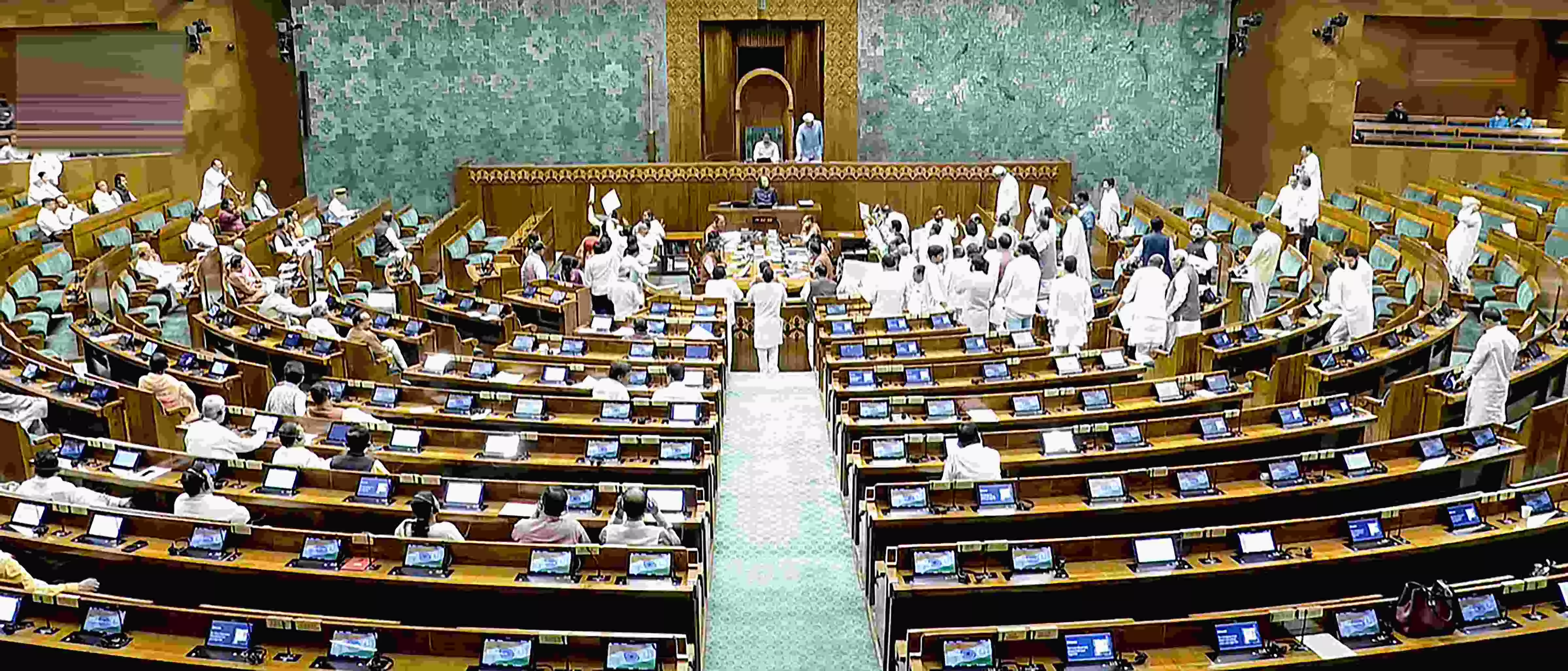
The Centre, which has categorically rejected a united Opposition’s demand for discussing the proposed laws “on any date after April 29” instead of pushing them through Parliament in the April 16 to April 18 extended session, will have much to explain about its motivations and intent in bringing these Bills with such haste.
The Opposition’s questions about and criticisms of the Bills are already mounting. On Wednesday, Congress president and Rajya Sabha’s Leader of Opposition Mallikarjun Kharge is scheduled to meet senior Opposition leaders to formulate a united stand of the INDIA bloc and other like-minded parties on these contentious Bills. A script for an acrimonious showdown between the Treasury and Opposition in the upcoming extended session of Parliament is being written. The early rollout of women’s reservation has, unfortunately, become a side story; its sheen worn off by the expected protests over the Centre’s skulduggery.