



Nilanjan Mukhopadhyay interview
75-year retirement to caste census: Decoding Mohan Bhagwat’s speech
If Bhagwat were serious, he could simply announce his successor, get it endorsed by the karyakari mandal, and step aside, notes Nilanjan Mukhopadhyay

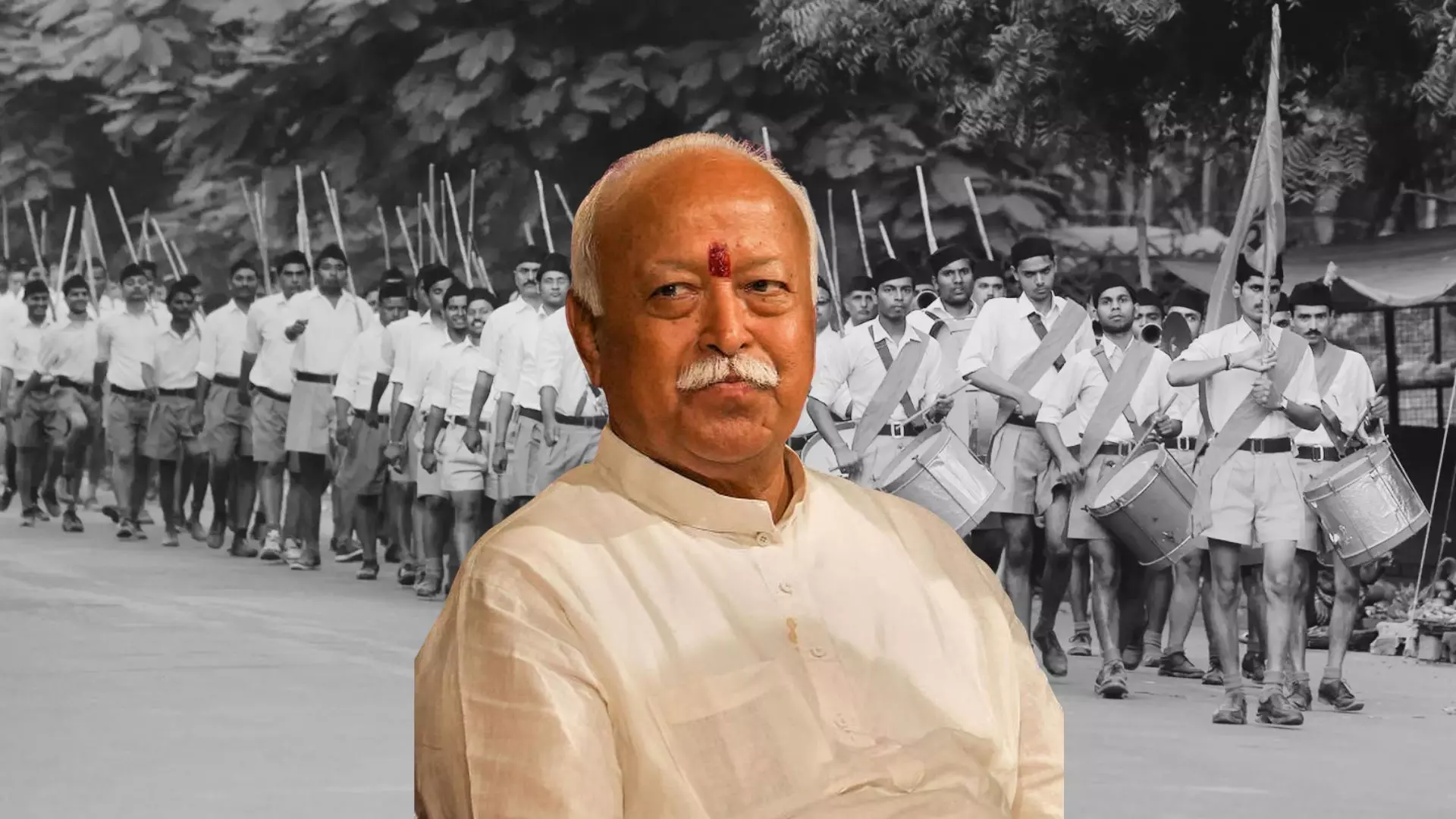
Mohan Bhagwat’s recent remarks on leadership age, caste, political authority, and cultural identity have reopened long-running debates about the Rashtriya Swayamsevak Sangh’s role in Indian politics. Coming as the RSS approaches its centenary, the comments have triggered questions about whether the organisation is asserting itself anew or grappling with a diminishing influence amid the dominance of Prime Minister Narendra Modi. The Federal spoke to senior journalist Nilanjan Mukhopadhyay to unpack what Bhagwat’s statements really signal at this moment.
Bhagwat has reiterated that leaders should step back after 75, but says the RSS asked him to continue. How should this be read?
I think this is a classic case of wanting to have the cake and eat it too. If Mohan Bhagwat is genuinely convinced that leaders should step down at 75, then there is nothing stopping him from initiating the process himself. In the RSS tradition, it is the sarsanghchalak who names his successor and steps down. There is no elaborate internal election process or debate like in political parties.
The argument that the RSS asked him to continue does not carry much weight. These decisions are taken by a very small and closed group. If he were serious, he could simply announce his successor, get it endorsed by the karyakari mandal, and step aside. That is how it has always worked.
Also Read: Ready to step down if Sangh asks me to do so: RSS chief Mohan Bhagwat
What this effectively does is create an impression that pressure is being exerted on Prime Minister Narendra Modi to follow the same norm. But in reality, there is no fresh or additional pressure on Modi to retire. BJP leaders have already made it clear that there is no question of him stepping down despite crossing 75.
Bhagwat has said the RSS brought ‘acche din’ for the BJP, not the other way around, and that political pressure comes from voters, not the RSS. How accurate is this separation in practice?
For the last 11 years, there has been a visible tussle between the RSS and the BJP over who calls the shots. Historically, Nagpur — the RSS headquarters — was always seen as the elder brother, with the political wing in Delhi as the younger one. That dynamic held from the days of the Jana Sangh through to the early BJP years.
The turning point came in 2014 when the RSS cleared Narendra Modi’s name as the BJP’s prime ministerial candidate. From that moment, the balance began to shift. Initially, it appeared like a partnership of equals, but Modi gradually asserted himself. Over time, he marginalised the RSS in matters of governance and policy.
Also Read: RSS no para-military organisation; can't be understood by looking at BJP: Bhagwat
This was not new. Even as Gujarat chief minister from 2001, Modi never believed in consulting the RSS on policy issues. That approach has continued at the Centre. Whether it is policy decisions or the way the BJP is run, Modi has chosen party presidents — Amit Shah, JP Nadda, and now Nitin Nabin — based entirely on his own preferences.
The RSS has periodically tried to reassert its relevance. In 2024, JP Nadda publicly said the BJP no longer needed the RSS. The Sangh responded by staying largely inactive during the Lok Sabha campaign. The result was telling: the BJP fell from 303 seats to 240 and lost its majority.
In the subsequent assembly elections — Haryana, Maharashtra, and others — the RSS returned actively to campaigning, and the results improved. This episode demonstrated that the BJP still cannot function entirely without the RSS. Bhagwat’s remarks must be seen as part of this ongoing one-upmanship.
Bhagwat says caste is not a barrier and that even an SC/ST person can head the RSS, but only a Hindu can. He also supports reservations ‘for as long as needed’. How should this mix be understood?
The key word here is “can”. While Bhagwat says an SC or ST person can become the RSS chief, the real question is whether it will ever happen. In practice, it is extremely unlikely. Scheduled Castes and Scheduled Tribes are historically outside the traditional caste hierarchy of Hinduism, and the RSS leadership has always come from within upper-caste Hindu society.
Then there is the larger contradiction in how the RSS defines “Hindu”. Bhagwat and other RSS leaders often say that everyone who lives in India is a Hindu, regardless of religion, because Hinduism is framed as cultural nationalism rather than faith. By that logic, Muslims and Christians are also Hindus culturally.
Also Read: Country belongs to all, do not judge by caste or wealth: Mohan Bhagwat
But in reality, the RSS does not accept this definition when it comes to leadership. Someone with a Muslim name or identity would never be considered for the post of sarsanghchalak, regardless of how “Hindu” they are described culturally. This is the double-speak that underlies these statements — inclusive in theory, exclusionary in practice.
Bhagwat’s remarks on Islam, Christianity, English, and swadeshi economics suggest a broader cultural framing. Is the RSS now more focused on shaping social behaviour than policy?
The RSS has always prioritised shaping social attitudes over direct political intervention. Its long-term objective has never been merely about winning elections or influencing immediate policy outcomes. If you ask an RSS ideologue about the organisation’s ultimate goal, they will say it is to transform society itself.
The idea is that society should become the Sangh, and the Sangh should become society. In other words, RSS ideology — particularly its understanding of Hindutva, nationalism, culture, and identity — should become the dominant social common sense. Political power then becomes secondary, almost incidental.
Also Read: Why, in 2025, centenarian RSS is having to weather the belief that it has been diminished by Modi
This is why the RSS consistently works on social conditioning — reinforcing prejudices, cultural norms, and historical narratives — especially in relation to Muslims and other minorities. Policy influence flows from this deeper social penetration rather than the other way around.
As the RSS marks 100 years, what phase is it entering, and how does this shape India’s politics ahead?
The centenary comes at a moment of deep uncertainty for the RSS. Despite prolonged negotiations over the BJP presidency, it was Narendra Modi who ultimately decided who would lead the party. The person chosen may have roots in the Sangh ecosystem, but he is effectively Modi’s proxy.
This raises serious questions about the RSS’s relevance and moral authority. As long as Modi remains prime minister — and there is no indication that he plans to step down — the RSS will continue to play a subordinate role in national politics.
Also Read: RSS at 100 stands tall but is shadowed by a fraught past and fractious present
The larger uncertainty is what happens after Modi. Will the RSS be able to reclaim its position as the ideological centre of the political ecosystem, or has that space permanently shifted? For now, despite its public assertions, the Sangh appears to be navigating one of the most precarious phases in its history.
(The content above has been transcribed from video using a fine-tuned AI model. To ensure accuracy, quality, and editorial integrity, we employ a Human-In-The-Loop (HITL) process. While AI assists in creating the initial draft, our experienced editorial team carefully reviews, edits, and refines the content before publication. At The Federal, we combine the efficiency of AI with the expertise of human editors to deliver reliable and insightful journalism.)


