Why, in 2025, centenarian RSS is having to weather the belief that it has been diminished by Modi
The Rashtriya Swayamsevak Sangh's stature has been diminished by PM Narendra Modi first as Gujarat CM from 2001 and later as the Indian Prime Minister from 2014. Instead of insisting on control over important party-related decisions, the RSS has opted to remain contented if its ideological goals are met.

It is a paradox that in its rather subdued centenary year, the Rashtriya Swayamsevak Sangh (RSS) has had to weather the popular belief that the ‘Big Brother’ from Nagpur has been considerably diminished by a man who not only emerged from the lowest rung of the organisation, but is also a contemporary of its chief, Mohan Bhagwat. This, however, is not a new challenge for the...
It is a paradox that in its rather subdued centenary year, the Rashtriya Swayamsevak Sangh (RSS) has had to weather the popular belief that the ‘Big Brother’ from Nagpur has been considerably diminished by a man who not only emerged from the lowest rung of the organisation, but is also a contemporary of its chief, Mohan Bhagwat. This, however, is not a new challenge for the organisation, which has long pursued the dream of brawny Hindu-first nation.
Not just in the year 2025, but the stature of the RSS has been consistently shrunk by Prime Minister Narendra Modi over two distinct stages, the first as Gujarat Chief Minister from 2001 and later as the Indian premier from 2014. However, the most dramatic decline of what is still termed more often than not as the ideological fountainhead of the Sangh Parivar, has been through the year that’s just slipping into history, less than three months after the RSS celebrated 100 years of its existence and Bhagwat delivered the centennial speech on Vijaya Dashami on October 2, in Nagpur, to an audience which included considerable presence of the international and national media.
In the initial weeks of the year, it seemed that finally Modi had to make amends and bow in reverence to the RSS and its leadership. In the last week of March, this reading appeared to be true as Modi made an as-if-in atonement much-publicised visit to Nagpur, spent ample time in the steeped-in-history and much-revered Hedgewar Smriti Mandir. During his visit here, Modi also spent several minutes cloistered with Bhagwat.
Thereafter, Modi concluded his day-long stopover by addressing a public meeting alongside Bhagwat after inaugurating a new wing of an eye hospital with links to the RSS and which is named after its second Sarsanghchalak, Madhav Sadashiv Golwalkar.
Also read: Politically vocal but electorally outfoxed — what 2025 has been like for India's Opposition parties
Through the entire period, beginning February-March 2024, when the RSS for once dominated Modi for the first time after he assumed a public office in October 2001, it was the organisational capacity and strength of this hydra-headed behemoth whose omnipresence in Indian polity was demonstrated once again. That this capability has not fizzled away despite Modi gaining the upper hand once again became ironically evident as the year began coming to a close, this time in the assertion of a lifelong political adversary: Congress veteran, Digvijay Singh, long-time bête noire of the Sangh Parivar said that he admired the RSS for its organisational abilities even though remaining a vociferous critic of the organisation and its ideological progenies, most importantly the Bharatiya Janata Party (BJP). His statement found support within the Congress, most importantly from Shashi Tharoor, who backed the core of Singh’s argument, the need to strengthen the Congress party’s organisational structure.
It is often said that the RSS has a long-term vision while individual leaders and other affiliates, especially the symbiotically-linked BJP, have a much shorter vision and essentially look at their tenure as leaders in government and how this can be extended for another term or two.
But even in this, the RSS has been consistently worsted by Modi: he has set targets far ahead of the time – 2047 for Viksit Bharat (Developed India) and the latest objective in his list, eliminate so-termed colonial mentality in 10 years. That Modi has bested the RSS is most evident in the fact that in his annual Vijay Dashami speech in 2025, Bhagwat linked the organisation’s mission to the Modi-set goal of becoming a developed nation by 2047.
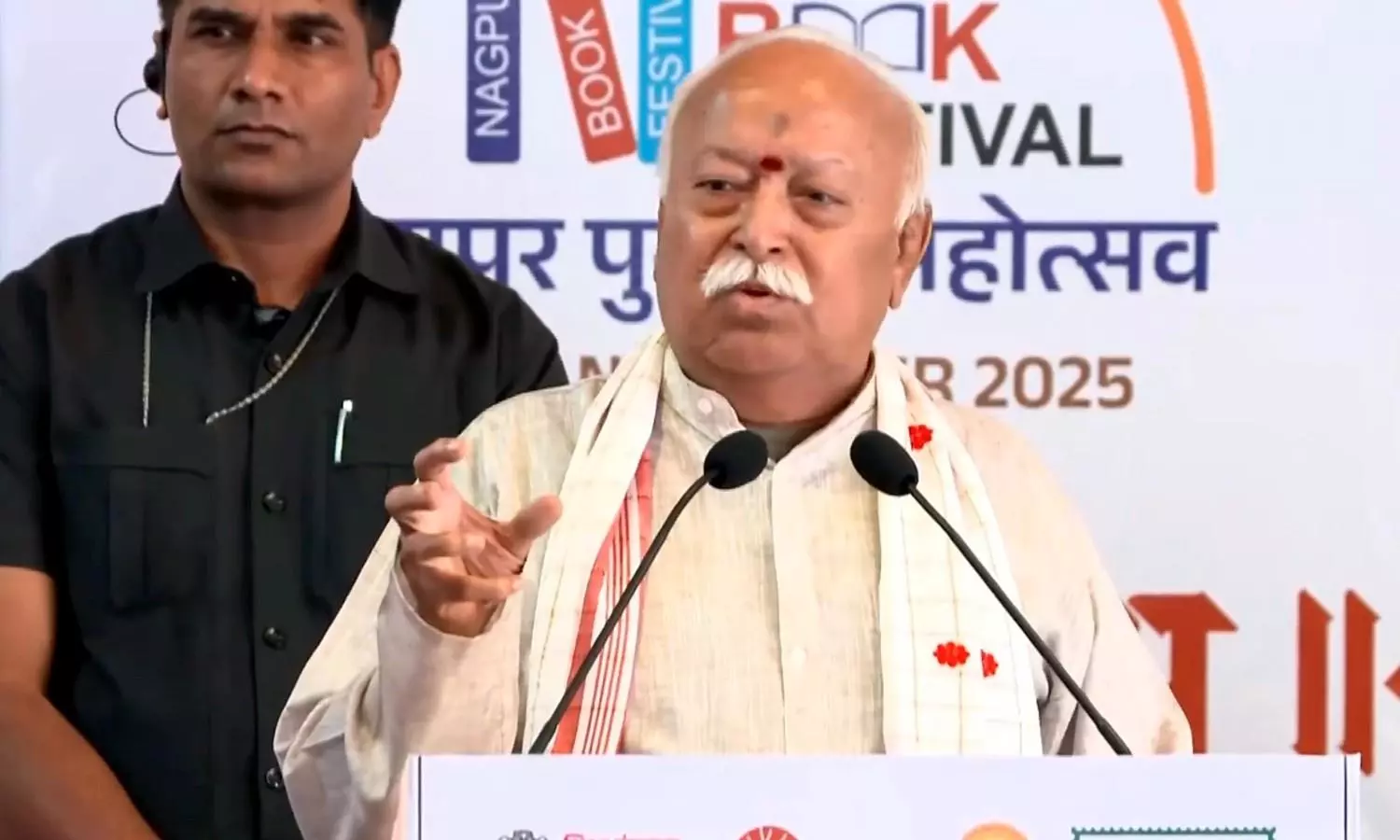
That Modi has bested the RSS is most evident in the fact that in his annual Vijay Dashami speech in 2025, the organisations chief Mohan Bhagwat linked the organisation’s mission to the Modi-set goal of becoming a developed nation by 2047. Representative mage: PTI file photo
From the first day in office after becoming Gujarat Chief Minister on October 7, 2001, Modi proved a difficult former pracharak. Unlike previous leaders of the BJP who assumed public offices, including Atal Bihari Vajpayee during his tenure as Prime Minister, Modi did not continue the practice of holding regular consultative meetings with the RSS brass.
As Chief Minister, the regional heads in the organisation expected him to kowtow with them. But Modi had nothing to do with this and within a couple of years, he not only ensured that the ‘problematic’ RSS hands were transferred to other states, but in time he emerged as the only Sangh Parivar leader whose voice mattered in the state.
With time, Modi was in such a dominant position that even the national leadership of the BJP took the backseat when it came to deciding matters related to Gujarat, be it selection of candidates for elections or policy matters related to the Gujarat government.
Also read: How fresh finds, research progress made 2025 a significant year for science and technology
In the initial period after assuming office as PM, Modi maintained a consultative relationship with the RSS and in October 2014, acquiesced to a meeting with select RSS leaders in which his ministers discussed policy matters and sought their views on various initiatives they intended to take. But with time, as Modi grew in confidence, it became clear that the political model of Gujarat was being replicated at a national level.
The phase of complete functional autonomy from the RSS started with Modi’s success in the 2019 Lok Sabha elections, when he successfully reversed initial trends and led the party to a majority numerically bigger than in 2014.
Initially, the RSS accepted their secondary status because Modi pursued and implemented long-time objectives of the Sangh Parivar – paving the way for the construction of the Ram temple, abrogating Article 370 and linking citizenship with religious identity with the Citizenship Amendment Act.
But with time, these became problematic, especially on the economic front, for instance, the three Farm Bills that were contentiously passed in 2020 (but since repealed) without any consultation with even farmers’ organisations that were part of the Sangh Parivar.
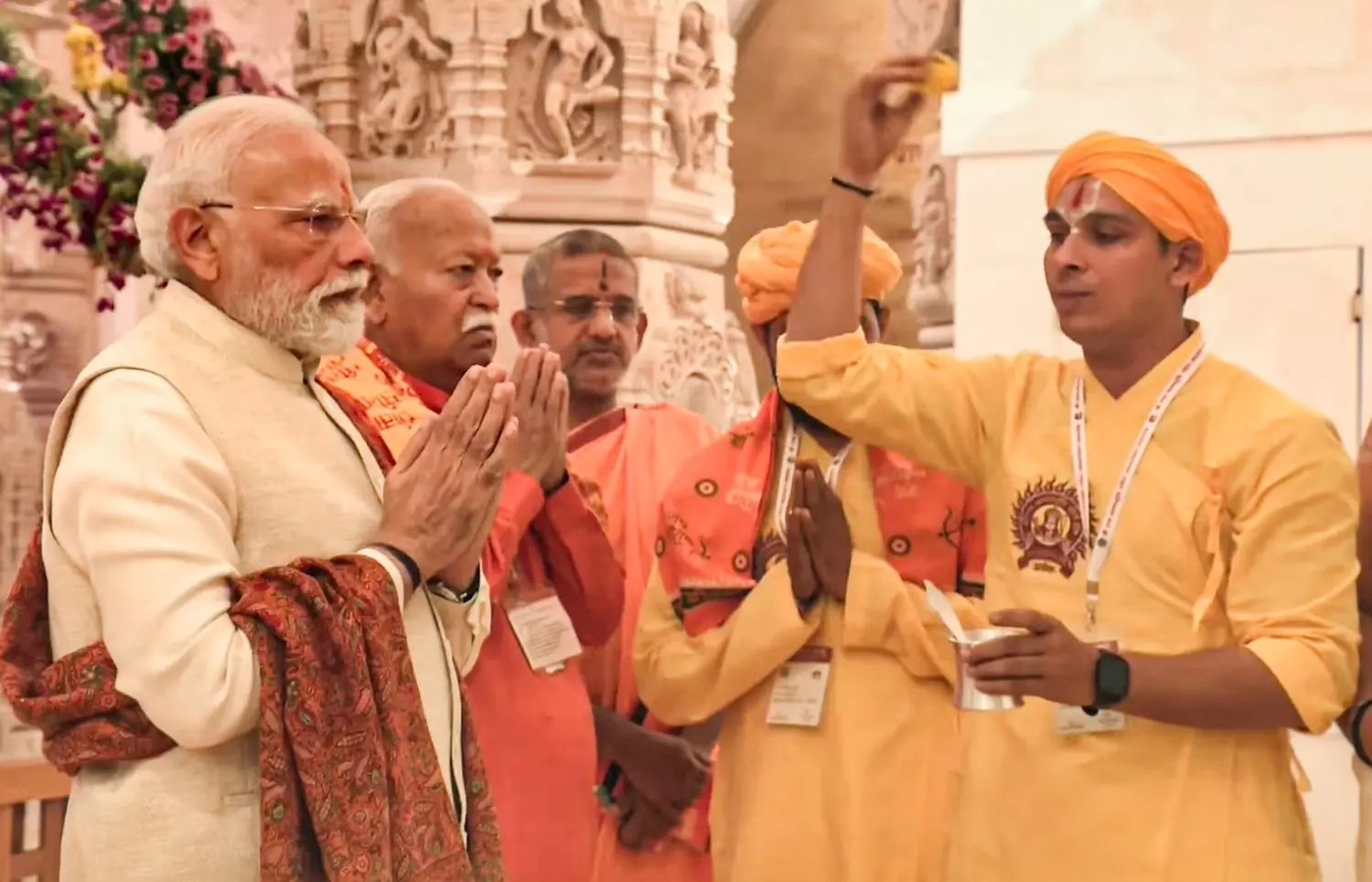
Modi performed the Bhoomi Pujan ceremony for the Ram Temple in Ayodhya in August 2020 and also the consecration ceremony in January 2024. Mohan Bhagwat too was accommodated in the rituals, but in a position that was secondary to Modi’s. Representative image: PTI file photo
Problems mounted between the two through the second term of Modi as Prime Minister, as he cornered more power and authority in his hands and the government’s publicity department acquired the reputation of being the most efficient section of the government.
Although shilanyas, the foundation laying ceremony was performed in the course of the Ram Janmabhoomi movement in November 1989, he personally performed the Bhoomi Pujan ceremony all over again, albeit with a different name for the ritual in August 2020, and also the consecration ceremony in January 2024.
The RSS did not publicly object to any of this because Bhagwat too was accommodated in the rituals, although in a position that was secondary to Modi’s.
Also read: GDP growth rebounds, but average Indian’s living standard dips — How Indian economy fared in 2025
What, however, got the goat of the RSS was the overt personalisation of the BJP’s 2024 Lok Sabha election campaign by the personality-centric slogan of ‘Modi Ki Guarantee’ (Modi’s Undertakes the Guarantee) and the overconfidence exuded by the poster headline – ‘Abki Baar 400 Paar’ (This time we shall cross 400 seats in Lok Sabha). The last straw was BJP President JP Nadda’s media interview last year in which he declared that the BJP had developed the required capacity and no longer “needed the RSS”.
In the elections, the RSS demonstrated its organisational prowess and the extent to which this was crucial for the BJP to win elections. The BJP’s victories in 2014 and 2019 were greatly attributed to the door-to-door campaign by the RSS foot soldiers.
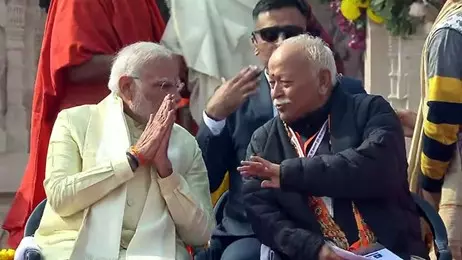
Although playing second fiddle, the RSS has the capacity to influence policy in almost every government with its personnel strategically placed in institutions in sectors from education to sports and culture. Image: PTI file photo
With this network staying away in 2024, the BJP’s tally plummeted by 20 per cent, from 303 in 2019 to 240 last year. Immediately thereafter, efforts to restore the relationship were started and the party president attended a coordination committee meeting of all important affiliates of the RSS at Pallakad, Kerala in the last week of August 2024.
Other backroom meetings between RSS and BJP leaders further restored the ties and the cadre was back for assembly elections in Haryana and Maharashtra. This restored to the BJP what it had lost and the party romped home with landslide victories in the two states. Modi’s visit to Nagpur was a thanksgiving of sorts.
But the domineering personality that he has, regained his hegemonic presence within the saffron fraternity with Operation Sindoor and repeated it with the recent elections in Bihar. Quite clearly, the RSS has chosen to accept the secondary position because its objectives are being fulfilled.
Also read: AI, Trump and the desi tech job meltdown of 2025
Instead of insisting on control over important party-related decisions, the RSS has opted to remain contented if its ideological goals are met and it continues to secure a firmer presence within the steel frame of the system.
Despite playing second fiddle, like for instance in the eventual ‘selection’ of the party president, the RSS has the capacity to influence policy in almost every government with its personnel strategically placed in institutions in sectors from education to sports and culture.
Although a culture that is poles apart from its puritanical ideal, the RSS is now following the dictum articulated in the hit song from the Hindi film, Gully Boy ‘Apna Time Aayega’ (My Time Will Come).
Clearly, the RSS believes that even the self-defined ‘non-biological’ beings are not immortal and that its fortunes will pick up in the post-Modi era, whenever it begins.