



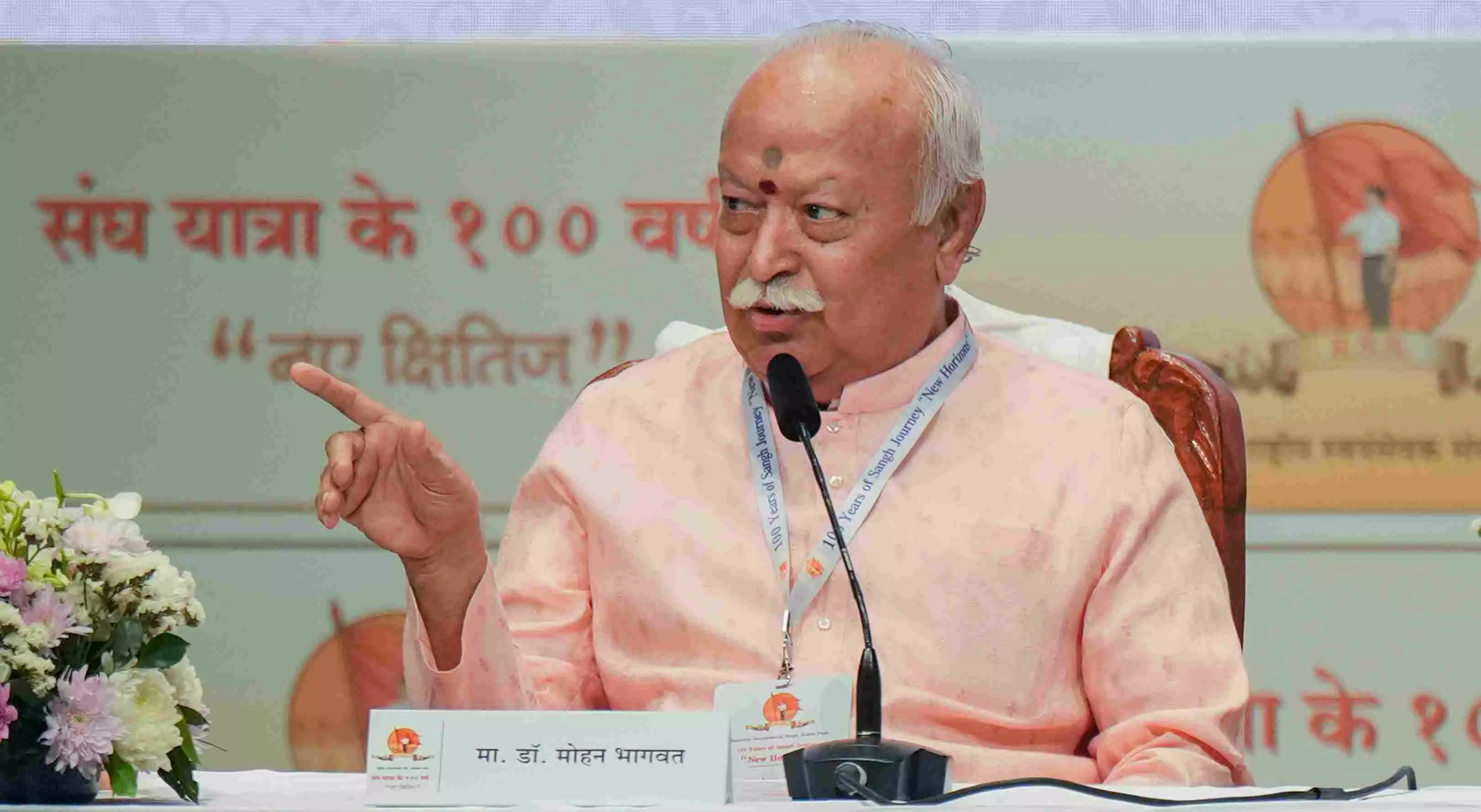
Bhagwat delivered a sharp message on the situation of Hindus in crisis-hit Bangladesh. He said that if the country's Hindu population decides to stand and fight for its rights, they will receive the support of Hindus across the world. Photo: PTI
Ready to step down if Sangh asks me to do so: RSS chief Mohan Bhagwat
RSS chief the top post in the sangh is for “best available Hindu” regardless of caste, urges vigilance on infiltration, pledges support for Hindus in Bangladesh

RSS chief Mohan Bhagwat on Sunday (February 8) said he is ready to step down from his post whenever the organisation asks him. However, the 75‑year‑old leader added that the Sangh has asked him to continue working despite his age.
He has completed 75 years and informed the RSS about it, he said. "But the organisation asked me to continue working. Whenever the RSS asks me to step down, I will do so, but retirement from work will never happen," Bhagwat added.
He also made it clear that the person heading the Sangh will always be a Hindu, irrespective of his caste, with the top post going to the best available candidate.
"There is no election to the post of RSS chief. Regional and divisional heads appoint the chief. Generally, it is said that after turning 75, one should work without holding any post," Bhagwat said, responding to questions during an interactive session with attendees at the Nehru Centre in Worli in Mumbai, during a two-day programme to mark the Rashtriya Swayamsevak Sangh's (RSS) centenary.
'RSS chief has to be a Hindu'
The RSS does not have community-based representation, and volunteers rise through ranks based on their work, Bhagwat said, adding that the RSS chief has to be a Hindu, irrespective of caste.
He pointed out that when the RSS was founded, its work began in a Brahmin-dominated community and hence, most of its founders were Brahmins, which led to the organisation being labelled as a Brahmin outfit at the time. People always look for an organisation that has representatives from their community, he said.
Also read: RSS no para-military organisation; can't be understood by looking at BJP: Bhagwat
Bhagwat said he could not give a definite answer on whether the Sangh head would be from the SC or ST background, as the decision rests with those who appoint the chief.
"If I were to choose a chief, I would go by the 'best available candidate' criterion. When I was appointed RSS chief, there were many best candidates, but they were not available. I was the one who could be relieved from duties and appointed," he said, adding that to belong to the Scheduled Caste or Scheduled Tribe communities is not a disqualification, and neither is being a Brahmin a qualification to become the RSS chief.
“Kshatriya, Vaishya, Shudra or Brahmin does not qualify for the sarsanghchalak position (RSS Chief), a Hindu will become it — the one who works and is the best available,” he said, pointing out that can also be an SC or ST. "Anyone can become (RSS chief), it depends on the work. Today, if you see, all classes have representation in the Sangh. The decision is taken on the basis of one who works and is best available," he said.
Supporting Hindus in Bangladesh
Earlier, in his speech, Bhagwat delivered a sharp message on the situation of Hindus in crisis-hit Bangladesh. He said that if the country's Hindu population decides to stand and fight for its rights, they will receive the support of Hindus across the world.
"There are about 1.25 crore Hindus in Bangladesh. If they decide to stay there and fight, all Hindus across the world will help them," Bhagwat said. Bangladesh has witnessed a sharp escalation in mob attacks targeting minority communities, particularly Hindus, in recent months after the death of Sharif Osman Hadi, a radical student leader known for his anti-India stance.
Population changes
RSS chief Mohan Bhagwat criticised past governments for failing to adequately address India’s shifting population trends. He pointed to rising birth rates and illegal immigration as key drivers of demographic change.
“The government has a lot to do regarding infiltration. They have to detect and deport. This wasn’t happening until now, but it has started little by little and will gradually increase,” said Bhagwat.
Also read: No conflict between science and dharma, says RSS chief Mohan Bhagwat
According to Bhagwat, census exercises and the ongoing Special Intensive Revision (SIR) of electoral rolls often reveal individuals who are not citizens, and such names are automatically excluded. He was referring to the revision of electoral rolls currently underway in several states, including West Bengal, where the ruling Trinamool Congress has accused the BJP of targeting Muslims by labeling them “Bangladeshi infiltrators.”
Detect, report infiltrators
Bhagwat urged citizens to remain alert and find infiltrators and report them. He asked them to avoid offering employment to alleged infiltrators.
Also read: RSS at 100 stands tall but is shadowed by a fraught past and fractious present
“We can do one thing: we can work on detection. Their language gives them away. We should detect them and report them to the appropriate authorities. We should inform the police that we suspect these people are foreigners, and they should investigate and keep an eye on them; and we will also keep an eye on them,” Bhagwat said.
Sangh work culture
In a lighter vein, Bhagwat said the organisation "extracts work till the last drop of blood from its volunteer" and maintained that there had not yet been a situation in the RSS's history where someone had to be retired.
Bhagwat said the Sangh's work was about inculcating "sanskar" (values) and not about campaigning.
"We have lagged behind in promoting ourselves. Excessive campaigning leads to publicity and then arrogance. One needs to protect oneself from it. Publicity should be like rainfall, adequate in timing and quantity," he said, adding that the RSS was carrying out outreach initiatives.
Muslim areas
Asked about the work of Sangh volunteers in Muslim communities despite resistance, Bhagwat said that if both sides oppose each other, there would only be confrontation, and no work can be done. The Sangh avoids confrontation, he asserted.
"Challenges in Muslim areas are handled by not responding. They may use cuss words, but we don't respond. That way conflict does not increase," he said and added that the RSS does not target any caste or community but works geographically.
(With agency inputs)