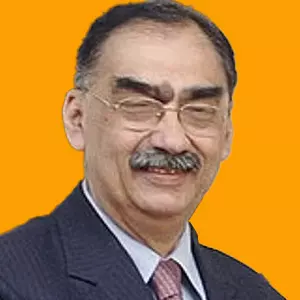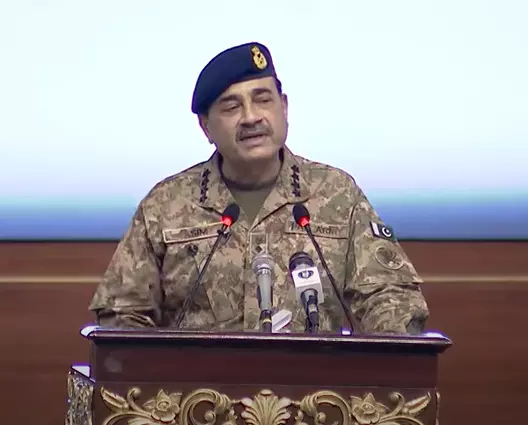
The arrest and trial of Hameed, the former chief of Pakistan's Inter-Services Intelligence, brings to the fore the ruthlessness of the country's army-civilian political games
On December 12, the Inter-Services Public Relations (ISPR) wing of the Pakistani military made a stunning announcement.
It stated that Lt Gen Faiz Hameed (Retd), a controversial former director-general of the Inter-Services Intelligence (ISI), “was tried on four charges related to engaging in political activities, violation of Official Secret Act detrimental to safety and interest of the State, misuse of authority & government resources and causing wrongful loss to persons”.
Also Read: Pak Army chief Asim Munir promoted to Field Marshal; trolls have a field day
The trial was conducted by a Field General Court Martial. The court martial concluded that the retired DG ISI “has been found guilty on all charges and sentenced to 14 years of rigorous imprisonment by the Court, which has been promulgated on 11 December 2025”.
The ISPR press release also referred to the retired officer only as Hameed. This indicated that his former military rank was also taken away. This amounted to rubbing him out of his military service.
Charges against Hameed
Hameed was arrested on August 12, 2024, following an army enquiry on a complaint made by a private builder to the Pakistan Supreme Court, that the officer, while in army service, had harassed him and extorted funds from him.
Despite being a Bajwa protégé, Hameed soon made himself indispensable to Imran Khan. He began to handle all his political manoeuvring. Bajwa found that his protégé was carving an independent space for himself and was often at the former PM's side.
In November 2023, the top court had observed that the accusation against Hameed was serious and needed to be enquired into. Thereafter, an army inquiry found substance in the builder’s charges against him.
Field Marshal Asim Munir, who was then the army chief, ordered Hameed’s arrest and instituted court-martial against him.
Also read: Pak to sell national airlines PIA for IMF loan; Munir’s Fauji company a bidder
Munir would have been delighted to do so. He would have been supported by the Shehbaz Sharif government and the other opposition parties. To understand why this would have been so, Hameed’s background and the developments in Pakistani politics since 2016 need to be recalled in some detail. It confirms that the Pakistani Army is both professional and political.
Hameed's rise in Pakistan army-civilian tussle
In 2016, the Pakistan Muslim League (Nawaz) leader and Shehbaz’s brother, Nawaz Sharif, was the prime minister. He had been in office since winning the 2013 election. His relations with the army were always bad.
In 2016, Gen Raheel Sharif retired as the army chief and Nawaz, overlooking seniority, chose Qamar Bajwa to replace him. Contrary to Nawaz’s expectations, Bajwa showed no loyalty towards his benefactor. Instead, he followed the traditional hostility of the army towards the PML(N) leader.
His chosen instrument to cause political trouble for Nawaz was his protégé Hameed, who was then a Major General. Hameed liaised with anti-Nawaz religious and political elements to cause great trouble for the Prime Minister. Hameed showed great competence in organising these conspiracies.
The release of the Panama Papers, which indicated that the Sharifs had foreign companies and residential property in London, came in handy. Judges of the Pakistan Supreme Court before whom petitions against Sharif were filed, found him unfit to become a member of the National Assembly.
Consequently, Sharif had no choice but to resign in July 2017 and hand over the prime minister’s office to a loyal PML(N) member, Shahid Khaqan Abbassi, who replaced him in August 2017 and continued till May 2018. It was after a few months that national elections were held in the country.
The Imran Khan-Asim Munir clash
Bajwa decided that the election would be won by Imran Khan. The army ensured that the election was manipulated in a manner in which the Sharifs, whose base was in Punjab, would stand no chance there.
Also Read: Pakistan Army chief warns India of 'decisive response' to even minor provocation
The army officer who pulled the electoral strings from behind the scenes under Bajwa’s orders was Hameed. Khan won the 2018 election and became prime minister. Along with Bajwa, the government was carried out in a ‘hybrid’ system.
Munir began to target Khan, whom he ensured languished in prison, and Hameed, against whom a court martial was launched in August 2024 and which has now resulted in this unprecedented punishment for such a senior, although retired, Pakistani army officer.
At this stage, Munir was the director-general of the ISI—considered to be the second-most powerful position in the Pakistani Army. In 2019, Munir cautioned Khan that his wife and her associates were making money by engaging in corruption.
Khan took offence and demanded Munir to be replaced. Bajwa obliged because in 2019, he wanted a second term as the army chief. The officer he chose to replace Munir was Hameed. Naturally, Munir, who is known to be ruthless, gulped the insult of removal, but began to nurse an unforgiving hatred for Khan, Bajwa and Hameed.
Situation changes soon after
Despite being a Bajwa protégé, Hameed soon made himself indispensable to Khan. He began to handle all his political manoeuvring. Bajwa found that his protégé was carving an independent space for himself and was often at the former prime minister's side.
In October 2021, Bajwa removed Hameed from the ISI and made him a Corps commander. He did not even consult Khan, who was irked and indicated that he wanted Hameed to continue to head the ISI.
However, Bajwa did not change his decision, and Khan had to back down. This incident broke Bajwa’s trust in Khan and he began a dialogue with the Sharifs, the Bhuttos and Maulana Fazlur Rehman, who constituted the opposition, for the fall of Khan's government.
His manoeuvring succeeded, and Khan had to go amidst great drama in April 2022. Shehbaz became the prime minister with the support of the other opposition parties. Bajwa’s first desire was that the government should continue until his term was over in November and that he should have his own man take over as the army chief.
Munir’s arrival and Hameed's fall
Meanwhile, Munir established contact with Nawaz, who was in exile in London. He convinced him that he would be loyal to him if he succeeded Bajwa.
There was a technical hitch in Munir getting the office, as he was retiring a few days prior to the end of Bajwa’s term. The difficulty was resolved. Shehbaz was willing to go by Bajwa’s advice and choose another officer but had to give way to Nawaz’s insistence.
Also Read: Pakistan passes bill giving Army Chief expanded powers, legal immunity
Consequently, in May 2022, Munir became army chief. Soon after, Hameed resigned.
Elections were to be held in Pakistan in 2023, but they were delayed because the country's Election Commission, on one excuse or another, kept deferring them. Hence, Shehbaz continued as the PM, while intense political drama was taking place in Punjab, where Khan was still powerful.
Meanwhile, Hameed, after resigning, gravitated towards Khan and once again began to manage his politics from behind the scenes. On May 9, 2023, Khan was arrested on corruption charges. His supporters began to attack army installations.
Some of the army's key sections, who were sympathetic to Khan, did not take adequate action to stop the rioting. Reports indicated that the planning and execution of the rioting was managed, among others, by Hameed. Munir brought the situation under control, and over the next few months, it is believed that he purged around 80 officers who sympathised with Khan.
Elections were held in February 2024. Munir ensured that Shehbaz returned as the prime minister and that Nawaz's daughter became the chief minister of Punjab. The Sharifs were greatly beholden to Munir, who became more powerful than before.
He began to target Khan, whom he ensured languished in prison, and Hameed, against whom a court martial was launched in August 2024 and which has now resulted in this unprecedented punishment for such a senior, although retired, Pakistani army officer.
Operation Sindoor
Ironically, India's Operation Sindoor helped Munir consolidate his power further. He indulged in propaganda that under his leadership, India had been given a befitting reply by the Pakistan military. He was invited to lunch at the White House by US President Donald Trump, which helped him develop an aura around himself in the army and among sections of the Pakistani people.
Also Read: Asim Munir warns India of a ‘swift and intense’ response to any aggression
In order to earn his gratitude, Shehbaz promoted him to the rank of Field Marshal, and a few weeks ago, the Constitution was amended to make the Pakistani Army chief the Chief of Defence Forces. That would give him control over the navy and the air force as well.
Now, Munir decided to push his old rival Hameed into the dust to signal that anyone who has sympathy for Hameed or Khan would also be treated ruthlessly. It was also a signal to Khan’s party—the Pakistan Tehreek-e-Insaaf (PTI)—that their leader would never be treated leniently. Earlier, the second rank of the PTI had distanced itself from Hameed.
Hameed's bleak chances
Pakistan is now under a ruthless army chief who is imbued with an Islamic zeal. He has developed great confidence and is in full control of the military. Otherwise, such a sentence could not have been imposed on Hameed.
The Sharifs and the Bhuttos will not oppose him either. Pakistan’s friendly powers, such as China and Turkey, also like Munir and will consider the Hameed matter as Pakistan’s internal one.
Hameed has the opportunity to appeal, but the chance for his success in this is next to zero. One of Pakistan’s most clear-headed journalists, Khurram Husain, wrote after the sentencing of Hameed that the last paragraph of the ISPR statement was “critical and ominous” for the latter.
The paragraph reads “Involvement of the convict in fomenting vested political agitation and instability in cahoots with political elements and in certain other matters is separately being dealt with”.
Khurram correctly notes that this could mean “using Faiz Hameed’s testimony to convict Khan on charges of conspiring to incite mutiny within the armed forces”.
Neither Khan's nor Hameed’s troubles have ended. Munir will continue to go after them strongly.
(The Federal seeks to present views and opinions from all sides of the spectrum. The information, ideas or opinions in the articles are of the author and do not necessarily reflect the views of The Federal)