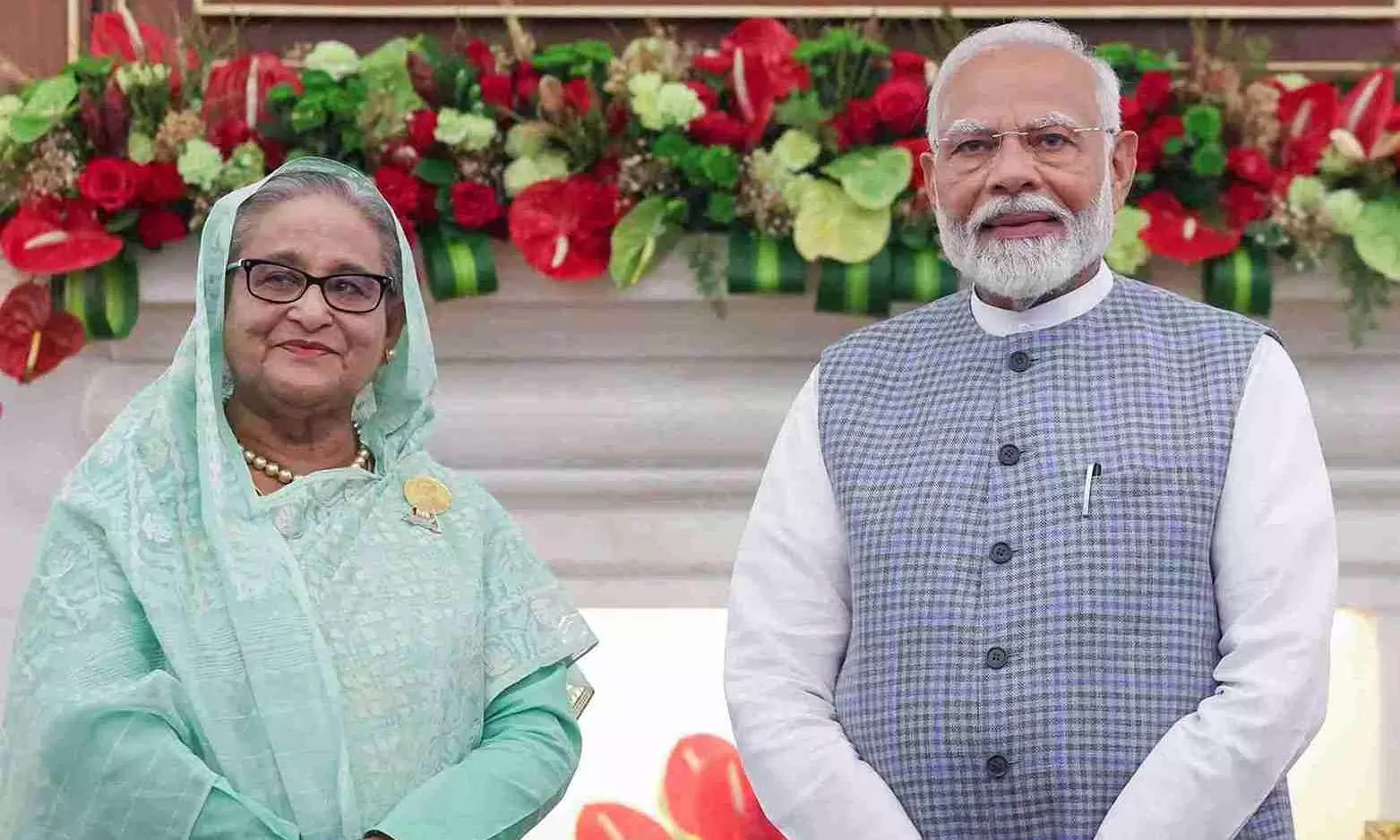
Dhaka brands Hasina’s Delhi media event an affront to sovereignty, dashing reset hopes as China gains ground and India’s strategic miscalculation deepens
India-Bangladesh relations appear headed into a dangerous tailspin following Dhaka’s strident criticism of New Delhi for allowing former Bangladeshi prime minister Sheikh Hasina to hold a press conference in New Delhi on Wednesday (August 5).
The Awami League leader, living in self-exile in India for the past two years, addressed the media virtually on Wednesday to express her determination to return to Bangladesh in December. In a late-night statement, a seething Dhaka said it was “outraged that the absconding convicted genocider Sheikh Hasina” was allowed to hold a press interaction.
The government, led by Tarique Rahman of the Bangladesh Nationalist Party (BNP), characterised the move as an “affront to the sovereignty of Bangladesh” and said “allowing her the opportunity to openly interact with the media under any pretext is deeply hurtful to the development of harmonious bilateral relations between Bangladesh and India”. The scathing remarks by Dhaka effectively dash any immediate hopes for a diplomatic reset between the two neighbours.
Dhaka’s outrage
It now seems unlikely that Rahman will accept New Delhi’s invitation to participate in the Outreach Session at the BRICS Summit next month. The visit was expected to enable a meeting between Rahman and Prime Minister Narendra Modi on its margins, offering a vital opportunity for the two neighbours to normalise ties that have remained strained since Hasina’s ouster two years ago.
Also read: ‘Bangladesh has become another Pakistan’, says Sheikh Hasina’s son, cautions India
Dhaka reiterated on Wednesday that it wants a “constructive, mutually beneficial and forward-looking relationship with India based on sovereign equality, mutual respect, non-interference in each other’s internal affairs, and national dignity.” The messaging is clear: Dhaka is not willing to play second fiddle to New Delhi, nor accept any acts it perceives as an affront to its sovereignty lightly.
What has also outraged Dhaka is the timing of Hasina’s press conference. It was held on August 5, the day on which her government was toppled two years ago. It was observed in Bangladesh as the July Mass Uprising Day. Not mincing words, Dhaka described Hasina as a “mass murderer”.
A miscalculation?
Although New Delhi had earlier sought to minimise the damage from the press conference in stating it was a private event, it was clearly not a satisfactory explanation for Dhaka. After all, India has played host to Hasina for the past two years and, according to her son Sajeeb Wazed, she is being treated like a “head of state”.
New Delhi’s decision to overlook Dhaka’s objections, both in public and through diplomatic channels, regarding Hasina’s political activities represents a major miscalculation. Rather than safeguarding its own long-term strategic interests in Bangladesh, India appears to have prioritised the political ambitions of a deposed leader.
Allowing Hasina to carry out political activities at the cost of its own security interests, knowing well this would draw Dhaka’s ire, can only be seen as a diplomatic misstep by New Delhi.
An old friend
While Dhaka has been seeking Sheikh Hasina’s extradition, it’s unlikely that New Delhi will comply, given that her government remained mindful of India’s strategic interests during her tenure as PM.
Also read: Behind Chuppu’s sudden exit: US’s geopolitical ambitions, bid to install Yunus
During her nearly 30-minute audio address, the 78-year-old leader defended her regime’s actions during the student movement while mounting a fierce attack on her political opponents, including economist Muhammad Yunus, who headed the interim government as chief adviser following her ouster. Hinting at a broader foreign conspiracy, Hasina claimed the unrest was “not a peaceful student movement”, but rather an operation driven by “organized groups” acting on “invisible instructions” to create a violent political tool.
Using a mixture of emotional rhetoric and political guile, Hasina invoked the memory of her father, Bangabandhu Sheikh Mujibur Rahman, and the 1971 Liberation War, lamenting the destruction of historical monuments. While the Awami League remains banned from political activity and was barred from contesting the February parliamentary elections, Hasina made it clear that she was actively laying the groundwork for a political comeback, asserting that she cares little for her personal safety when her people are suffering. She also made sure to tom-tom her government’s achievements in her nearly half-an-hour-long opening remarks.
A question of security
A potential return by Hasina to Bangladesh, where she is facing a death sentence, would trigger a political firestorm, shattering India’s hopes for regional stability along its long, porous eastern border. An unstable Bangladesh carries severe national security risks for India.
The BNP-led administration took office in February this year after winning a two-thirds majority in Parliament. Highlighting the shift in regional alignment, Rahman has yet to visit India, but was in China in June. He signed 17 pacts with China, India’s primary geopolitical rival.
Also read: Hasina's home-return promise rattles Bangladesh government, Islamists
During his four-day visit, bilateral ties were elevated from a “comprehensive strategic cooperative partnership” to a “China-Bangladesh community with a shared future”. Worryingly for New Delhi, Dhaka and Beijing also agreed to launch a 2+2 dialogue covering foreign policy and security.
The China factor
Also a cause for anxiety for India is the agreement signed between Dhaka and Beijing to expand Mongla Port, alongside the decision to grant a Chinese firm the right to develop its adjacent economic zone.
India would also be concerned about China pledging support for the restoration project for Bangladesh’s Teesta River. Bangladesh has turned to China after India failed to deliver the long-awaited Teesta water-sharing treaty to Bangladesh after it was opposed by the previous Mamata Banerjee-led government in West Bengal. With a BJP government now leading West Bengal, delivering the Teesta treaty to Bangladesh should not be a difficult task for India.
Domestic dynamics
The Rahman government also has to tackle domestic political dynamics. Any overtures towards India risk a severe backlash from the Opposition, particularly if his government is seen as being overly accommodating to New Delhi.
Also read: 'Chest thumping not foreign policy, New Delhi-Dhaka must return to dialogue' | Worldly-Wise
Rahman faces pressure from a resurgent Jamaat-e-Islami, which now leads the Opposition in Parliament. The Jamaat has refused to be part of the parliamentary panel that is looking into constitutional amendments. He also needs to deliver on the July Charter which is possible only if he has the support of Opposition parties. Amid this backdrop, he cannot risk alienating the Opposition.
Ultimately, India must recognize that the “shonali adhyay” (golden chapter) in bilateral relations enjoyed during Hasina’s tenure is over. With China expanding its footprint in Bangladesh, and the United States taking an increasingly active role, India needs a far more pragmatic and realistic foreign policy approach towards its neighbour. Failing to adapt to the new political reality in Bangladesh will only undermine India’s own strategic and security interests.
(The Federal seeks to present views and opinions from all sides of the spectrum. The information, ideas or opinions in the articles are of the author and do not necessarily reflect the views of The Federal.)