Despite criticism and a fiasco in Kolkata, the GOAT Tour was hugely successful and inspiring and changed many things in Indian sport
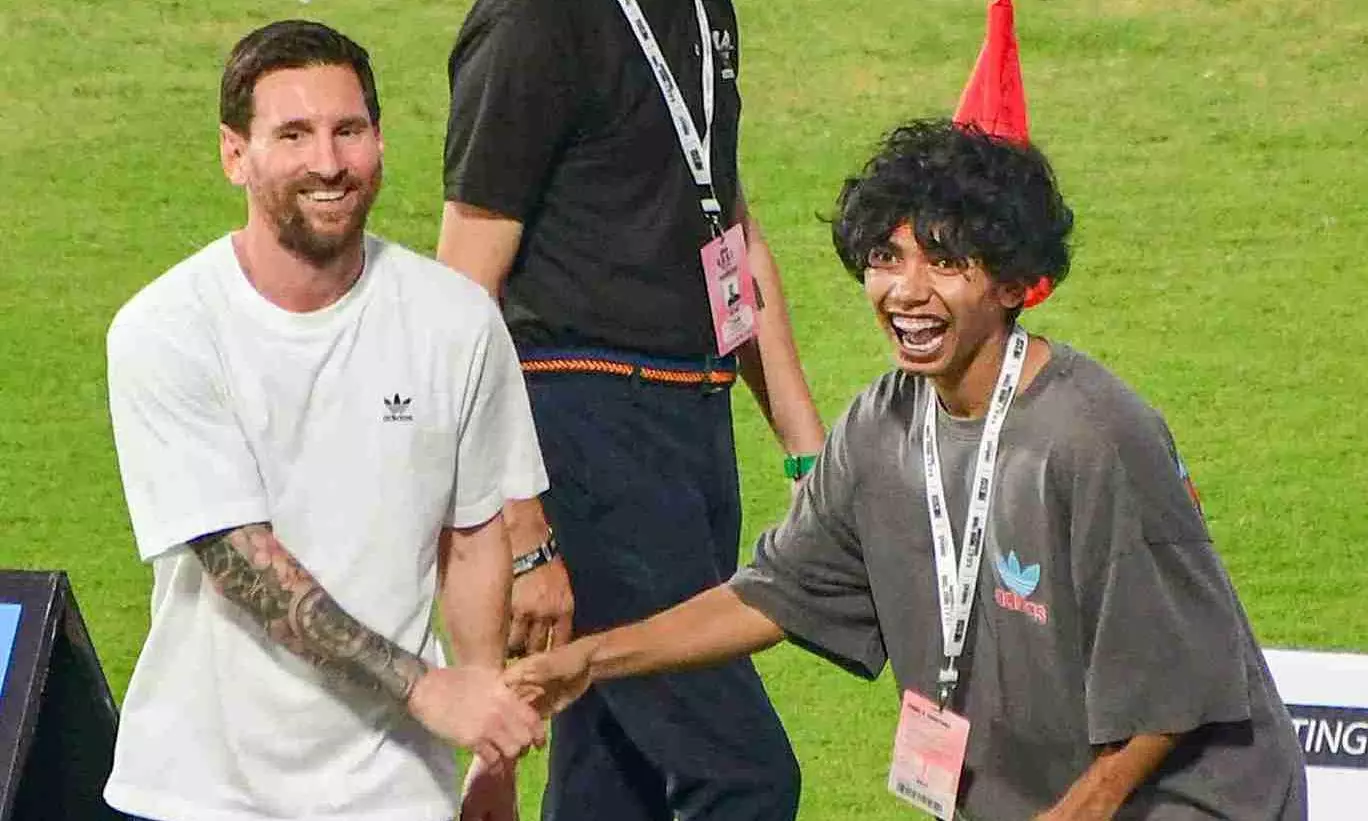
The just-concluded three-day tour of India by Lionel Messi, “The GOAT Tour”, organised by the Kolkata-based Satadru Dutta, was full of youthful frenzy. This is the first such sports event where a chief minister (Telangana’s Revanth Reddy) himself donned a football jersey to do a kick-about.
This tour came just a month after another tour—the Argentina team's FIFA-sanctioned friendly in Kerala, organised by the state government—fell through after months of anticipation, despite the government ordering a refit of the football stadium in Kochi.
The Kolkata fiasco
The tour of Messi, accompanied by his two footballer friends and Inter Miami teammates, Uruguayan forward Luis Suarez and fellow Argentinian Rodrigo de Paul, was in the headlines for all the wrong reasons after the Kolkata crowd rampaged the Salt Lake stadium when Messi exited after 20 minutes due to a security scare. The fiasco led to the arrest of the organizer and the resignation of the sports minister. Dutta was remanded in 14 days’ police custody—an unprecedented order just for some minor damage to public property.
Also read: ‘What is happening?’: Confused Messi cuts short Kolkata appearance
What needs to be mentioned here is that the tour was a fantastic opportunity for young football and sports fans to see a footballing genius — not just as a player who creates magic on television, the only place where most Indians (he played a game in Kolkata in 2011, though) have seen him and swooned many times, but just as a man who is alive and real. He created magic most recently at the last World Cup finals, when Argentina, led by Messi, beat France in a pulsating final that is retold every day throughout the world.
A quietly-growing football frenzy
In the man and in the folklorish tales and surreal skill that surround him, a sport is recreated every other day. Though big football has never been staged in India, and no World Cup star has been seen in action at his prime, India, which is a cricket-mad country with a surfeit of tournaments, lived football in its imagination, apart from, of course, television.
Despite being a country with a huge number of cricket stadiums, India has never been visited by any big football team, mostly because of its below-100 ranking in world football. But much smaller countries like Singapore and Thailand have hosted Premier League clubs in their pre-season tours. India was a no-show and no-go for big football. Yet, unseen and unknown, a humungous football frenzy was building up inside the country.
The Messi tour capitalised on it. No sporting event in India with a minimum ticket price between Rs 7,000 and Rs 10,000 has seen such crowds. IPL, which sees as much crowds, has a base ticket price of Rs 500, or even Rs 250 for early matches. Delhi’s famous Arun Jaitley cricket stadium drew 25,000 people to see Messi even though it was just a kick-about event with no match (rock music events sell as much).
Also read: Lionel Messi’s Mumbai visit a ‘golden moment’, says Sachin Tendulkar
Ticketing, though at a high price, democratised the event when it could easily have been privatised for more money. The fact that Messi and his friends were whisked away by the Ambanis for a quick trip to the not-fully-legalised Vantara zoo shows that private money was waiting to capitalise on Messi’s global fame and recognition. A dinner-cum-photo op event in Mumbai for the Richie Rich SoBo crowd was priced at Rs 12 lakh per person.
Criticism based on puritanical view
But leading sportsmen have criticised the event. Olympic champion shooter Abhinav Bindra shot off the first salvo, calling it a waste of money, though no government fund was involved. He angrily said that millions were spent on proximity photographs and meets-and-greets rather than strengthening India’s sports culture. He wanted to know what we were trying to achieve by such spectacles.
The puritanical view that sporting spectacles serve no purpose is not based on facts. Sport is both spectacle and national glory, apart from nurturing notions of defeat and victory and achievement. Sporting idols play a big role in nurturing spirits of achievement.
This writer was part of the huge crowd (watch the video) that thronged the Arun Jaitley Stadium in Delhi and brought central Delhi to a standstill for the whole afternoon, on a day when the Parliament session was in session. Many of the youngsters who stood in the queue were students and those who had taken leave from work. A philosophy honours student of the Delhi University told this writer that he rushed out of the exam hall after answering just two questions to be in time for the Messi match about 8 km from the campus. He said the exam didn’t matter because he had done well in the class tests.
A dream come true
The Indian Express quoted a steel factory worker from Sangrur in Punjab who finished his arduous shift at 9 the previous night, rushed to catch the midnight train to reach Delhi at 1.30 pm, the time when the delayed event was scheduled to start. “It was well worth the 7,000 rupees I spent. It was my dream to see Messi.”
Also read: ‘What were we trying to achieve?’: Abhinav Bindra on Messi India tour
Also, for poor people like this steel factory worker, living on the fringes of society, being part of a spectacle like this is also to be part of the country’s centre, where big things happen. The huge ticketing price did not matter to many like him. Apart from the fact that the ticket enables them to log on to a globally-talked-about event, such ticketed events also occasionally convince them that they are part of a large whole and not just left on the fringes to ultimately perish, if not from the heat of the factory oven, then the crush of the elite.
A stadium is always an urban phenomenon, and even if it is situated in aspiring suburbia, to be there as a legitimate viewer is also to view the world on the move. In such moments of euphoria and frenzy, the aspiring youth who lives always in hope that one day the die will roll in his favour, the stadium is also a cathedral. Here, there is just one god, and one desire, and one prayer. Every barrier is broken in love with the game or the man.
Also read: Messi hopes for 'bright future' of football in India
That way, Messi and the many meanings and aspirations that he carries on his lean frame were divinity itself for the more than one lakh Indian youngsters who gave up everything that day to see him. To be near such a man, an idol, was for them a great realisation.
(The Federal seeks to present views and opinions from all sides of the spectrum. The information, ideas or opinions in the articles are of the author and do not necessarily reflect the views of The Federal.)