As Tamil Nadu awaits the election verdict, one feature of this cycle stands out with unusual clarity: the distinctive political style forged by Tamilaga Vettri Kazhagam (TVK) under actor-turned-politician Vijay. Even before votes are counted, the campaign deserves scrutiny, not for what it might win, but for what it reveals about the changing grammar of political mobilisation in the state.
From the outset, the TVK framed the contest in stark moral terms. The ruling Dravida Munnetra Kazhagam (DMK) was cast not merely as a political rival but as an “evil force”, opposed by the TVK as a “pure” alternative. This binary, simple, sharp, and emotionally resonant, became the campaign’s organising principle.
Tamil Nadu has long been receptive to charismatic leadership, but it has also demanded that such charisma be anchored in governance, accountability, and institutional competence.
In the process, ideological nuance was pushed aside. Politics was recast as a moral confrontation, where opponents were delegitimised rather than debated. This framing extended seamlessly into the campaign’s interpretation of events. Disruptions in rallies, administrative constraints, and even deeply personal matters such as Vijay’s divorce were folded into a sweeping narrative of conspiracy attributed to the DMK.
Nature of TVK's mobilisation
From early mobilisation to the final stretch, allegations of sabotage formed a recurring refrain. Derailments of public meetings, law-and-order concerns, logistical hurdles were presented as evidence of an entrenched establishment seeking to stifle a rising force.
Such a strategy may be effective in generating cohesion among supporters. But it becomes deeply problematic when applied to moments that demand accountability. The tragic Karur stampede, which claimed multiple lives, required sober reflection on crowd management, planning, and responsibility. Instead, it was subsumed within the same accusatory framework.
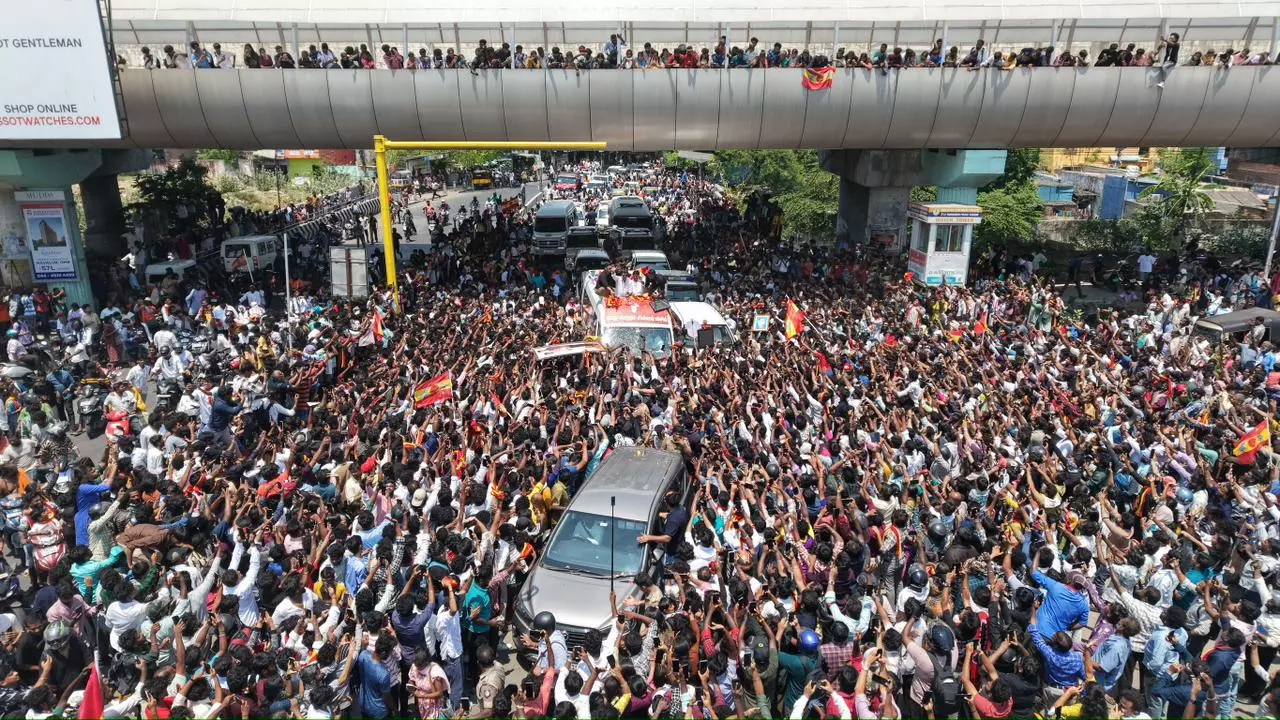
TVK's roadshows, marked by unruly behaviour and inadequate crowd control, pointed to an organisation still in formation, one that struggles to convert affective energy into disciplined political action.
Notably absent were visible, organised relief efforts led by the party, an omission that stands in contrast to the swift ground-level responses typically mounted by established political formations in the state.
This raises a larger question about the nature of TVK’s mobilisation. There is little doubt that the campaign succeeded in drawing crowds, particularly among younger voters attracted to Vijay’s persona. However, the enthusiasm often spilled over into spontaneity and at times, disorder.
TVK's roadshows marked by unruly behaviour and inadequate crowd control pointed to an organisation still in formation, one that struggles to convert affective energy into disciplined political action.
Spectacle over structure
Tamil Nadu’s political history offers a telling contrast. Mass leaders such as MG Ramachandran and J Jayalalithaa built their appeal not merely on charisma, but on robust organisational networks: layered cadres, local leadership structures, and institutional depth. The TVK, by comparison, has prioritised spectacle over structure, excelling at attracting attention but faltering in building the systems required for sustainability.
Equally striking is the gap between perception and empirical indicators. Media coverage and social media amplification have created the impression of an unprecedented surge behind TVK throughout the state. Yet voter turnout data, adjusted for revisions in electoral rolls, suggests only modest increases. However, in urban centres such as Chennai, there is a significant spike of 2.5 per cent.
While first-time voters appear to have responded to the novelty of Vijay’s entry, this enthusiasm has not translated into a broad-based shift across demographics.
TVK may well alter the arithmetic of this election. But the more consequential question is whether its current approach can sustain relevance beyond the immediacy of the electoral cycle.
The mismatch is instructive: visibility, especially in the age of digital amplification is not the same as electoral strength. Durable momentum rests on consistent, cross-sectional support, not episodic attention.
TVK's long-term relevance
None of this is to dismiss TVK’s potential impact. New political entrants in Tamil Nadu have historically influenced outcomes by fragmenting vote shares and forcing recalibrations among established parties.
The TVK may well alter the arithmetic of this election. But the more consequential question is whether its current approach can sustain relevance beyond the immediacy of the electoral cycle. For that, three elements are indispensable: ideological clarity, organisational resilience, and an ability to engage beyond adversarial framing.
At present, the TVK appears to fall short on all three counts. A heavy reliance on conspiracy narratives risks eroding credibility in a political culture that, for all its theatrics, still values argumentative clarity. Organisational weaknesses laid bare during moments of crises underscore the need for deeper institutionalisation. And while moral binaries may mobilise core supporters, they limit the capacity to appeal to a diverse and discerning electorate.
On May 4, the TVK will stand as a revealing case study in the possibilities and limits of celebrity politics. Tamil Nadu has long been receptive to charismatic leadership, but it has also demanded that such charisma be anchored in governance, accountability, and institutional competence.
Nature of support base
So, the election results will offer a measure of TVK’s immediate standing. But beyond seats and vote shares lies a more complex question: the nature of its support base.
Much of its visible strength appears rooted in a devoted fan following tied to Vijay’s cinematic persona rather than a clearly articulated ideological project. Such intensity can drive mobilisation, but it also carries an inherent fragility.
When political allegiance is personalised, electoral setbacks risk being experienced as personal betrayals, a dynamic already visible in anxious social media discourse surrounding the campaign. The implications extend beyond a single party. For democracy, the challenge is to convert spectacle into citizenship and transforming momentary enthusiasm into informed, sustained participation.
Charisma can ignite political interest, but it cannot substitute for the slow, demanding work of building trust, institutions, and credibility.
Ultimately, the lesson from the 2026 assembly election in Tamil Nadu transcends the fortunes of any one party. Frenzy may draw crowds, and suspicion may consolidate a base. But neither can replace the patient labour that underpins democratic politics: the cultivation of ideas, the strengthening of organisation, and the steady earning of public trust.
(The Federal seeks to present views and opinions from all sides of the spectrum. The information, ideas or opinions in the articles are of the author and do not necessarily reflect the views of The Federal.)