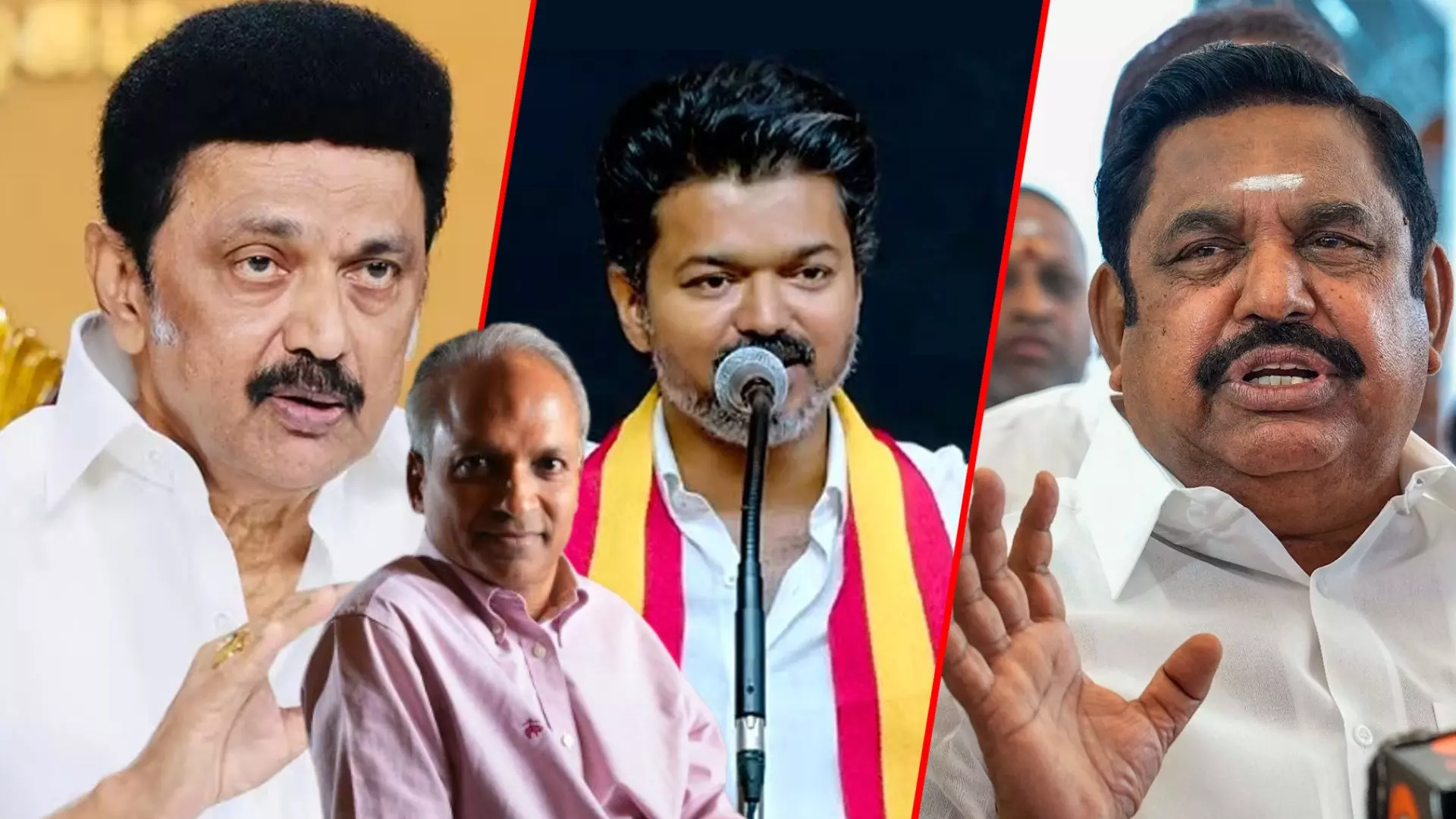
Vijay was grossly underestimated since he hadn't made much noise: R Kannan
His move to announce candidates for all 234 seats has surprised all, and his entry could disrupt traditional Dravidian vote banks, says the political analyst

The 2026 Tamil Nadu Assembly election is shaping up to be a three-cornered contest, with TVK leader Vijay emerging as a serious third force. However, winning power on his own would be “physically impossible,” says political analyst R Kannan in an exclusive interview with The Federal.
Edited excerpts:
How do you view Vijay announcing candidates in all 234 constituencies?
I think those who believed he would not be able to field candidates in all 234 constituencies have been proven wrong. He was grossly underestimated because he had not made much noise and had stayed away from the public space. His party does not speak often, and there are no second-rung leaders engaging regularly with the media. Because of this, many analysts assumed he would struggle to find suitable candidates.
However, people who have seen the list say that at least half the candidates are strong and stand a good chance in the contest. We will ultimately know the outcome on May 4.
Why do you think Vijay is contesting from two constituencies?
This is a first in Tamil Nadu. No leader has contested from two constituencies here before. The maximum allowed is two, and historically, this has been done by leaders to signal wider appeal.
The idea is to project themselves as larger-than-life figures with state-wide or even national appeal, showing that they can transcend regional boundaries. Vijay wants voters to believe that. His advisors would likely have conducted internal surveys and chosen what they consider safe seats.
Which voter groups are likely to support Vijay?
A majority of his support could come from younger voters, especially those below 30 and even up to 45 years of age. Many of them may be looking for change after decades of dominance by the two Dravidian majors.
Every fifth voter is under 30, and based on rally turnout, many of them could gravitate towards Vijay. Some women voters may also support him. A significant section of Christian minority voters may also lean towards him, as this is the first time a leader of his stature has emerged from their community.
Additionally, a large section of undecided or floating voters—possibly a third of the electorate—could consider him as an alternative.
Is DMK bringing in younger candidates due to pressure?
That is one way to look at it. Another explanation is that the party is replacing underperforming MLAs who may not be re-electable. It could also be a strategy to strengthen the position of Udhayanidhi Stalin, with younger candidates aligning more closely with his leadership.
The presence of Vijay may also have influenced this shift. It is likely a combination of multiple factors, including internal surveys and strategic assessments.
What does giving tickets to young candidates indicate?
The DMK has historically relied on young leaders and women candidates. This is part of its political tradition. Giving opportunities to young candidates, especially women, reflects that legacy.
At the same time, Vijay’s entry into politics may have altered some of these calculations.
How do you see AIADMK’s seat-sharing strategy?
Seat-sharing is always complex. While things appear smoother compared to the DMK alliance, there are still concerns among partners. Typically, major parties try to retain strong constituencies and allocate relatively weaker seats to allies.
This is a common practice. Every ally tries to limit the number of weak seats assigned to them, while major parties attempt to minimise their own risks.
Is this election a four-cornered or three-cornered contest?
I would consider this a three-cornered contest rather than four. We clearly have two major alliances — DMK and AIADMK. Based on crowd turnout and public discourse, Vijay appears to be the third major force.
While others may be in the fray, Vijay is likely to secure a significant vote share, possibly around 15%, making this a triangular contest.
Can Vijay come to power on his own?
To win power in a three-cornered contest, a party typically needs 35-40% of the vote. That level of support is usually achieved only by established alliances.
For Vijay to achieve this single-handedly would be extremely difficult — almost physically impossible. Such a feat has rarely happened in Indian politics.
This is a bold attempt. Whether it is strategically sound or flawed will become clear on May 4.
The content above has been transcribed from video using a fine-tuned AI model. To ensure accuracy, quality, and editorial integrity, we employ a Human-In-The-Loop (HITL) process. While AI assists in creating the initial draft, our experienced editorial team carefully reviews, edits, and refines the content before publication. At The Federal, we combine the efficiency of AI with the expertise of human editors to deliver reliable and insightful journalism.