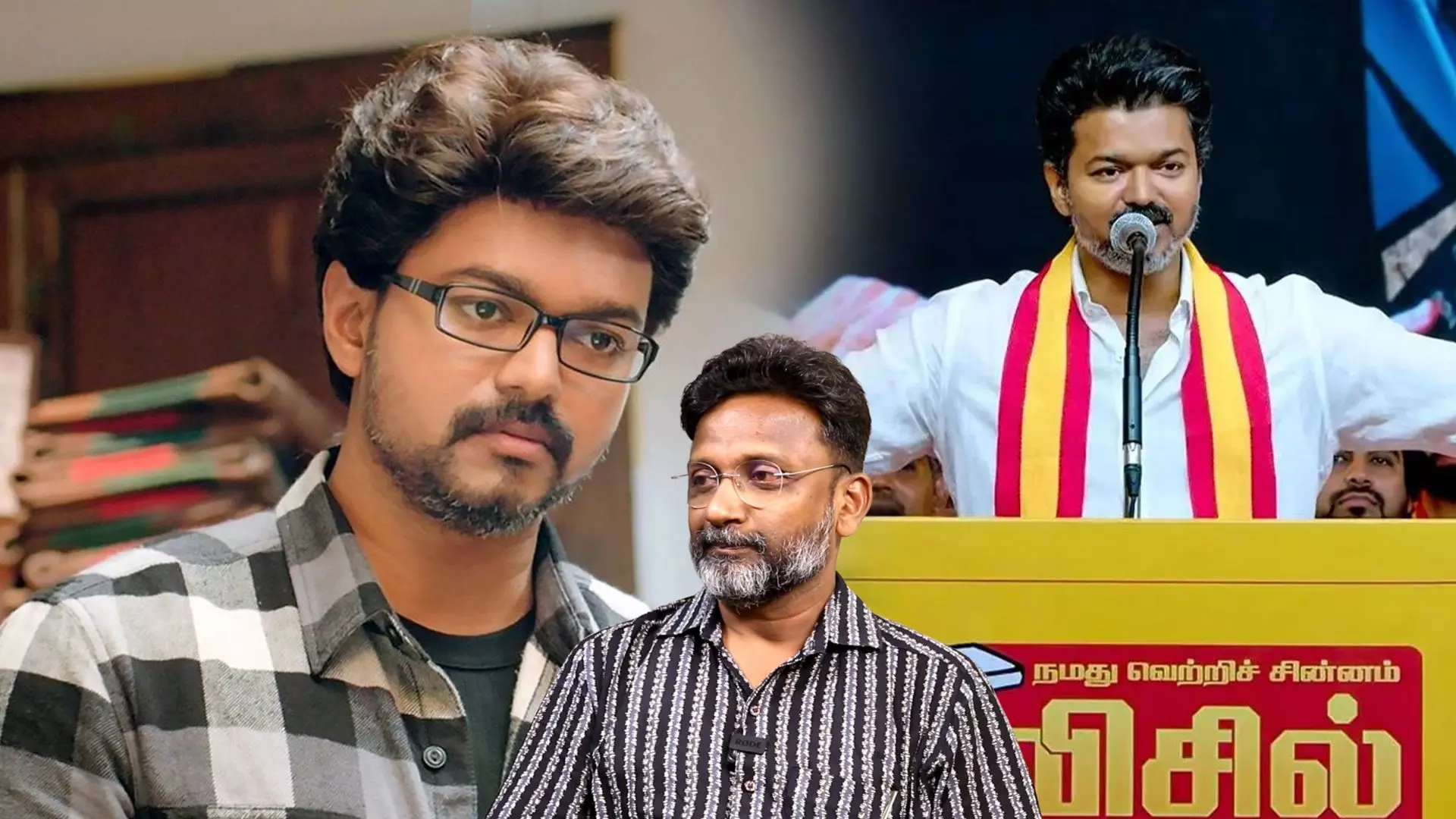
Vijay’s identity politics won’t click in TN: Political analyst A Muthukrishnan
Political critic A Muthukrishnan says TVK’s minority outreach and social media buzz may not convert into votes in Tamil Nadu’s highly aware electorate

“Banking on communal identity in the very first election is not going to work in Tamil Nadu,” says political critic A Muthukrishnan, sharply assessing actor Vijay’s political strategy. As Vijay’s entry with TVK reshapes the electoral narrative—especially with outreach to minorities, women, and Gen Z—questions remain about whether this approach can translate into votes. The Federal spoke to A Muthukrishnan, political critic and author, to decode Vijay’s political playbook and its potential impact.
Do you think Vijay is banking on his Christian identity in the 2026 Assembly elections?
He introduced himself as Joseph Vijay and gave a clear call to minority voters. From what I’ve observed over the last few days, this move has not gone down well. A couple of years ago, when H. Raja referred to Vijay using a religious identity, there was widespread backlash in Tamil Nadu. People were upset.
Now, when Vijay himself is foregrounding his religious identity, people feel he has an agenda. Tamil Nadu has moved beyond caste and religious identifiers in public life. Using such identity markers is no longer seen as a matter of pride—people often look down on it.
So, for a young leader entering politics to highlight religious identity for political mileage raises questions. People understand what he is trying to communicate through that move.
What are the prospects for TVK and Vijay as a full-time politician?
From the party’s inception, things have been unclear. There is a lot of chaos, noise, and uncertainty around TVK. Having closely observed politics for 30 years, I can say that usually leaders enter politics with a clear agenda and roadmap. That clarity is missing here.
Vijay is not behaving like a conventional politician. Everything appears highly professional and managed by a large team. He appears more like a “supreme star” figure who steps in at the final stage, while the rest is handled by others.
There is also a lot of noise on social media, but the boundaries and messaging are unclear. His second-rung leadership has not articulated a strong political voice rooted in Tamil Nadu’s realities, whether it is development, governance, or history.
Why do you think Vijay is contesting from two constituencies?
The strategy, including constituency selection, seems to reinforce the perception that he is banking on communal votes. If, in his very first election, he is relying heavily on such identity-based calculations, it is unlikely to work in Tamil Nadu.
This state has never elected leaders purely on communal lines. That approach does not resonate here.
Do you think minority voters, especially Christians, may relate more to him because of this identity projection?
People now clearly understand why he is using his Christian name and how constituencies are being chosen. It signals an attempt to consolidate communal votes.
But Tamil Nadu’s political history shows that such strategies don’t succeed. Voters here do not align purely along religious lines when it comes to elections.
If caste and community don’t determine voting patterns, why do parties still consider them while selecting candidates?
There is a perception that elections revolve around caste, but I don’t fully agree. At the ground level, caste may play a role in social or cultural contexts, but politics works differently.
People may have caste affiliations, but politically they align with parties and leaders. You cannot directly map caste groups to voting outcomes.
Take any community—there are leaders from that group across multiple parties. Even dominant communities are split across parties like AIADMK, DMK, BJP, Left, and others. The same applies to Dalits.
This idea that one caste will consolidate behind one party is largely a perception. It hasn’t worked consistently, especially after the 1990s.
There are surveys suggesting women, minorities, and Gen Z may support Vijay. What is your view?
Social media is playing a huge role in shaping perceptions this time. Every party has strong IT wings and digital strategies. It’s a level playing field where all parties are trying to influence voters through algorithms and targeted content.
But ultimately, elections in Tamil Nadu come down to something else. As we get closer to polling day, especially in the last few days, the manifesto becomes the central focus.
People here are politically aware. They debate, discuss, and critically evaluate promises. You cannot win with fake promises. The electorate in Tamil Nadu and Kerala is highly politicised—they question everything.
Historically, this culture of debate goes back to the Sangam era. Leaders like Periyar encouraged people to question and think independently. That tradition continues today.
So, no matter how strong the campaign or social media push is, voters will take time, process the information, and then decide. Emotional appeals or identity-based calls won’t translate into votes overnight.
The content above has been transcribed from video using a fine-tuned AI model. To ensure accuracy, quality, and editorial integrity, we employ a Human-In-The-Loop (HITL) process. While AI assists in creating the initial draft, our experienced editorial team carefully reviews, edits, and refines the content before publication. At The Federal, we combine the efficiency of AI with the expertise of human editors to deliver reliable and insightful journalism.