As Washington weaponises Section 301 tariffs against India and other trading partners, New Delhi appears increasingly reluctant to challenge American unilateralism
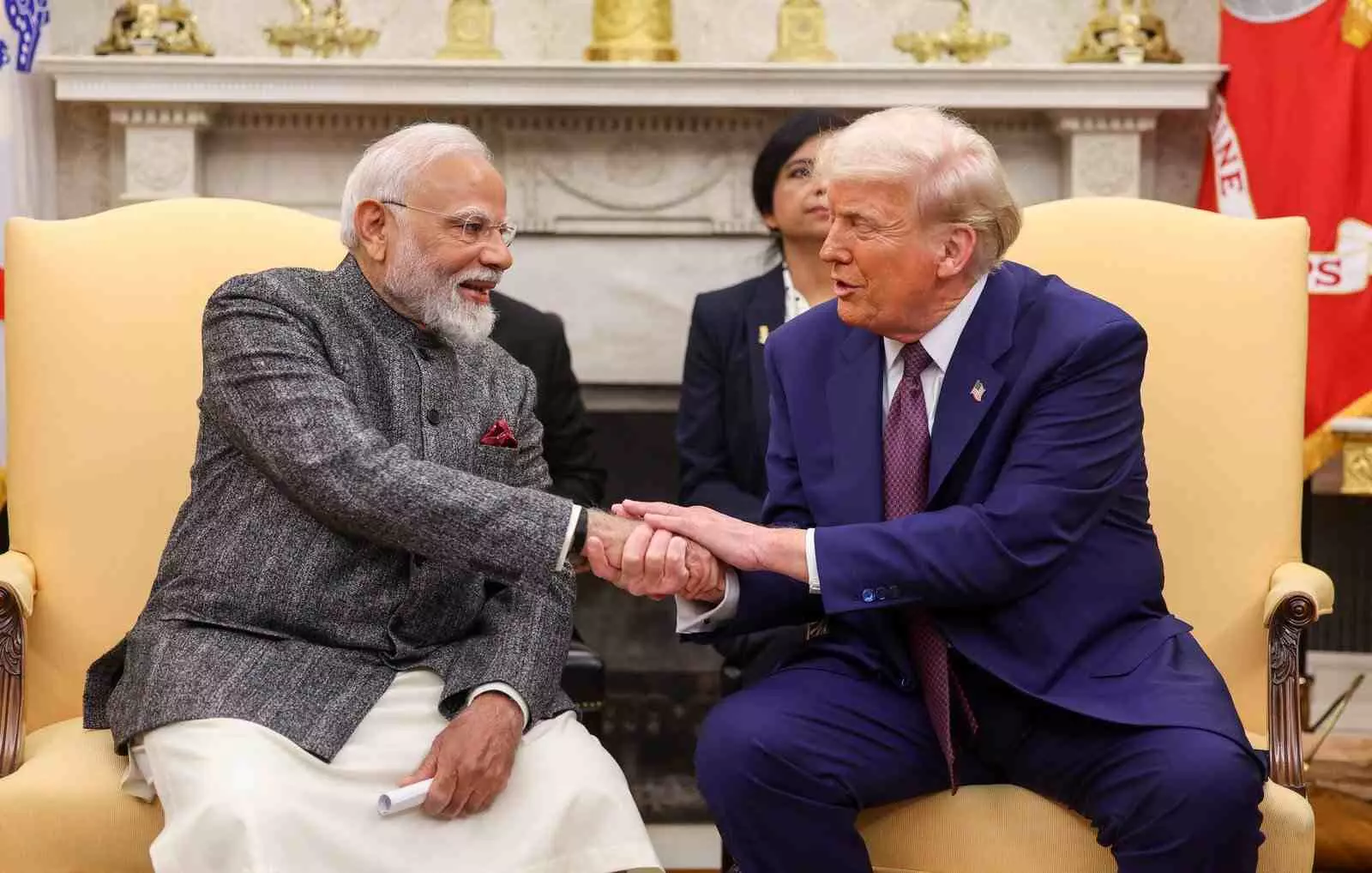
The Narendra Modi government must be eyeing the possibility of clinching the first tranche of the proposed MAGA + MIGA = MEGA trade deal next month, during the G20 leaders’ summit. The copyright for this equation — Make America Great Again plus Make India Great Again equals a MEGA trade deal — belongs to Prime Minister Modi, who announced during his visit to Washington in February 2025 that the two sides would strike a mega deal.
Since then, the two countries have held several rounds of trade negotiations, and the contours of a possible agreement are becoming somewhat clearer. However, the emerging picture raises serious questions about what India is prepared to concede to secure an agreement with an increasingly assertive Washington.
On Wednesday (November 25), US Trade Representative Ambassador Jamieson Greer announced Washington’s intention to impose a 25 per cent tariff on Indian goods, citing what he described as insidious subsidies that were driving excess capacity in various Indian sectors and harming American producers.
Also Read: Trump’s 17 pc tariff offer to India: Deal or pressure tactic?
Greer identified five reasons for what he called “India’s unreasonable acts, policies, and practices.” These include “(1) industrial plans to expand manufacturing; (2) inadequate labour protections; (3) financial repression policies; (4) sustained market access barriers; and (5) failure to address global excess capacity and production, including through imports and foreign direct investment from non-market economies.”
New Delhi appears to be considering offering substantial market access to highly subsidised American agricultural and fruit exporters, pharmaceutical giants, and industrial producers seeking zero-tariff access to India.
Greer also dangled a carrot before New Delhi. If the Modi government agreed to what could hardly be described as a fair and reciprocal deal with the Trump administration, the proposed tariff would be reduced to 17 per cent — an eight-percentage-point concession.
However, the one-percentage-point advantage that Indian exporters might secure over exporters from competing countries seeking access to the American market hardly tells the full story.
The reality is considerably more complex and obscures the potential losses India could incur by opening its enormous domestic market of 1.4 billion people, including close to 300 million belonging to the so-called affordable middle class.
New Delhi appears to be considering offering substantial market access to highly subsidised American agricultural and fruit exporters, pharmaceutical giants, and industrial producers seeking zero-tariff access to India. The central problem is the opacity surrounding the assurances given by New Delhi. The statements issued by the multi-mouthed Commerce Minister Piyush Goyal offer little clarity about the depth of the overall tariff and non-tariff commitments India may already have undertaken.
Little wonder, then, that New Delhi's immediate response to Washington's latest move appeared somewhat namby-pamby. India maintained that it did not have structural excess capacity in any sector, while insisting that trade-related concerns should be addressed within the framework of ongoing trade negotiations.
This response raises a larger question: why is India reluctant to challenge Washington's unilateral trade actions when other countries are standing up to them? Such a submissive approach risks completely eroding India's proclaimed Vishwa Guru status.
Consider what India said when Section 301 tariffs were first challenged in 1999. The then Indian trade envoy, Ambassador S Narayan, denounced the Section 301-310 tariffs, stating: “It is clear that Section 301-310 are a case of United States reneging on its commitments undertaken by in the Uruguay Round” that established the WTO in 1995.
That was India's position when it was prepared to defend the multilateral trading system against unilateral American action. The contrast with New Delhi's present response is striking.
Brazil refuses to bend
On Tuesday, a day before the USTR announced separate Section 301 tariff actions against Brazil, outside the 14 countries now being targeted, Brasilia called for the establishment of a dispute settlement panel at the WTO to rule against the Section 301 tariffs. The United States blocked the establishment of the panel, although the request is expected to be automatically approved at next month's meeting.
Unlike the Modi government, Brazilian President Luiz Inácio Lula da Silva's administration has reportedly made clear that it will not bend to the latest American tariff “threat”.
Also Read: US proposes 25 pc tariff on India over excess-capacity claim; New Delhi rejects rationale
“Brazil will not yield to this type of threat”, the Brazilian government said, adding that the “unilateral decision constitutes an unacceptable action within the framework of the ongoing bilateral negotiations.”
Brazil's response demonstrates that it is possible to challenge Washington's coercive trade tactics without abandoning negotiations. New Delhi, by contrast, appears more concerned about preserving the prospect of a deal than defending its trading rights.
China challenges Washington's narrative
China, which is facing one of the highest tariff burdens, with an additional 20 per cent tariff over and above existing levies of 20 per cent (12.5 per cent due to alleged forced labour and 10% due to exports of fentanyl), accused Washington of “political manipulation”.
Beijing has consistently maintained, during the ongoing WTO reform discussions, that the purported problem of “industrial overcapacity” does not really exist in the manner portrayed by Washington.
Also Read: India-US trade deal: Piyush Goyal says first tranche finalised
More importantly, China won a trade dispute against the United States at the WTO in 2020, when a dispute settlement panel condemned the Section 301 tariffs imposed by Washington on Chinese exports. However, the United States chose to “void” the panel ruling by appealing to a dysfunctional Appellate Body (AB).
The irony is unmistakable. It was the United States that rendered the highest adjudicatory body for resolving global trade disputes dysfunctional by repeatedly blocking, since December 2019, the selection process to fill all seven vacancies in the Appellate Body.
Washington is now using Section 301 as an instrument to punish trading partners, even as it continues to undermine the multilateral dispute settlement system that is supposed to resolve precisely such trade conflicts.
The boomerang of excess-capacity politics
The latest raft of Section 301 investigations appears to be designed, among other things, to penalise countries for conducting trade with Washington's favoured category of “non-market economies” — a euphemism for China.
At a time when China has been redirecting its trade towards major developing countries, contributing to what is increasingly being described as South-South trade, the United States is threatening countries in Southeast Asia and elsewhere with consequences for deepening their commercial relations with Beijing.
There is an important lesson here for countries participating in global trade negotiations: they must be mindful of what they demand, particularly when they seek to legitimise unilateral trade measures outside the WTO.
The latest Section 301 actions must also be viewed against the backdrop of the Trump administration's successive attempts to impose tariffs through different legal instruments.
The European Union and Japan, alongside the United States, had earlier established a trilateral initiative to counter what they described as China's excess capacity and subsidies to state-owned enterprises outside the WTO framework.
Also Read: It’s time for reign of US dollar to end, but is de-dollarisation possible?
On Wednesday, however, the EU and Japan faced what appeared to be the proverbial grapes of wrath when they themselves came under the Section 301 dragnet on account of alleged excess capacity.
The episode exposes the dangers of legitimising unilateral trade investigations and punitive measures. Countries that help construct such instruments against others may eventually find themselves on the receiving end.
Seeking to justify Washington's latest measures, Ambassador Greer stated: “For decades, many of our trading partners have adopted industrial strategies built on targeting manufacturing, wage and labour suppression, financial and other support, non-market economy inputs, and other market-distorting practices that tilt the trade balance in their favour while eroding America’s manufacturing base.”
This sweeping argument effectively gives Washington the authority to judge the industrial policies, subsidies, labour practices and trade relationships of its trading partners according to its own standards. It also risks turning legitimate differences over industrial policy into grounds for unilateral punishment.
From IEEPA to Section 301: the weaponisation of tariffs
The latest Section 301 actions must also be viewed against the backdrop of the Trump administration's successive attempts to impose tariffs through different legal instruments.
In February 2025, the Trump administration imposed punitive tariffs on several countries under the International Emergency Economic Powers Act (IEEPA), citing persistent trade deficits that had apparently contributed to the deindustrialisation of the US economy.
However, the US Supreme Court struck down the IEEPA tariffs, ruling that these tariffs were not covered by the Act's provisions.
Also Read: Trump’s rout holds critical economic lessons for other governments
Subsequently, on February 24 this year, the United States invoked Section 122 of the Trade Act of 1974 to address its balance-of-payments deficit. Those tariffs expired after 150 days, on 24 July.
Since August, Washington has resorted to Section 301 tariffs ranging from 10 per cent to 12.5 per cent on all countries. The latest action substantially expands their scope, turning the measure into an increasingly flexible instrument for penalising trading partners whenever the administration considers their policies objectionable.
A trade agreement cannot be judged merely by the tariff concessions Washington offers Indian exporters. It must also be assessed against the reciprocal concessions India is expected to make, the market access it surrenders, and the policy space it could lose.
The pattern is becoming increasingly apparent. When one legal instrument is struck down or expires, Washington reaches for another to sustain its unilateral tariff agenda.
The price of a MEGA deal
For India, the immediate issue is not simply whether the proposed American tariff will be reduced from 25 per cent to 17 per cent. It is whether New Delhi is prepared to accept sweeping tariff and non-tariff concessions in return for a marginal improvement in its competitive position in the American market.
The Damocles sword of the latest Section 301 tariffs hanging over several countries represents yet another attempt by Washington to regularise its inconclusive fair and reciprocal trade agreements with Uncle Sam. Countries that fail to accommodate the Trump administration's demands risk continuing to face the unilateral wrath of an embattled hegemon.
Also Read: Is ‘politician’ Trump’s biggest enemy ‘businessman’ Trump?
If the Modi government believes that securing the first tranche of a MAGA + MIGA = MEGA deal at the G20 summit would constitute a diplomatic triumph, it needs to examine the price India may ultimately have to pay.
A trade agreement cannot be judged merely by the tariff concessions Washington offers Indian exporters. It must also be assessed against the reciprocal concessions India is expected to make, the market access it surrenders, and the policy space it could lose.
The larger danger is that, in its eagerness to strike a deal with Washington, India may abandon the very principles of multilateralism, reciprocity and sovereign policy-making that it once defended so vigorously at the WTO.
A MEGA deal that makes America greater at India's expense would be anything but a great achievement for India.
(The Federal seeks to present views and opinions from all sides of the spectrum. The information, ideas, or opinions in the articles are of the author and do not necessarily reflect the views of The Federal.)