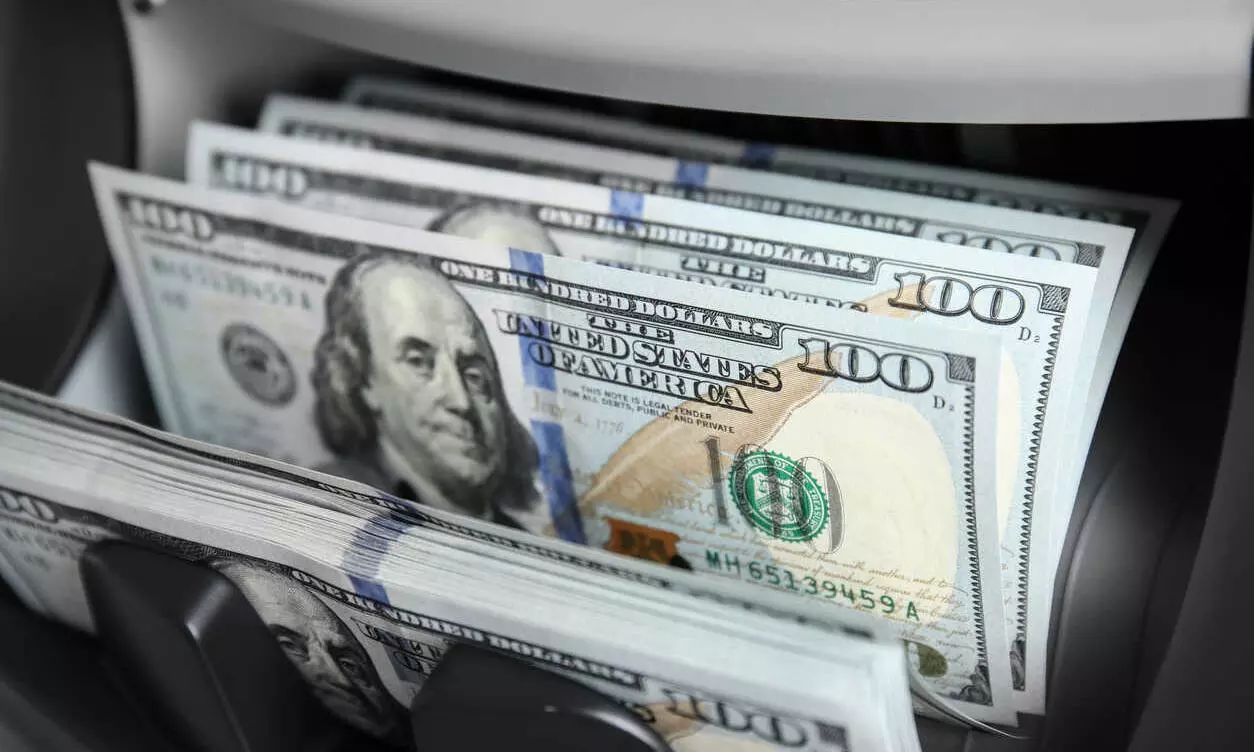
The push to reduce dollar dependence is growing, but no rival currency yet matches the US dollar's depth, liquidity and global trust
Remember the old Hindi movies, Khuda Gawah, Andha Kanoon, and the like? A common streak running in these movies is that the villain seeks ransom to be paid in US dollars (USD). Barry Eichengreen in his brilliant book Exorbitant Privilege goes on to highlight this phenomenon and the many privileges which the USD holds in the world-relevant even today.
US Dollar holds sway
Thus, in the calendar year 2025, the world trade in goods and services, on a balance of payments basis, increased to USD 34.89 trillion. As much as 54-58 per cent of all this trade was done in USD.
Almost 88 per cent of the foreign transactions are done in USD—and far exceed the US global share of GDP and trade. Even trade in goods between two independent countries, with goods not touching the shores of the United States, is invoiced in USD.
Central Banks across the globe hold their foreign exchange reserves primarily in USD—from anything to 56-60 per cent. International prices of crude oil, as well as all major metals and minerals, are quoted in USD. It is estimated by the US Federal Reserve Board that over USD 1 trillion of dollar banknotes, or physical US currency, is held outside the US.
Exorbitant privilege
What is it about the USD that makes it so ubiquitous in regard to trade, to its being used to quote prices of resources, to its being held in such large quantities outside the country of its printing, and to various countries holding up to 31 per cent of its treasury bonds? What is it that makes it a store of value? Its importance made sense in the post-World War II era, but now it is a shadow of what it was.
Also read: Why Subhash Garg believes India’s dollar GDP growth is 'among the lowest’
The US is the source of less than 18 per cent of foreign direct investment to India. The US has a national debt of about USD 40 trillion, which is growing, with the government periodically nearing a shutdown. Kalshi, the US-based prediction market exchange, is taking odds on a government shutdown this year. Yet the dollar enjoys international acceptability. It is this that Valery Giscard d’Estaing, when he was France’s finance minister, referred to as the US’s ‘exorbitant privilege’.
Paradox of the dollar
Professor Eswar S Prasad of Cornell University has spoken about the paradox of the dollar—despite massive US debt and political dysfunction, the dollar’s status as a haven continues.
As Eichengreen has pointed out, the dollar may have its problems, but so do all possible rivals. To paraphrase him, the euro is a currency without a state, while China’s yuan/renminbi is a currency with too much state.
The International Monetary Fund (IMF)‘s Special Drawing Rights (SDR), an international reserve asset, on the other hand, is not a currency. The US is still the largest economy with the largest financial markets.
The US is no longer the dependable, trustworthy ally and is losing friends and influence.
But things are changing. The US is no longer the dependable, trustworthy ally and is losing friends and influence. Even Canada, historically one of its closest trading partners, has faced the brunt of US ire.
Canadian Prime Minister Mark Carney, while speaking at the World Economic Forum in Davos earlier this year, famously described the present era as a ‘rupture’, and called on the middle powers to join hands and stop competing with each other. ‘If we’re not at the table, we’re on the menu,’ he cautioned.
Is de-dollarisation possible?
But the larger question is that, given the erratic conduct of the US in recent times, be it in trade or in foreign policy, is de-dollarisation, or lesser dependence on the USD, lesser use of the USD in global trade and financial transactions, while necessary, possible?
Also read: Why BRICS must build trade, brick by brick, and not an anti-US bloc
Lesser dependence on the USD will be good for the world economy. We undoubtedly are living in a globalised world, but the fortunes of the globe need not be tied to the economy of any one country. The US is wary of losing its ‘exorbitant privilege’ and resorts to threats, which, given its present stature, look increasingly hollow.
De-dollarisation can happen not just with a decrease in confidence in the US but, more importantly, if there are credible alternatives that have the same universal acceptance. But the million-dollar question is, are there any such alternative currencies?
Can BRICS offer an alternative?
The original grouping of BRICS countries was a more cohesive and powerful lobby. Its expansion to 11 countries with 10 partner countries has made it a very disparate group, but perhaps has given it more bandwidth.
BRICS countries account for nearly 50 per cent of the world’s population, 40 per cent of global GDP, and approximately 25-26 per cent of global trade, and can build on local currency settlement (rupee-rouble, real-yuan) mechanisms, which is happening in inter-BRICS trade. They can cut exposure to the US dollar and take the lead. But it will be crucial that they first build trust with each other; plus, the fact remains that there are multiple conflicting interests at play here.
While a universally acceptable alternative primary currency might not happen easily, alternatives to the dollar can happen. What can be done is to fast-forward the process of lesser dependence on the dollar and SWIFT system.
Also read: Rupee outlook: SBI Research calls for rate hikes, tighter overseas outflow checks
Nobody apart from China, both within BRICS and outside of it, has the necessary economic strength to take on the US. China is the manufacturing factory of the world and is by far the largest exporter, with a share of 14-15 per cent of global trade. China’s sheer size and heft make it a natural choice to lead the drive against lesser dependence on the USD; unfortunately, its hegemonic tendencies have made nations wary. So, it has its work cut out for it—to become a trustworthy ally. Besides, the threat of sanctions has meant that Russia’s role in devising an alternative is limited.
Possible alternatives
While a universally acceptable alternative primary currency might not happen easily (in any case, it should not be reduced to dollar ‘weaponisation’), alternatives to the dollar can happen. What can be done is to fast-forward the process of lesser dependence on the dollar and SWIFT system (SWIFT is Belgium-based, but it functions under enormous US influence) in settlements—both have commenced and should be expanded further.
BRICS Pay is one such concept designed to move to an alternative system of settling payments where national payment systems are linked directly, thus moving away from SWIFT. Similarly, China has developed CIPS (Cross-Border Interbank Payment System). Central Banks across the globe, and not just those of BRICS countries, tired of the vagaries of the US, are moving towards gold reserves as a non-USD store of value.
Also read: Why RBI is considering polymer banknotes and how they differ from paper currency
If history is taken into account, the USD at some point in time will face a challenge to its status as an international currency, just like the British pound sterling and the Dutch Florin, once dominant currencies, faced at various points in history. Nobel Prize-winning economists Daron Acemoglu and James A Robinson’s thesis about man-made political and economic institutions determining a country’s fate comes to mind.
What the recent developments have shown is that countries across the globe are realising the need to move towards less dependence on the USD. The need is more so now, especially when the country is being led by someone who is in his final two years of presidency and likely to become more mercurial. The speed at which this happens will ultimately depend on the check the new Congress can impose on US policy makers.
(The Federal seeks to present views and opinions from all sides of the spectrum. The information, ideas or opinions in the articles are of the author and do not necessarily reflect the views of The Federal)