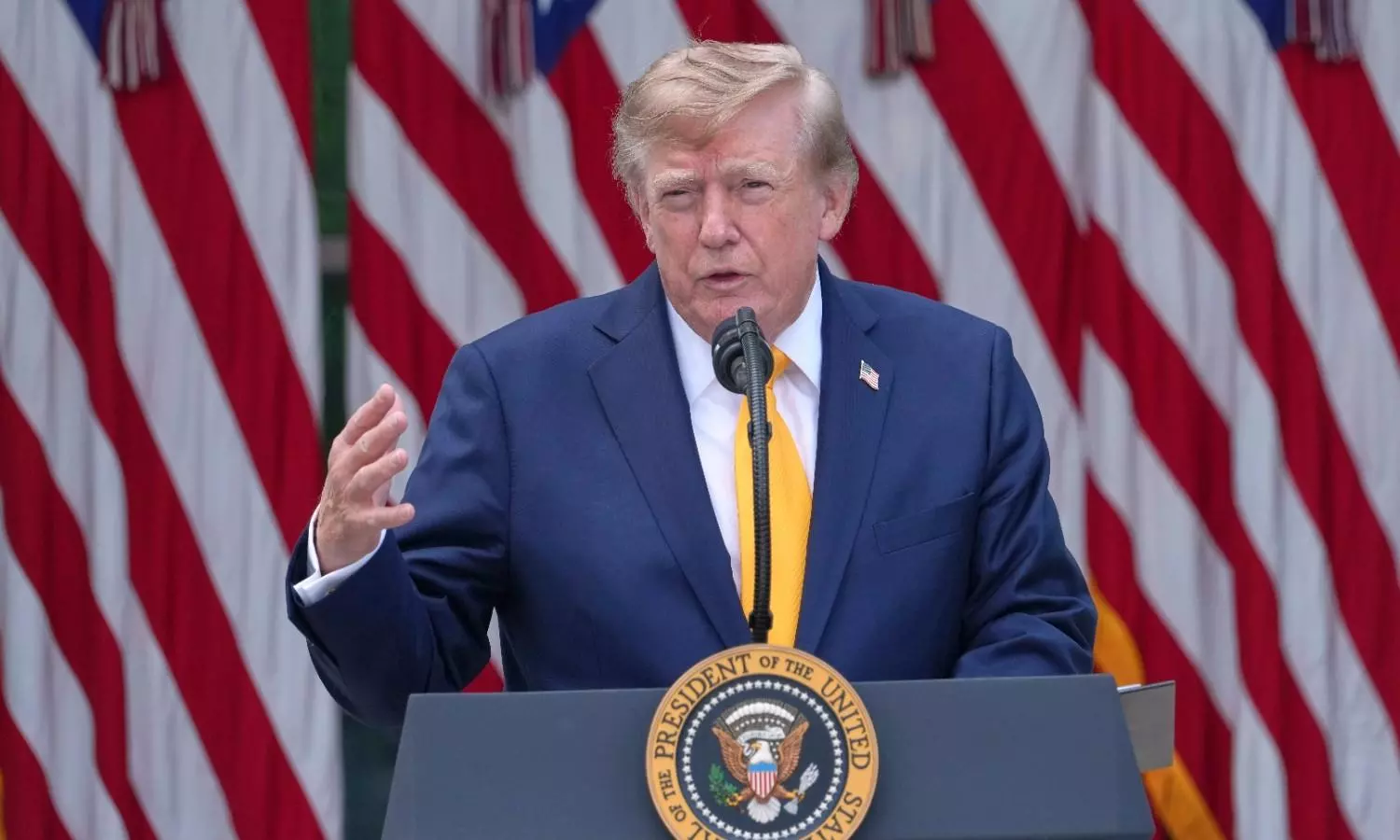
The affordability crisis, which is affecting households from France to India, can no longer be ignored or politically manipulated by those in power
The political landscape in Washington has undergone a dramatic transformation. The blue tsunami that swept through the United States at the ballot box has suddenly re-energised American politics, bringing a seemingly out-of-control President Donald Trump to his heels.
The Democratic Party’s sweeping victory in the November 3 midterm elections, securing control of both the House of Representatives and the Senate, has delivered an unmistakable message: Trump’s political authority is no longer beyond challenge.
Yet the conditions for this Democratic wave had been building slowly within the American body politic over the past two years. A country with a 250-year-old constitutional tradition of checks and balances appeared increasingly fragmented under Trump's presidency.
Trump’s policies fuel growing backlash
Beginning with the launch of the Department of Government Efficiency (DOGE) initiative in January 2025, under the leadership of his biggest political donor, Elon Musk, the administration embarked on a series of controversial measures. These included unilateral reciprocal tariffs imposed on trading partners, a war against Iran, costly economic giveaways through tax cuts benefiting billionaire financiers, and sharp reductions in spending on health, education and social programmes.
Also read | Blue wave, red flags: How Iran War, rising prices cost Trump the midterms
At the same time, the administration intensified coercive measures against immigrants, including those who were legally residing in the country. Taken together, these policies appeared to be pushing the United States towards an increasingly turbulent political and economic future.
But it was the war launched jointly by Trump and Israeli Prime Minister Benjamin Netanyahu against Iran on February 28, amid the continuing devastation and genocide of Palestinians in Gaza that appears to have decisively accelerated the political backlash, both within the United States and internationally.
As analysts had warned, the war unleashed tectonic shocks across the global economy, fuelling inflationary pressures and worsening the cost-of-living crisis in the United States. The disruption and effective closure of the strategically vital Strait of Hormuz, through which a substantial proportion of global energy supplies passes, triggered cascading economic consequences across countries and markets. Rising fuel prices, higher transportation costs and inflationary pressures intensified the affordability crisis confronting ordinary Americans.
This was, above all, an election shaped by the politics of affordability.
Trump had promised to end America’s “forever wars” and reduce the burden of living costs on ordinary households. Instead, his decision to join Israel in the war against Iran produced precisely the opposite consequences. Vice-President JD Vance attributed the Republican losses in the House and Senate to the Iran war. Trump himself, albeit reluctantly, acknowledged the political consequences of the conflict while remaining defiant and insisting that he had no regrets.
A historic repudiation of Trump’s presidency
It is not unusual for incumbent presidents to suffer setbacks in midterm elections. George W Bush’s Republican Party suffered substantial losses in the 2006 midterms amid mounting opposition to the Iraq war. Barack Obama, too, experienced what he famously described as a “shellacking” in 2010.
But the scale and political geography of the latest Democratic victory suggest something more consequential. The Democrats’ sweeping gains, including in traditionally Republican strongholds such as Texas and Kansas, represent a particularly damaging repudiation of Trump’s political standing. The results also recall the Democratic gains following Richard Nixon’s downfall in 1974, when public anger over Watergate reshaped the political landscape.
The Democrats’ sweeping gains, including in traditionally Republican strongholds such as Texas and Kansas, represent a particularly damaging repudiation of Trump’s political standing.
Billions of dollars poured into Republican campaigns by wealthy donors close to Trump, including Musk, could not reverse the electoral tide, as the new Democrat-elect senator from Texas declared on early Wednesday. The enormous financial resources deployed to defeat Democratic candidates proved insufficient against the mounting public discontent.
The message from American voters was unmistakable: money, political intimidation and presidential power cannot indefinitely insulate an administration from accountability at the ballot box.
Economic backlash against Trump’s tariffs
The election also carries important lessons for governments across the world. The affordability crisis, which is affecting households from France to India, can no longer be ignored or politically manipulated by those in power.
Trump’s unilateral reciprocal tariffs, imposed on America’s trading partners, became a major source of economic uncertainty. Although the US Supreme Court struck down the administration's use of the International Emergency Economic Powers Act (IEEPA) to impose these tariffs in February 2026, the economic and political damage had already been done. The disruption to supply chains, increased business costs and uncertainty over future trade arrangements had taken their toll.
The Democratic victory could now open the way for a fundamental reassessment of American trade policy.
Key Democrats have already signalled their intention to reclaim congressional authority over trade policy. Senator Ron Wyden, a leading contender to chair the Senate Finance Committee, has said he intends to “reassert congressional authority over our country’s trade policy to bring down costs, end Trump’s disastrous and corrupt tariffs, re-establish critical trade partnerships and hold trade cheats accountable.”
Democrats face hurdles in reversing tariffs
His likely counterpart on the House Ways and Means Committee, the current ranking Democrat Richard Neal, has also indicated that addressing the higher prices caused by tariffs will be a priority.
Democratic National Committee chair Ken Martin has echoed calls for the repeal of Trump’s tariffs. However, dismantling the administration’s entire tariff architecture will not be straightforward. The Supreme Court’s ruling has already invalidated the IEEPA-based measures, while other tariffs imposed under different statutory authorities remain a separate matter.
Moreover, although Democrats have secured control of both chambers, overriding a presidential veto would require a two-thirds majority in the Senate, or 67 votes. That threshold is unlikely to be within their reach.
Also read | What Trump’s midterm setback means for India and world | Meera Shankar interview
Nevertheless, the new Democratic majorities can use congressional oversight, legislation and investigations to challenge Trump’s trade policies and bring the issue of affordability back to the centre of the political debate.
The Republican-controlled Congress will remain in place until the new Congress takes office in January 2027. How it uses its remaining legislative time, and whether it attempts to advance any of Trump's outstanding priorities, remains to be seen.
India must reassess its unfinished trade deal
The electoral outcome also has potentially significant implications for India’s ongoing trade negotiations with the United States.
The Modi government must now carefully assess whether it should rush to conclude the trade agreement that has been under negotiation with Washington. With Trump’s political authority weakened and Democrats preparing to exercise congressional oversight over trade policy, New Delhi has an opportunity to reconsider some of the costly concessions it has reportedly been prepared to make.
The United States remains an important economic and strategic partner for India. But a trade agreement should not become an instrument through which New Delhi makes disproportionate concessions under pressure from Washington.
India could use the changing political circumstances to slow down the conclusion of the agreement and reassess commitments involving tariff reductions across a range of industrial and agricultural commodities.
More importantly, New Delhi should insist on a simpler and less costly regulatory framework for the export of Indian services, particularly in the information technology sector. It must also seek substantially better terms for Indian students seeking admission to expensive American universities.
The United States remains an important economic and strategic partner for India. But a trade agreement should not become an instrument through which New Delhi makes disproportionate concessions under pressure from Washington. India’s negotiating priorities must be guided by its domestic economic interests, the livelihoods of its farmers and the future of its services sector.
The Democratic victory provides New Delhi with an opportunity to reassess the balance of the negotiations rather than rush into an agreement shaped by Trump's unilateral demands.
The danger of an angry lame-duck president
There is, however, another potentially ominous consequence of the election for the United States and the rest of the world.
What happens if a politically weakened, lame-duck Trump turns into an angry duck? A President who feels increasingly cornered by domestic political developments could use the considerable powers of the executive branch, particularly over foreign policy, to vent his frustrations elsewhere.
The danger is that an embittered and politically weakened administration could become even more unpredictable. As has been suggested, “a rancorous and unrestrained Trump could do immense damage, by relaunching his Iran war or embarking on perilous new escapades elsewhere.”
This is not an inconsequential concern. The war against Iran has already demonstrated how decisions taken in Washington can destabilise entire regions, disrupt global energy supplies and impose enormous economic costs on countries far removed from the conflict.
Will electoral backlash restore accountability?
A Democratic-controlled Congress can exercise greater scrutiny, investigate the administration and block legislation. But it cannot automatically take away the President’s considerable executive authority over foreign policy and military operations.
Also read | Midterms make Trump admin ‘lame duck’: How it impacts India-US trade, immigration
The international community therefore has reason to remain vigilant.
The November 2026 election has demonstrated that American voters are prepared to challenge a presidency that they believe has become increasingly detached from their economic concerns and constitutional expectations. The Democratic victory is a powerful reminder that even an administration backed by enormous financial resources and an assertive political machinery remains answerable to voters.
But the larger question is whether this electoral repudiation will translate into a meaningful restoration of democratic accountability, economic stability and a more predictable American foreign and trade policy.
For the United States, and indeed for the rest of the world, the answer could determine whether the next two years bring a restoration of institutional checks and balances or an even more dangerous period of presidential unpredictability.
(The Federal seeks to present views and opinions from all sides of the spectrum. The information, ideas or opinions in the articles are of the author and do not necessarily reflect the views of The Federal.)