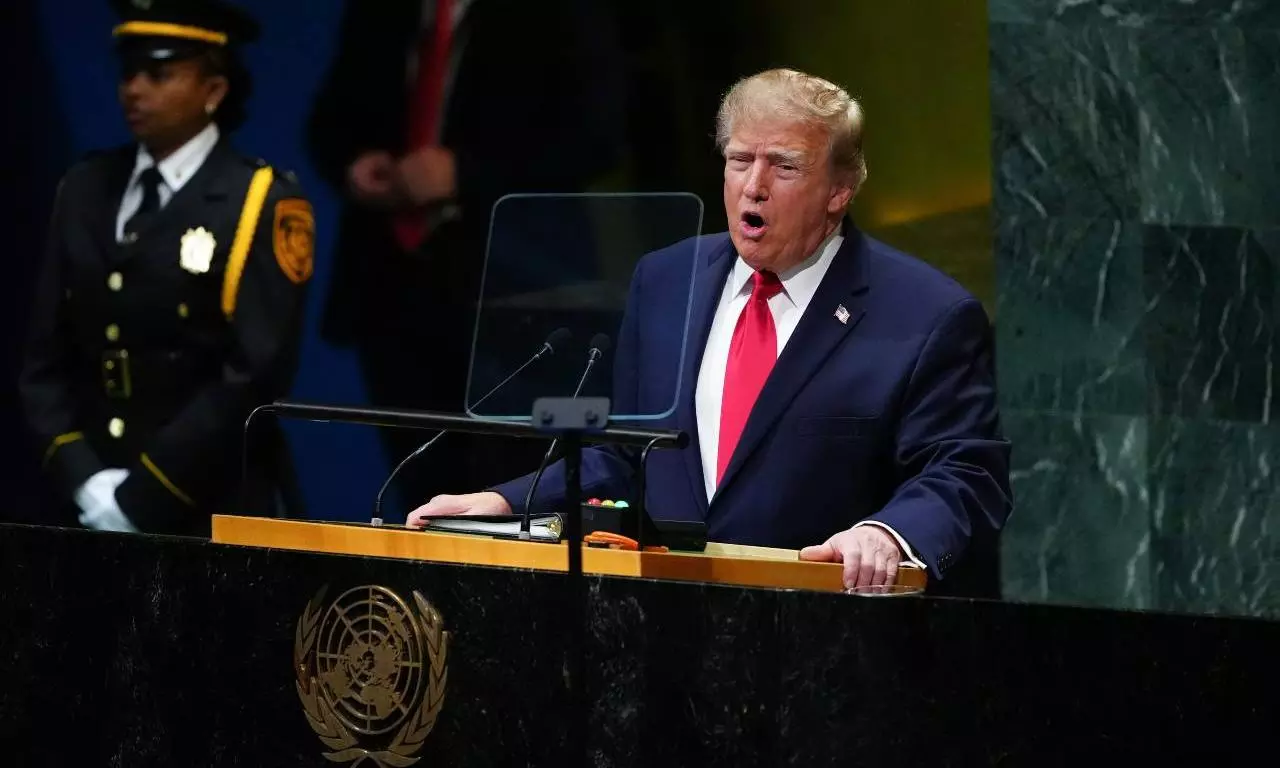
There’s merit in demand to relocate UN headquarters as US administrations have chosen to treat the world body with disdain
Has the United Nations, over time, turned into an extended arm of the United States government? Besides the power of veto, the US continues to dictate the organisational work of the global body, eight decades after it started – such as who can or cannot attend the UN General Assembly (UNGA) sessions.
US denial of visas
For the second year running, the US denied visas to the delegation headed by Palestinian Authority (PA) President Mahmoud Abbas to attend the high-level debate at the ongoing 81st session of the UNGA in New York. A delegation from Sudan and part of the Ugandan delegation were denied visas as well.
These denials clash directly with the founding charter of the UN, which explicitly bars the US from denying visas to official delegations from any nation, for whatever reason. Palestine is a “Permanent Observer State” at the UN, a status that allows it to participate in all of the world body’s proceedings, except for voting.
Also read/watch: Has the United Nations failed? Experts call for urgent reform
This is not the first time that the US has denied visas to delegations that have not acted in sync with the thinking and mindset of its administration. And there is no guarantee it won’t happen again. Some 152 nations, in response to the denial of visas to the Palestinian delegation, criticised the US decision and asked for it to reverse it, but in vain. Mahmoud Abbas eventually addressed the UNGA via video.
Demands to shift UN headquarters
Last year, Colombian President Gustavo Petro’s visa was revoked for asking an armed force to “free Palestine”, at a gathering outside the UN headquarters in New York. In response, Petro said the US decision flouted all the norms of immunity on which is based the functioning of the UN and its General Assembly. “The United Nations headquarters cannot continue to be in New York,” he said.
The point is, who gives the US the lever to manipulate and control the manner in which the UN holds its crucial General Assembly meetings. The UN, when formed in 1945, as the Second World War was ending, was organically headquartered in New York given that the US emerged as the key nation that led the Allies to victory. But that was in the past.
Also read: India may look bigger on world maps after UN resolution; here’s why
Since then, the times have changed considerably, with the US oftentimes unwilling to work with the global institution and the values it represents. The UN’s location in New York has therefore turned out to be contentious, with several nations asking for it to be relocated. Among the first to make this demand was the former president of Venezuela, Hugo Chavez, in 2005.
Over time, various other countries and international organisations too have demanded that the headquarters be shifted out of New York to a neutral location, like Geneva.
Is relocation viable?
Last September, a UN official, Stephane Dujarric, was quoted as saying that a proposal to relocate the headquarters was being evaluated. But nothing more has been heard about it. His comments, however, showed that the idea to relocate the UN’s base is not outlandish, and in fact, doable.
There’s a precedence. In 1988, in a one-off move, the General Assembly meeting was held in Geneva in protest against the US denial of visa to a Palestinian delegation led by the iconic Yasser Arafat.
Of the six main organs of the UN, five are located in New York – the UN Secretariat, the Security Council, the General Assembly, the UN Economic and Social Council and the Trusteeship Council. The sixth, the International Court of Justice is located in the Netherlands at The Hague.
US’s wilful disdain for UN
There’s merit in the demand to relocate the headquarters as successive administrations in Washington have progressively chosen to treat the UN with disdain. The Trump administration has been among the most egregious of these, distancing itself from the many arms of the UN, criticising it for trying to act even-handedly in a world caught up in myriad conflicts and open wars.
Also read: Trump-Xi summit leaves India caught between two undesirable possibilities
Take the case of the Palestinian delegation. According to the reasons for denying it a visa, the Trump administration found fault with it for pursuing legal action against Israel in the International Criminal Court and International Court of Justice on charges of committing genocide in Gaza, and for supporting families of Palestinian political prisoners in Israeli jails.
There could have been a modicum of logic for New York to remain the headquarters of the global body if the US had remained true to the United Nations’ vision. But, far from it, the US has a controversial track record of wilfully ignoring the UN and the various forums under it.
High-profile violations
Among the more high-profile violations include the US’s invasion of Iraq without getting clearance from the UN Security Council, and more recently, initiating a war with Iran unilaterally without giving the UNSC an opportunity to consider it beforehand.
Over the decades, the US, using its veto power, has consistently protected Israel from facing any censure or punitive action from the Security Council for a slew of moves that violate international law. Israel’s recent genocidal assault on Gaza that killed over 70,000 people and the ongoing attack on Palestinian residents in the West Bank using settlers are other recent activities that the US has blocked from being brought up before the UNSC.
Also read: India warns Pakistan of ‘consequences’ over terrorism at UN, rejects Kashmir claims
Trump, in his second term, has withdrawn the US from at least 31 agencies working under the aegis of the UN on the grounds that “they act contrary to the interests of the US”. These include the high-profile UN Framework Convention on Climate Change, the International Renewable Energy Agency, the World Health Organisation (WHO), UNESCO, and the UN Human Rights Council.
Why US holds sway over UN
Clearly, Trump has drastically minimised the US’s involvement with the UN, making it all the more imperative for the global body to reconsider its relationship with the US, including the location of its headquarters. It’s easier said than done, though. The one factor that is probably making it difficult for nations to vote for a change is the volume of funding for the UN from Washington.
Two years ago, before Trump returned to power for a second term, the US’s contribution to the UN was $14 billion, the highest donation by any single country. Since Trump slashed the US’s involvement in the UN, the US owes around $5 billion to the global body. This includes $2 billion to the regular UN budget and the rest towards UN peacekeeping operations. Of this, his administration has reportedly paid up $725 million for the regular budget and $285 million for peacekeeping.
Also read: Delegates walk out as Netanyahu addresses UN, he calls them 'cowards'
The shift of the UN to a neutral location outside New York may not be substantive as far as its efficacy is concerned. But it will serve to cut to size the world’s superpower, and show that the UN can survive well even if it is based outside the US. A relocation could also fire up the dormant but long-pending proposal to reform the UN, including the abolishing of the veto power of the five permanent members of the Security Council.