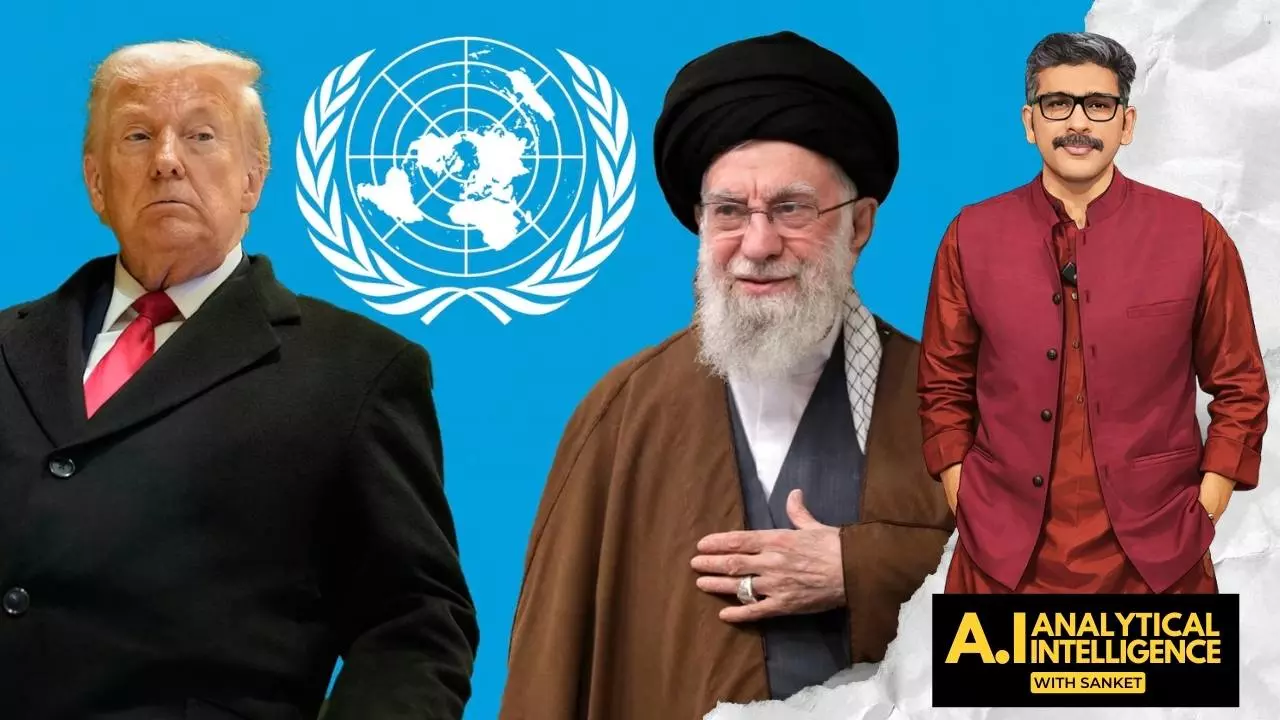
Has the United Nations failed? Experts call for urgent reform
Experts debate whether structural flaws and veto power have made the United Nations ineffective in preventing global conflicts.

As wars continue to erupt across the world — from Gaza to Ukraine and beyond — the debate over the effectiveness of the United Nations has resurfaced. Critics increasingly question whether the organisation created after World War II to prevent global conflict still serves its original purpose.
In this episode of AI with Sanket, Dr James M Dorsey, senior fellow at the Rajaratnam School of International Studies, and Jayant Krishna, former CEO of the National Skill Development Corporation (NSDC), examined whether the UN has failed to prevent wars — and whether meaningful reform is still possible.
UN’s core mission
The United Nations was established after the failure of the League of Nations, with the primary goal of preventing global conflicts and maintaining international peace. However, according to Dorsey, the organisation’s failures stem largely from its internal structure rather than a lack of intent.
He argued that the UN remains the only global forum where countries can engage diplomatically, especially at a time when power politics is resurging.
Also read: Trump blames Iran for deadly school attack despite evidence pointing to US strike
“The United Nations is the only thing we have, particularly in a world in which the principle of ‘might makes right’ is gaining the upper hand,” Dorsey said.
Despite its limitations, the organisation’s agencies continue to play critical roles across the world. Bodies working in areas such as humanitarian relief, food security, labour rights, and nuclear monitoring still provide vital support in conflict zones and developing nations.
Without these institutions, Dorsey suggested, suffering in regions like Sudan, Gaza, and Somalia would likely be far worse.
Structural paralysis
Yet both panellists acknowledged that the UN struggles most when dealing with war and major geopolitical crises.
Krishna pointed directly to the structure of the UN Security Council as the primary problem. The council’s five permanent members — the United States, United Kingdom, China, France, and Russia — each possess veto power, allowing them to block any resolution.
According to Krishna, this has often prevented decisive action even in humanitarian disasters.
He cited several historical examples where the UN failed to act effectively, including the Rwandan genocide in 1994 and the genocide linked to the Bangladesh crisis of 1971.
Also read: Water a bigger concern than oil for Gulf countries as Iran war rages
“If any one of these five members vetoes a resolution, the process stops. The world is much bigger than these five powers,” Krishna said.
He also pointed to the frequency of veto usage — noting that Russia has vetoed resolutions more than 140 times, while the United States has repeatedly blocked resolutions concerning Israel.
Veto dilemma
Dorsey agreed that the veto system lies at the heart of the organisation’s paralysis.
In conflicts where a permanent member is directly involved or has strong geopolitical interests, meaningful UN action becomes almost impossible.
“If you want a resolution on Ukraine, Russia will veto it. If you want one on Gaza, the United States will veto it,” Dorsey explained.
This built-in stalemate makes the UN “structurally incapable” of resolving certain conflicts, he argued.
Even when international law exists, enforcement mechanisms are weak. Legal frameworks may appear strong on paper, but without collective political will, they rarely translate into action.
This gap between law and enforcement, Dorsey said, is another fundamental weakness in the global system.
Funding questions
Another issue raised during the discussion was the influence of financial contributions within the UN system.
The United States contributes about 22 percent of the UN’s funding, followed closely by China at around 20 percent. Japan and Germany also contribute significant shares, despite not being permanent members of the Security Council.
Also read: Mourning Khamenei: Lucknow’s ties with Iran run deeper than geopolitics
Krishna noted that financial disparities raise important questions about representation and influence.
“Countries with larger economies inevitably contribute more. But structural reforms must ensure that the voices of poorer and developing countries are not lost,” he said.
However, Dorsey cautioned against overstating the role of financial power in determining UN decisions.
He pointed out that the United Nations General Assembly and various agencies often pass resolutions that the United States opposes.
“The real power lies in the permanent membership of the Security Council — not necessarily in who pays the most,” he said.
Changing world order
The conversation also turned to how shifts in global politics affect the UN’s relevance.
Dorsey argued that recent changes in U.S. foreign policy — particularly during Donald Trump’s presidency — have transformed international diplomacy.
According to him, American policy during that period emphasised power politics and unilateral decision-making.
“Foreign policy became driven by the principle that the United States can impose its will — that might makes right,” Dorsey said.
This approach, he argued, weakened multilateral institutions such as the United Nations.
Countries increasingly began adjusting their diplomatic strategies not only around U.S. power but also around individual leadership dynamics.
“In a world like that, the United Nations becomes irrelevant at the highest level,” he said.
Reform proposals
Despite the criticism, neither panellist argued for abandoning the United Nations entirely.
Instead, they emphasised the urgent need for reform.
Dorsey suggested expanding the Security Council to include additional permanent members such as India, Germany, and Japan. However, he acknowledged that even this change would not solve the core issue if veto powers remain intact.
Also read: This is the real Gulf War, and the world is paying the price
Krishna outlined several pillars for reform within the UN system.
These include restructuring the development framework, improving peacekeeping effectiveness, strengthening financial accountability, and updating member contribution formulas based on modern economic indicators such as GDP and population.
Security Council reform, however, remains the most complex challenge.
“Even if you expand the permanent membership, if the veto remains unchanged, the problem continues,” Krishna said.
A global catch-22
Ultimately, both experts agreed that the UN faces a fundamental dilemma.
Meaningful reform requires the consent of the same powerful nations that currently benefit from the system.
“To reform the UN, you need the agreement of the five permanent members,” Dorsey explained. “That’s the catch-22.”
Dismantling the organisation and building a new global institution would be an even more difficult and uncertain process.
Also read: Iran war: Is the multipolar world a myth?
For now, the world remains dependent on a flawed but necessary institution.
As global conflicts intensify and geopolitical rivalries deepen, the challenge facing the international community is clear: reform the system or risk watching it lose relevance altogether.
(The content above has been transcribed from video using a fine-tuned AI model. To ensure accuracy, quality, and editorial integrity, we employ a Human-In-The-Loop (HITL) process. While AI assists in creating the initial draft, our experienced editorial team carefully reviews, edits, and refines the content before publication. At The Federal, we combine the efficiency of AI with the expertise of human editors to deliver reliable and insightful journalism.)