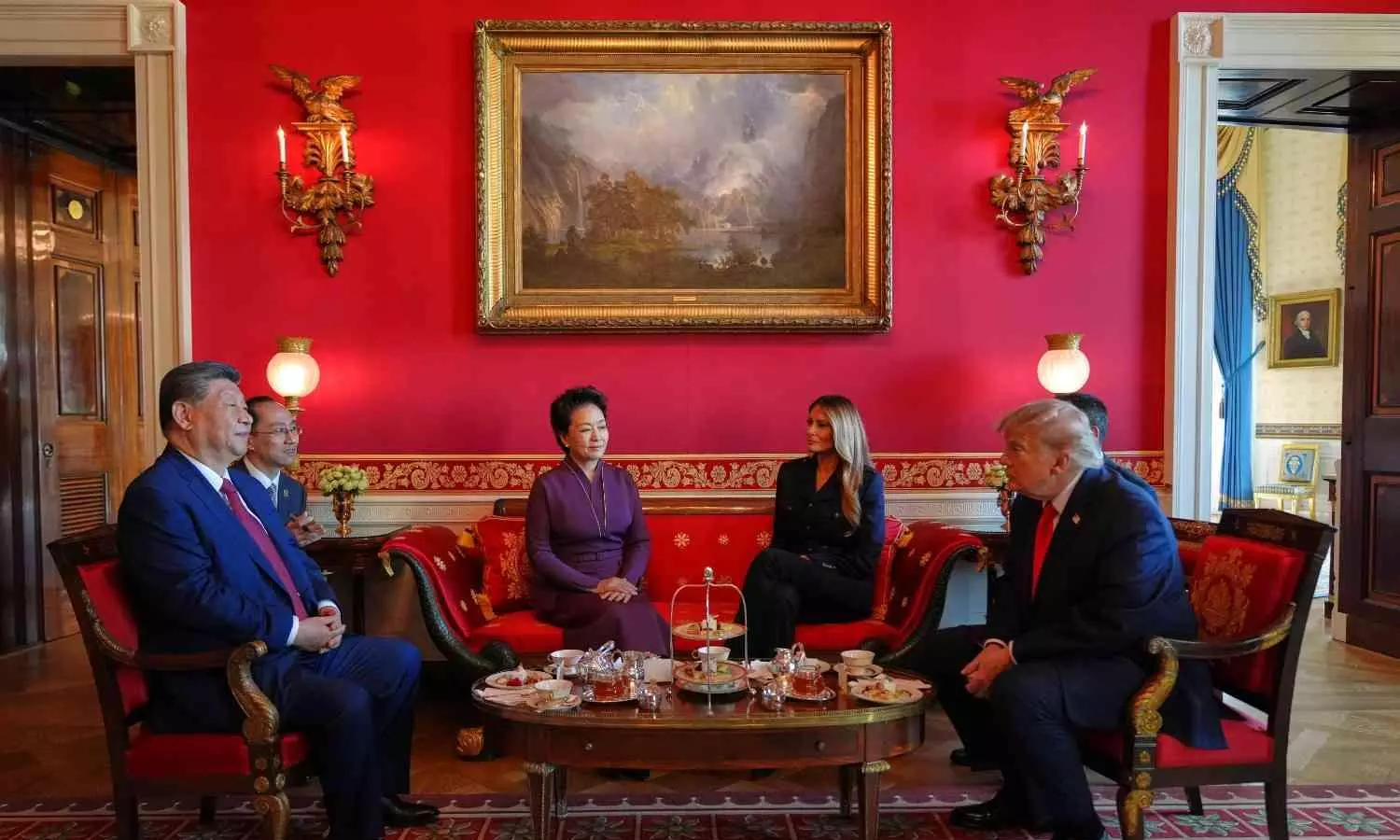
US President Donald Trump and first lady Melania Trump with China's President Xi Jinping and his wife Peng Liyuan in the Red Room of the White House on Friday (Sept 25) in Washington. Photo: AP/PTI
Trump-Xi summit leaves India caught between two undesirable possibilities
A renewed US-China trade war could hurt India’s fragile economy, but a closer Washington-Beijing embrace could shrink New Delhi’s room for manoeuvre

The glittering optics surrounding Chinese President Xi Jinping’s visit to Washington last week suggest a relationship that has travelled a long way from the tariff wars and confrontations of the past. But as the saying goes, all that glitters is not gold.
There was no breakthrough in any contentious issues during the summit, yet what is important is that Washington and Beijing appear to have realised that managing their rivalry may serve both their interests better than escalating it. At least for now.
For India, however, the summit poses a particularly difficult dilemma. New Delhi has much to lose from a renewed US-China confrontation, but little to gain from an accommodation between the two powers that could leave the rest of the world on the sidelines.
'Truce in trade war'
At the end of the summit, the two sides agreed to reduce tariffs up to USD 30 billion.
“A truce in the trade war extended to another two months comes as a breather to the rest of the world. Disagreements persist, but officials will continue the conversation,’’ says Alka Acharya, director at the Institute of Chinese Studies.
Also Read: Xi Jinping concludes US visit, says talks with Trump add ‘new substance’ to ties
A high-level committee on AI would meet in November to come to an understanding as both countries continue to race for dominance. Reports have surfaced of Xi pressing Trump on Taiwan during the talks. However, Trump has kept on hold a USD 14 billion arms deal approved by Congress for Taiwan. Both Taiwan and rare earths remain pressure points to be deployed in future.
US-China trust deficit remains
The message from Washington and Beijing is not that the strategic rivalry is over; they remain competitors despite Xi’s reassuring reference that the Thucydides Trap — a political theory stating that when a rising power threatens to displace an established ruling power, the structural stress and mutual fear often make war the most likely outcome — need not apply. Trust deficit remains, but neither country can gain from the relationship spiralling out of control, at a time when two ongoing wars in Ukraine and West Asia have sent the global economy into a spin.
Also Read: Xi says US, China should be partners, not rivals, after airport welcome by Trump
Every country is in trouble thanks to the energy crisis triggered by the near closure of the Strait of Hormuz and the Houthi action in the Bab el-Mandeb Strait, which has affected Saudi oil supplies.
Two undesirable possibilities
India is caught between two undesirable possibilities. A renewed US-China trade confrontation will affect India’s economy with disruption of oil and fertilizer supply chains, and world trade in general. New Delhi’s economy cannot take this strain when it is already fragile.
A US-China rapprochement that becomes a de facto G2, a term to signify that the US and China will together shape the world, is bad news for India.
Also Read: US-China must avoid ‘Thucydides Trap’, says Xi as Trump calls for better future
The summit did not establish a formal G2, nor did Trump and Xi embrace the formulation. But the very possibility matters, because the US and China are the two powers with the economic and military weight to shape the international agenda. The G2 concept has periodically resurfaced and India is wary of this. An alignment between the US and China will leave little room for middle powers like India to assert their interests.
So New Delhi would have noted with relief that even as Xi’s flight landed back in Beijing on Saturday (September 26), Chinese Vice President Han Zheng, addressing the UN General Assembly, pushed back against the US without naming it. He called for the national sovereignty of Gulf countries to be respected and urged the “relevant country’’ to stop threatening Cuba. Everyone knows that Donald Trump’s administration is squeezing Cuba with its blockade.
India’s dilemma
India’s position at the moment is, to say the least, awkward.
Prime Minister Narendra Modi’s tenure took a decided turn initially towards the US. The first Trump tenure followed by the Biden years saw New Delhi at ease in Washington, confident that India-US ties were on firm ground, with both apprehensive about China’s assertive rise in Asia, its growing military power, and the strength of its economy. Suspicion of China helped weld strategic ties with the US, resulting in the resurrection of the Quad - the India, US, Japan, and Australia grouping. Though India remained part of the China-Russia-led Shanghai Cooperation Organisation and BRICS, it increasingly looked to the US and the West.
The second Trump presidency came as a reality shock to the Modi government. 25 years of sustained nurturing of ties between the US and India under various governments in Washington and Delhi slipped dramatically. A multi-polar world is now again India’s anthem.
Also Read: China President in US: Trump hails 'truly great friendship' with Xi
While not abandoning Washington, New Delhi has gradually recalibrated its ties with China and the Global South.
India’s dilemma is that it needs US investments and technology, as much as it needs a functioning relationship with China, its large and powerful neighbour. It cannot afford to choose sides, nor can it afford to be irrelevant to either side.
The Trump-Xi summit is a reminder of the limits of India's room for manoeuvre. New Delhi cannot decide whether Washington and Beijing compete or cooperate. What it can decide is how much space it creates for itself in either eventuality.