Bangladesh's Teesta River project: 'India should oppose it, seek modification'
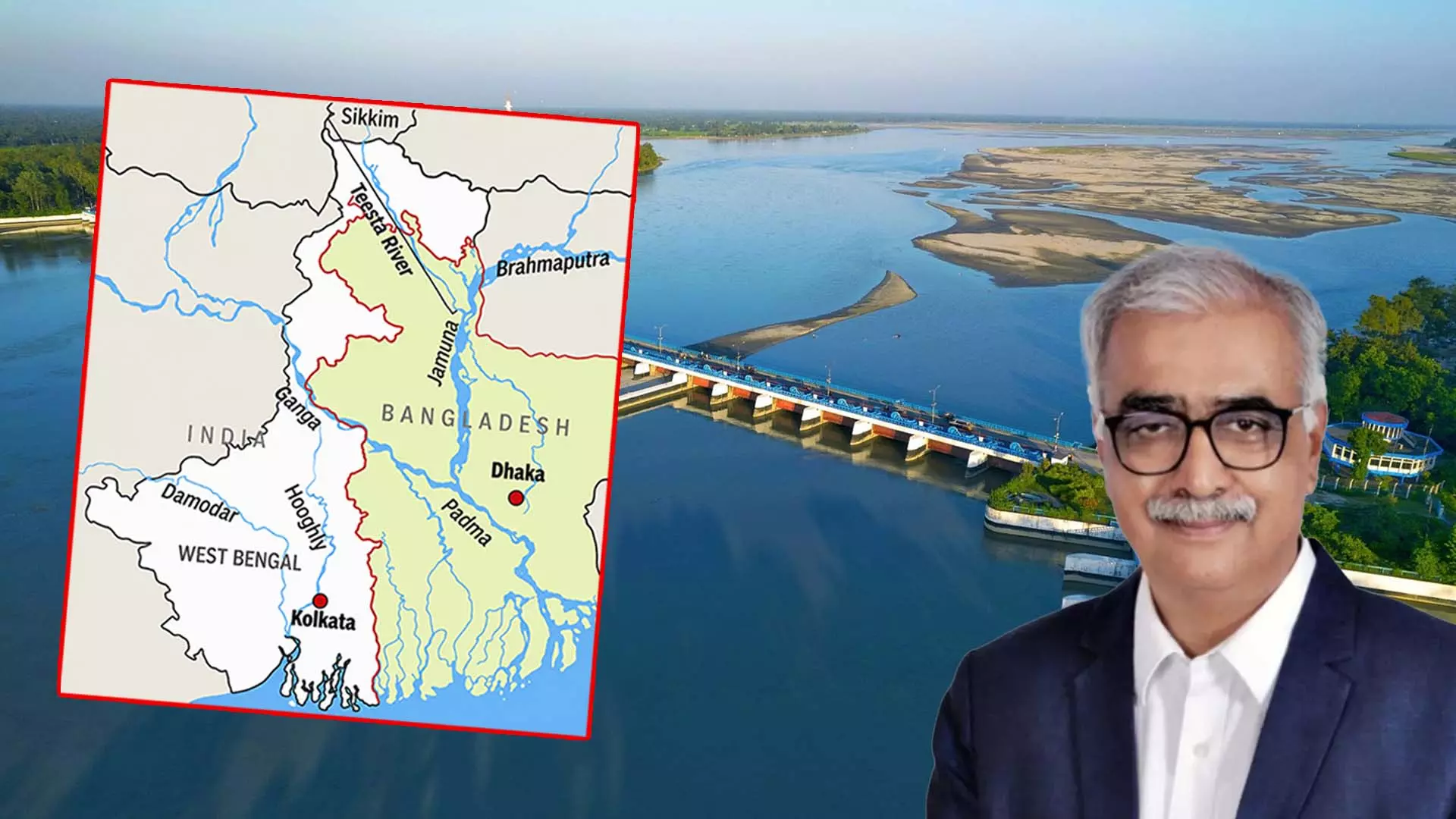
The Teesta project is a highly sensitive one. It involves spending about USD 1.5 billion to construct a barrage in Bangladesh and to train the river, says senior Supreme Court advocate and transboundary water expert Mohan Katarki

China’s potential involvement in Bangladesh’s Teesta River project risks putting India at a disadvantage, as any backwater flooding could directly submerge parts of the highly sensitive Siliguri Corridor. The critical "chicken's neck" corridor serves as the sole geographical link connecting mainland India to its northeastern states, making its security non-negotiable.
On the latest episode of Worldly-Wise, The Federal's Consulting Editor KS Dakshina Murthy spoke to Mohan Katarki, designated senior Supreme Court advocate and transboundary water expert, to discuss the geopolitical, technical, and ecological implications of the Teesta River project and the upcoming renewal of the Indo-Bangladesh Ganges Water Treaty.
Also read: India-Bangladesh ties under strain as pushbacks threaten reset
How would Chinese funding for the Teesta project impact India?
The involvement of China by funding the project is a matter between Bangladesh and China, which India is not directly concerned with. But the matter is not that simple either, because any access China gets into the management of water resources in Bangladesh may have an impact on India in other forms. They may get leverage or a hand to bargain with India on other matters. Therefore, security experts feel that China getting involved in the project is not advisable for India.
The Teesta project is a highly sensitive one. It involves spending about USD 1.5 billion to construct a barrage in Bangladesh and to train the river. The training of the river involves narrowing down the scope of river carriage by building embankments. This is usually done to avoid flooding of the river in the nearby lands.
The problem is that this project, which China might fund, is located quite near the India-Bangladesh international border. It is dangerously close to the famous chicken's neck or Siliguri Corridor, which links mainland India to the northeastern states. If there is any impact on this corridor by way of flooding—what we call the backwater effect—India will be in a serious disadvantageous position during such times.
Therefore, it is necessary for India and Bangladesh to conduct backwater effect studies to see whether any part of the Siliguri Corridor will get submerged in case of floods coming down to the Teesta project. I am sure the Ministry of External Affairs and the Ministry of Jal Shakti in India must have thought of it already. If they have not thought of it, or if it has not occurred to them, they must immediately get down and study the backwater effect through various agencies, including our Central Water Commission, which is a highly competent body equipped with the latest software.
However, this will ultimately require the cooperation of Bangladesh because they have to provide the data and the project design. Until they provide these details, a proper study is not possible, making bilateral cooperation very essential.
Secondly, there is the larger question of sharing the Teesta water between India and Bangladesh. Some sort of a deal, which was not in the public domain, was worked out in 2011 between India and Bangladesh. But then West Bengal Chief Minister Mamata Banerjee protested against the deal, saying that it would adversely affect the interests of West Bengal, particularly its summer irrigation. In deference to the objections raised by her, India did not sign the treaty at that time.
Now, the time has come again for India and Bangladesh to sit together and address the concerns of West Bengal. After considering those concerns to the satisfaction of the state, the Government of India will have to take a decision, enter into negotiations, and sign a treaty if necessary. Ultimately, the treaty is in the interest of Bangladesh; India does not require it. It is Bangladesh that requires a treaty in the form of guaranteed flows of water. Yet, a treaty is essential in the overall interest of the Indo-Bangladesh relationship. India may sign it, provided the interests of West Bengal are fully addressed and protected.
Also read: How the India-Australia uranium deal presents a symbol of mutual trust
Was West Bengal's objection to the 2011 treaty technical or political? Is Bangladesh still interested?
Whether West Bengal will be adversely affected or not depends strictly upon its water requirement, particularly in the summer months or during the rabi crop season. West Bengal is part of a common delta formed by the Ganges, Teesta, Meghna, and Brahmaputra rivers. Water-intensive rice crops are grown heavily both in West Bengal and on the Bangladeshi side. Therefore, the water requirement has to be scientifically assessed by India. Once that assessment is done and the required flows are worked out, the Government of India will have a better standing to go ahead with the treaty.
As far as Bangladesh is concerned, the extent to which they are keen about the treaty depends on their position as a lower riparian state, at whose instance treaties are typically driven. If they are constructing the barrage and trying to help themselves by conserving and saving the water—since a large part of this water, almost 80 per cent, currently goes down to the sea—there is nothing wrong with that.
This is subject only to the point I already mentioned: such a barrage or river training should not cause any backwater effect in India, particularly in the Siliguri Corridor. That remains a highly sensitive area, and any flooding there would lead to the enormous consequence of cutting off mainland India from the northeastern states.
Can India avert these security risks as an upper riparian state?
India is an upper riparian state, so left to itself, it may not be keen to sign a water-sharing treaty. India comes into the picture only if the lower riparian state demands a treaty in the form of guaranteed or assured flows. It all depends on how Bangladesh pursues it. They have been pursuing it, but I am not sure they will be as keen to press for this treaty once they decide to go ahead and construct their own Teesta project.
The only critical question is whether the Teesta project is compatible with the interests of India. If it causes a backwater effect, India will certainly protest and object to it vehemently. India will take up the matter diplomatically with Bangladesh or at international forums to stop it from being executed. There is no doubt about it. India cannot sacrifice its interests as far as the Siliguri Corridor is concerned.
Should India actively oppose the Teesta project if flooding risks aren't resolved?
Yes, if it causes a backwater effect, India should certainly oppose it. India should seek a modification of the project in such a way that it eliminates any possibility of a backwater effect.
What is the status of the 1996 Ganges Water Treaty as it comes up for renewal?
This treaty was signed in 1996 when HD Deve Gowda was the Prime Minister. Having had extensive experience dealing with interstate water disputes in India, such as Karnataka versus Tamil Nadu and Karnataka versus Andhra Pradesh, Deve Gowda was able to cognise the subject much faster. He concluded at the time that guaranteeing flows to downstream Bangladesh would not harm India's interest in maintaining the specific depth of water needed at the Kolkata port along the Hooghly River.
The treaty was structured mathematically in an annexure: if a lean flow arrives at Farakka, it is divided in a particular fashion, and if there is a bumper flow, it is divided differently. It is not a guaranteed fixed volume in the strictest sense; rather, it is a proportionate division of whatever flow arrives at Farakka. India does not have a massive storage reservoir at Farakka to guarantee water independently of seasonal realities. It all depends on nature. If 'X' amount arrives, it is split between the two nations in the ratio provided.
There have been some allegations over the last 30 years—though nothing incredibly serious—that India was occasionally unable to adhere to the exact proportions prescribed under the treaty during critical summer months. These variations happen because water management is rarely rigid; there are always fluctuations in flows and operational challenges.
Overall, the treaty has worked remarkably well. I do not think there is any major cause for concern for Bangladesh. If Bangladesh wants the treaty to be renewed, India may consider it favourably, subject to being fully satisfied that the interests of the Kolkata port are completely protected.
There are certain valid concerns regarding the Kolkata port now. Over the last 30 years, there has been very little upgradation of the riverbed, resulting in significant sedimentation. Consequently, the flows currently allocated under the Farakka arrangement are proving inadequate to maintain the necessary depth in the Hooghly River to facilitate smooth maritime navigation.
These issues must be addressed technically. If necessary, India should seek specific amendments to the 1996 treaty while renewing it, introducing schedules that are a little more flexible. Apparently, there are demands from Bangladesh asking for about 5,000 cusecs more than what is currently decided—they want to scale it up from 35,000 to 40,000 cusecs.
Also read: 'Chest thumping not foreign policy, New Delhi-Dhaka must return to dialogue'
Is increasing Bangladesh's allocation by 5,000 cusecs feasible for India?
It entirely depends upon the technical requirements of India to sustain the Kolkata port. Just as Bangladesh is asking for more water, India also needs to ensure it retains enough water for its own navigation and downstream economic needs.
Ultimately, this is a highly technical job that must be assessed by experts. The political leadership will then have to make a final decision based on a pragmatic method of give-and-take. But I do not view this as an insurmountable problem. In the overall interest of maintaining a strong, stable relationship with Bangladesh, India can favourably extend the existing treaty with the necessary updates.
Does India need a comprehensive water agreement rather than a piecemeal approach?
There are two aspects to this. First, I often look at the sheer volume of water and wonder why there is a dispute between India and Bangladesh at all. There is an enormous amount of water flowing down. We share 54 international rivers, with the four primary ones being the Brahmaputra, Meghna, Teesta, and Ganges. These 54 rivers provide Bangladesh with an average of 900 million acre-feet (MAF) of water annually. To put that in perspective, that is almost nine times the amount of water India permits to flow into Pakistan through the Indus, Jhelum, and Chenab rivers under the Indus Waters Treaty.
Bangladesh simply does not have the capacity or the structural requirement to utilise that volume of water. Official statistics indicate that Bangladesh has an irrigated area of about 5.5 million hectares. If we calculate that 1 MAF (Million Acre-Feet) of water is required to irrigate 2.5 lakh acres of rice crops, then roughly 50 MAF is sufficient to meet their entire agricultural requirement. Even if you generously add environmental flows, drinking water requirements, and domestic usage, about 150 MAF is leisurely sufficient for Bangladesh to sustain itself. Yet, they receive 900 MAF.
So why does a dispute arise? It stems predominantly from seasonal variations and localised management problems. During dry seasons, specific regions in Bangladesh might experience a drop in river depth, making it difficult to divert water into local canals. When that happens, the political narrative immediately shifts to blame India, creating an impression that India is deliberately withholding water.
This is essentially like the liquidity problem of a rich man. A wealthy person might own assets worth 100 crores, but on a particular afternoon, he might lack cash liquidity in his bank account and must approach the banker for an overdraft. Localized dry spells are structural and temporal glitches, not an absolute water shortage. Overall, given the massive volume of water that flows downstream, there is no fundamental reason for Bangladesh to harbor grievances against India.
The Farakka Treaty of 1996 was our way of managing this liquidity problem, and it is up for renewal. As long as our core national interests, such as the depth of the Hooghly River for the Kolkata port, are securely protected, India has no reason to alter its fundamental upper-riparian outlook.
Should climate change impacts be factored into these water treaties?
It is a factor, indeed. But to what extent and which specific basins are being altered remains to be precisely quantified. India, Bangladesh, Nepal, and China must jointly conduct downscaled model studies of climate change to understand its exact, long-term impact on regional water resources. If such downscaled studies have not been initiated yet, they must be commissioned immediately.
However, because the baseline volume of water flowing from India to Bangladesh is so incredibly high, the immediate, existential effects of climate change will not disrupt the bilateral equation anytime soon. The immediate impacts of changing weather patterns and melting glaciers will be felt internally within India first, given our vast geography and diverse water demands. In the near term, climate change will not drastically alter the water-sharing matrix between India and Bangladesh.