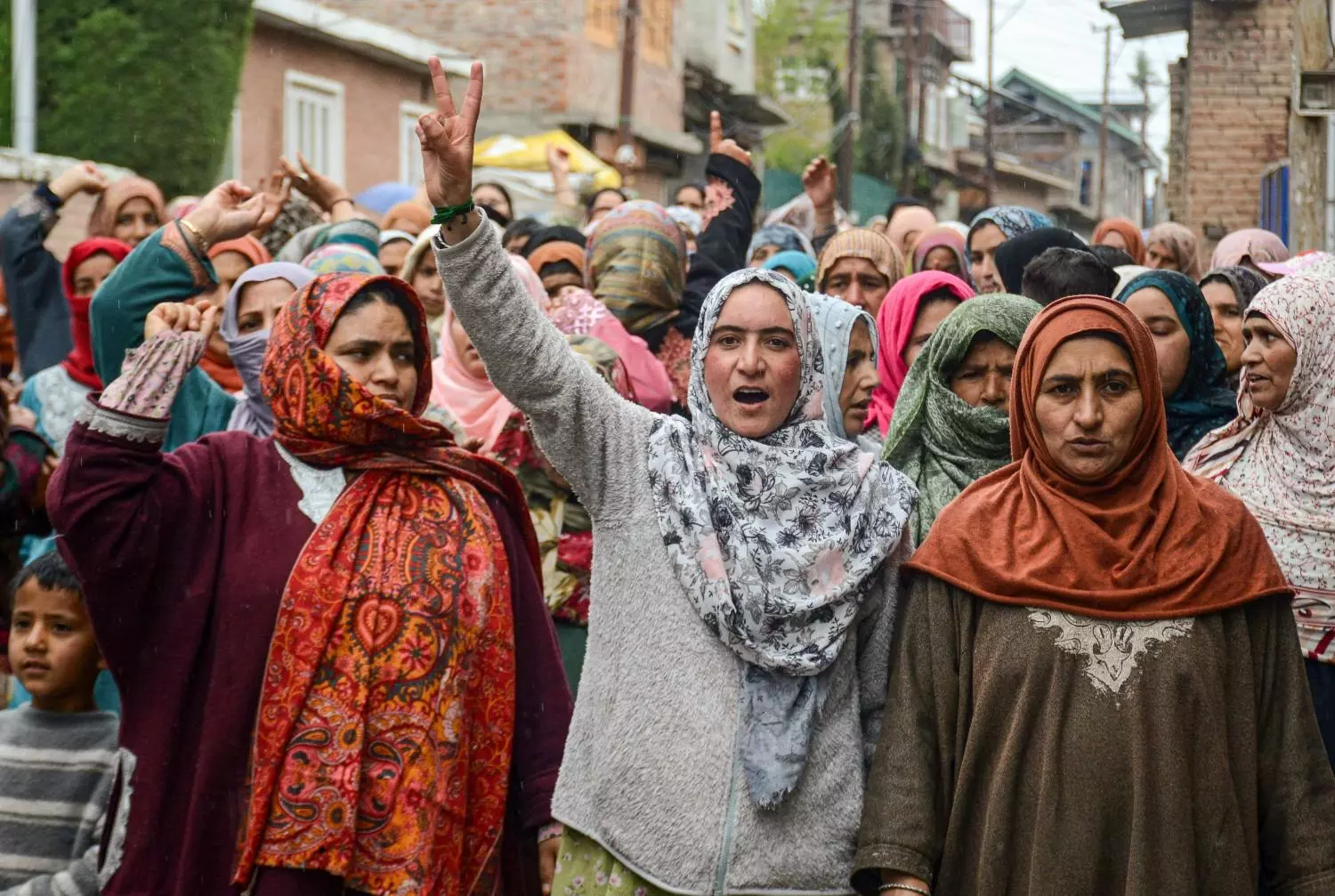
People raise slogans as they gather to celebrate in response to the ceasefire agreement between Iran, the United States and Israel, after US President Donald Trump pulled back from his threats to destroy Iranian "civilisation", in Srinagar, Jammu and Kashmir, on Wednesday, April 8. PTI
Pakistan gets a moment in the sun. But don’t confuse a two-week pause with a paradigm shift. The world economy is still topsy-turvy
So, has Pakistan suddenly become the Vishwaguru of crisis diplomacy? Or did it just happen to be holding the phone when a terrified world needed someone —anyone — to stop US President Donald Trump from erasing “a whole civilisation” before Tuesday’s (April 7) midnight deadline?
Let’s not mince words. Islamabad can parade its mediatory role all the way to the bank. According to The New York Times, Iran’s acceptance of a two-week pause came after Pakistani legwork and a last-minute Chinese shove. Yes, Pakistan deftly handled the final pieces of a very bloody jigsaw. But don’t mistake dexterity for leadership. What we witnessed wasn’t a diplomatic triumph. It was a temporary restraining order on Armageddon.
A pause, not peace
For four weeks, the US and Israel unleashed a predatory bombing campaign on Iran. Trump thundered about “complete and total regime change”. Iran’s military responded with the only dignity left to a nation under siege: “We win or we die, but we don’t surrender.” That wasn’t bravado. That was people staring into the abyss. And Karl Marx—yes, Marx—was right: men make history, but not under circumstances of their choosing. Iran didn’t choose this war. It was handed one.
Also read: Doomsday averted, but can Iran war be settled across the table?
Now we have 15 days. A pause. Not peace. And the questions multiplying faster than diplomats in Islamabad: Will this be a prelude to an end, or a ceasefire before the next, worse war? Will the US agree to reparations? Will Israel accept any outcome that doesn’t leave it as the Middle East’s sole hegemon? And most critically—who controls the Strait of Hormuz? That 52-kilometre waterway, carrying 20 per cent of global oil trade, remains Iran’s strategic dagger. They’ve already proven they can hit US bases, Gulf oil facilities, and Israeli assets. They’ve turned an asymmetrical war into a very symmetrical economic nightmare.
Iran isn’t naive. Its ambassador to China laid out the only sane path: a reliable, stringent, unbreakable security guarantee—backed by the UN Security Council (UNSC), China, Russia, and yes, Pakistan
Let’s call out the Western analysts who say “both sides can claim a sort of victory”. That’s cowardice dressed as balance. Tehran has won the strategic war. The US and Israel decapitated leaders and destroyed drone sites. So what? Iran still fired back. It still damaged the US-Israel military axis. And it made clear that genocide-level bombing doesn’t produce surrender—it produces defiance.
Iran’s 10-point proposal
Now for the real talks, reportedly in Islamabad. Trump, after his wild threats, suddenly tweets about “a big day for World Peace” and helping with “traffic buildup” in the strait. Spare us. The same man who joked about wiping out a civilisation now wants to “hang around” with supplies? And Israel? It will play the villain at every turn, sabotaging Trump’s own optimism the moment it suits them.
Also read: Trump blinks, ceasefire is brokered, but Iran has a warning; what next?
Iran isn’t naive. Its ambassador to China laid out the only sane path: a reliable, stringent, unbreakable security guarantee—backed by the UN Security Council (UNSC), China, Russia, and yes, Pakistan. Tehran wants US forces out, sanctions lifted, and war reparations. Its 10-point proposal is reportedly being examined. But this time, Iran won’t accept another American promise that dissolves the moment the next president arrives. After Israel Prime Minister Benjamin Netanyahu pushed Trump into this brutal campaign, Tehran has drawn its lesson: no ironclad guarantees, no deal.
So here we are. Pakistan gets a moment in the sun. But don’t confuse a two-week pause with a paradigm shift. The world economy is still topsy-turvy. The rules-based order is in tatters. And a civilisation that refused to die now demands something Washington has never truly offered: a guarantee that this nightmare won’t repeat.
Surrender was never an option. And neither, it turns out, was real peace. Just a 15-day stay of execution. Don’t call it victory. Call it a narrow escape — with Pakistan holding the door, not the keys.
(The Federal seeks to present views and opinions from all sides of the spectrum. The information, ideas, or opinions in the articles are of the author and do not necessarily reflect the views of The Federal.)