



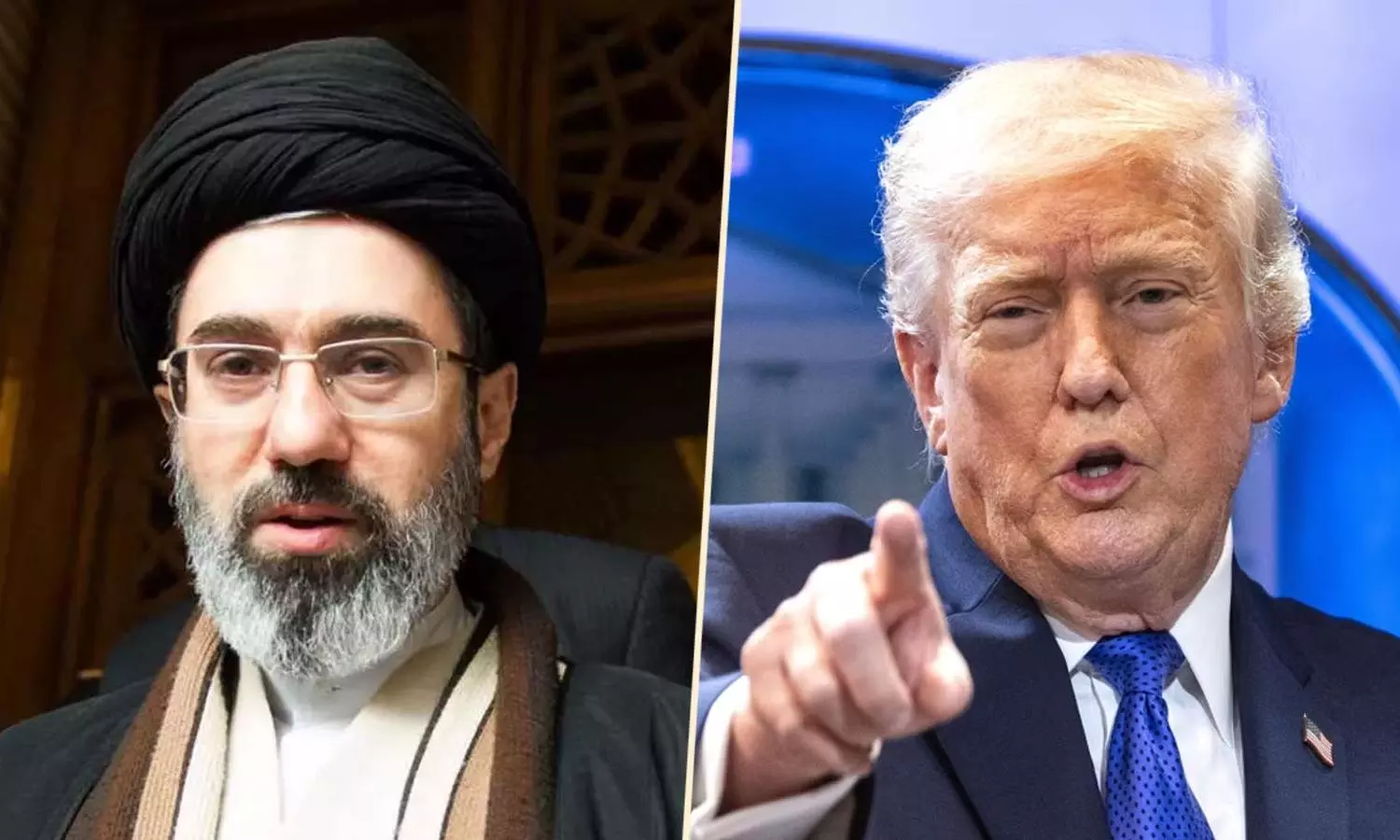
Iran-US ceasefire: Tehran’s statement and 10 conditions, what Trump said, and Israel's stance
US and Iran agree to a 2-week ceasefire just when doomsday seemed impending, but Israel throws a spanner by saying the deal does not cover Lebanon

In a dramatic pivot, US President Donald Trump has stepped back from his dire threat to "end a whole civilization" and instead opted for a two-week ceasefire with Iran, labelling their 10-point proposal as "workable". With this move, the US president has shifted the West Asia theatre from the brink of total war towards a diplomatic resolution.
Trump announced that this Pakistan-brokered proposal will open the Strait of Hormuz, through which a fifth of the world's energy supplies pass in peacetime, to facilitate peace negotiations between Washington and Tehran.
Negotiations, which will begin on April 10, will be held in Pakistan.
Lebanon not included, says Israel
However, Israeli Prime Minister Benjamin Netanyahu, who backed Trump's decision to suspend attacks against Iran for two weeks, said the ceasefire does not include Lebanon.
"Israel also supports the US effort to ensure that Iran no longer poses a nuclear, missile and terror threat to America, Israel, Iran's Arab neighbours and the world," Netanyahu's office said in a statement. "The two-week ceasefire does not include Lebanon," the statement curtly added.
Also read: LIVE | US, Iran agree to 2-week ceasefire; Iran to open Hormuz; Israel says Lebanon not covered
Neither Iran nor the United States said when the ceasefire would begin, and attacks continued in Israel, Iran and across the Gulf region early Wednesday.
Here are the highlights of the statements issued by the main players of this Middle East war:
Key points of Iran’s statement
Though Iran's Supreme National Security Council on Wednesday released a statement confirming a two-week ceasefire announced by the US President, a defiant Tehran made it clear that the ceasefire does not imply the end of the war.
Iran's statement said “its hands remain upon the trigger, and should the slightest error be committed by the enemy, it shall be met with full force."
In a statement read on the state-run Islamic Republic of Iran Broadcasting (IRIB), Iran’s Supreme Leader Mojtaba Khamenei said: "This is not the end of the war but all military branches should follow the Supreme Leader's order and cease their fire."
Khamenei also acknowledged Pakistan's mediation efforts and said it was responding to the “brotherly request of PM Sharif”.
Khamenei's statement said, "Considering the request by the US for negotiations based on its 15-point proposal as well as announcement by POTUS about acceptance of the general framework of Iran's 10-point proposal as a basis for negotiations, I hereby declare on behalf of Iran's Supreme National Security Council: If attacks against Iran are halted, our Powerful Armed Forces will cease their defensive operations."
On the strategic and vital Strait of Hormuz, he said, "For a period of two weeks, safe passage through the Strait of Hormuz will be possible via coordination with Iran's Armed Forces and with due consideration of technical limitations. Iran's chokehold on the Strait of Hormuz since the war began in late February is roiling the world economy and raising the pressure on Trump both at home and abroad to find a way out of the standoff.
Iran's 10-point proposal includes:
- A US commitment to ensure no further acts of aggression against Iran.
- Continued Iranian control over the Strait of Hormuz.
- Official acceptance of Iran's uranium enrichment rights.
- Immediate lifting of all primary US sanctions.
- Removal of all secondary sanctions.
- Termination of all UN Security Council resolutions against Iran.
- Termination of all IAEA Board of Governors resolutions.
- Payment of compensation to Iran for war losses/reconstruction.
- Withdrawal of US combat forces from the region.
- Permanent cessation of hostilities on all fronts, including Lebanon.
Significantly, the issue of the “acceptance of enrichment” for its nuclear programme was present only in the Farsi-language version of its 10-point ceasefire plan, something that was missing in English versions shared by Iranian diplomats with journalists.
It wasn't immediately clear why that term was missing. These terms would mean an extraordinary step down by the US after 47 years of hostilities with Iran, starting from the 1979 Islamic Revolution, said reports.
Trump’s statement
Meanwhile, in his tweet, Trump made it clear that the agreement is contingent on Iran providing immediate and safe passage through the Strait of Hormuz. Trump noted that because current military objectives have already been exceeded, this window allows negotiators to finalise a permanent peace deal based on a "workable" 10-point proposal from Tehran.
Also read: Trump’s ‘N-button’ threat: Bluff or breaking point in Iran war?
Trump said that the US and Iran have reached a consensus on nearly all major points of conflict. He stated that the two-week ceasefire serves as a final window to "consummate" the formal agreement. Speaking on behalf of the US and Middle Eastern interests, Trump expressed that it is an honour to be on the verge of resolving this long-standing regional crisis.
He highlighted the role of Pakistani leaders Shehbaz Sharif and Asim Munir in the ceasefire with Iran.
What's not clear
Trump initially had said Iran proposed a “workable” 10-point plan that could help end the war launched by the US and Israel in February. But, he later called the plan "fraudulent", without elaborating.
Trump has said ending Iran's nuclear programme entirely was a key point of the war. There are concerns in Israel about the agreement, according to a person familiar with the situation who spoke on condition of anonymity to a foreign media agency.
Iran's stockpile of highly enriched uranium allegedly still buried at enrichment sites had been one of the main issues cited by both Israel and the US in launching the war.
Moreover, another point is that Iranian Foreign Minister Abbas Araghchi in his statement said passage through the Strait would be allowed under Iranian military management. It wasn't immediately clear whether that meant Iran would completely loosen its chokehold on the waterway.
Also read: Trump’s handling of Iran conflict keeps MAGA base loyal even as ratings slide
The plan allows for both Iran and Oman to charge fees on ships transiting through the strait, according to a regional official, who spoke to news agency AP, on condition of anonymity to discuss negotiations they were directly involved in. The official said Iran would use the money it raised for reconstruction.
Strikes continue
Before the ceasefire, airstrikes hit two bridges and a train station, and the US hit military infrastructure on Kharg Island, a key hub for Iranian oil production.
Even as the ceasefire was announced, missile alerts continued in the United Arab Emirates, Israel, Saudi Arabia, Bahrain and Kuwait early Wednesday, hinting at the chaos surrounding the diplomatic moves.
A gas processing facility in Abu Dhabi was ablaze after incoming Iranian fire, officials told news agencies. Israel was continuing its attacks on Iran, an Israeli military official who spoke on condition of anonymity in line with military regulations told AP. Iran also kept up fire on Israel.
Death toll
More than 1,900 people have been killed in Iran since the war began, but the government has not updated the toll for days.
In Lebanon, where Israel is fighting Iran-backed Hezbollah militants, more than 1,500 people have been killed. and more than 1 million people have been displaced. Eleven Israeli soldiers have died there. In Gulf Arab states and the occupied West Bank, more than two dozen people have died, while 23 have been reported dead in Israel, and 13 US service members have been killed.