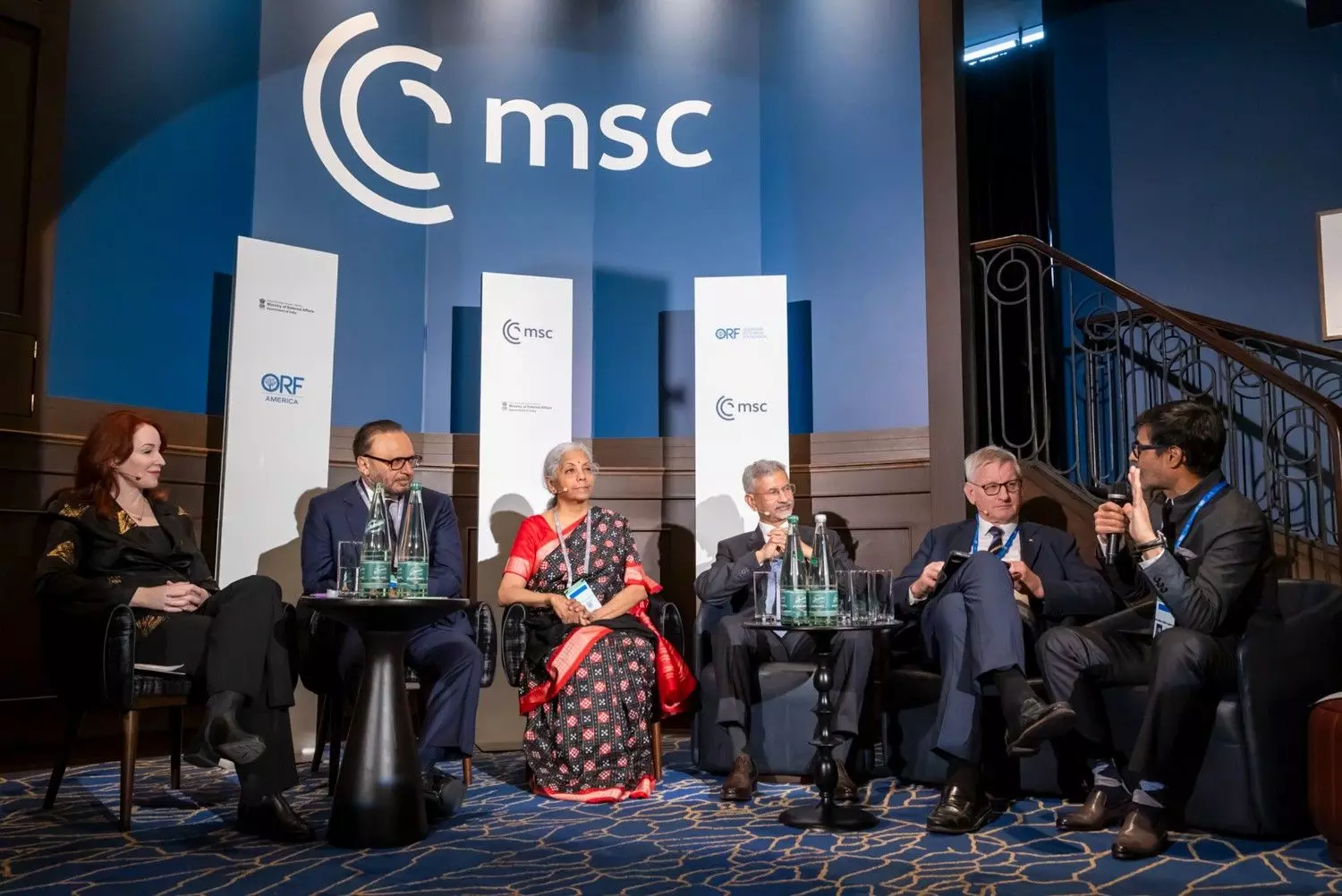
Union Finance Minister Nirmala Sitharaman and External Affairs Minister S Jaishankar with other international leaders at a panel at the 62nd Munich Security Conference in Munich, Germany. Photo: X/@DrSJaishankar via PTI
Marco Rubio's take on 'mass migration' as a 'crisis destabilising societies all across the West' closely tracks Samuel Huntington’s warning: large-scale immigration could erode core cultural identities
Amid competing visions of global order, the 62nd Munich Security Conference concluded on Sunday (February 15) in the German city against a backdrop of deepening geopolitical fragmentation. What emerged from the gathering was not merely a debate over Ukraine, Gaza, or sanctions regimes, but a more fundamental clash of paradigms: between a resurgent civilizational rhetoric in the West and an alternative discourse centered on sovereignty, multipolarity and international law.
Also read: India-US trade deal raises key questions of diplomacy
From the American delegation came an unmistakable articulation of what can only be described as a civilizational worldview. Marco Rubio, speaking as the US Secretary of State, framed transatlantic relations not primarily in strategic or economic terms, but in cultural and spiritual ones.
“We are part of one civilization, Western civilization,” he declared, grounding the Atlantic alliance in “Christian faith, culture, heritage, language, ancestry”.
From Huntington’s theory to American Doctrine
His formulation echoed, almost verbatim, the thesis advanced three decades ago by Samuel Huntington in The Clash of Civilizations. Huntington argued that in the post-Cold War era, global politics would no longer be defined chiefly by ideology or economics but by fault lines between major civilizations — Western, Islamic, Sinic, Hindu and others.
Civilization, in his definition, was “the highest cultural grouping of people and the broadest level of cultural identity people have short of that which distinguishes humans from other species”.
Atlantic alliance recast as cultural fortress
Rubio’s speech in Munich appeared to translate this academic thesis into statecraft. He did not invoke NATO as a military bloc or the European Union as a regulatory superpower; instead, he appealed to what he described as a spiritual and ancestral bond. The United States and Europe, he said, are “connected spiritually” and their “destiny is and will always be intertwined.”
Also read: In today’s global cacophony, India’s challenge is to act with quiet steadiness
He illustrated this through a personal anecdote, recounting the journeys of his Italian and Spanish forebears, Lorenzo and Catalina Giraldi and Jose and Manuela Reyna, presenting his own ascent as America’s top diplomat as a symbolic “homecoming” of a child of Europe.
India, for its part, sought to preserve its doctrine of strategic autonomy. Yet Rubio’s remarks suggested growing US pressure on New Delhi over energy ties with Moscow. “The US has imposed additional sanctions on Russia as well. In our conversations with India, that we've gotten their commitment to stop buying additional Russian oil,” he said.
This framing extends beyond rhetoric. Huntington maintained that in a world shaped by civilizational competition, states would align naturally with “kin-countries” — nations sharing deep cultural roots.
Rubio’s insistence on transatlantic unity, and his call for coordination in securing “market share in the economies of the global South” and building a Western supply chain for critical minerals “not vulnerable to extortion from other powers,” situates economic competition within a broader civilizational contest.
China, though not always named explicitly, looms large as the principal rival in this vision.
Identity politics as grand strategy
Equally significant was Rubio’s emphasis on identity and internal cohesion. He challenged the technocratic framing of security as a matter of budgets and procurement, asking instead: “What exactly are we defending?” His answer was not abstract democracy or procedural liberalism, but a historically rooted “way of life”.
By invoking cultural touchstones — Mozart, the Sistine Chapel, the Cologne Cathedral — alongside the rule of law, he suggested that political institutions are expressions of a deeper civilizational inheritance.
Migration framed as civilizational threat
On migration, Rubio described “mass migration” as a “crisis… destabilising societies all across the West,” language that closely tracks Huntington’s most controversial domestic warning: that large-scale immigration could erode core cultural identities. In this reading, demographic change becomes not simply a humanitarian or labour-market issue but a question of civilizational survival.
Europe’s rearmament
Meanwhile, European leaders at the conference underscored plans to strengthen defence-industrial capacity, signalling support for a more robust military posture in response to Russia’s war in Ukraine.
Also read: Trump's world: Are global leaders sleepwalking into World War I-like crisis?
The European Union and the United Kingdom have increasingly discussed expanding domestic arms production to reduce dependency and bolster deterrence — moves framed as necessary responses to Moscow’s actions.
China’s call for sovereignty, negotiated peace
In sharp contrast stood China’s messaging. As the world’s second-largest economy and a central node in global manufacturing, Beijing used the forum to call for “peace” in Gaza and Iran and reiterated the primacy of the United Nations and international law.
This appeal to multilateralism and non-interference highlights the widening conceptual gap between a West rallying around civilizational solidarity and a China positioning itself as a defender of state sovereignty and negotiated settlement.
India’s autonomy tested by sanctions diplomacy
India, for its part, sought to preserve its doctrine of strategic autonomy. Yet Rubio’s remarks suggested growing US pressure on New Delhi over energy ties with Moscow. “The United States has imposed additional sanctions on Russia as well,” he stated.
Also read: Why has India stopped short of condemning US action against Venezuela?
“In our conversations with India, that we've gotten their commitment to stop buying additional Russian oil. India will sanction some of the Russian oil. India agreed.”
If accurate, such commitments would mark a significant recalibration for a country that has balanced relations with both Washington and Moscow.
Rise of 'hard economy, hard culture' politics
The ideological underpinnings of this moment are not limited to Huntington. In Hayek's Bastards, historian Quinn Slobodian traces how strands of neoliberal thought evolved into what he calls the “three Hs”: Hard economy, Hard immigration and Hard culture.
Rubio’s intervention in Munich also signalled a partial departure from liberal universalism. While earlier generations of Western policymakers framed democracy and human rights as universal aspirations, Rubio rejected the notion that the West should be “ashamed” of its heritage or treat its way of life as “just one among many”.
Variations of this triad can be observed in the politics of leaders such as Narendra Modi, Donald Trump and Benjamin Netanyahu — figures who emphasise economic nationalism while Modi’s unabashedly neo-liberal turn based on his mantra “Reform Express”, strict border controls and cultural majoritarianism.
Also read: Testing time for India's foreign policy: Can Modi govt rise to the challenge?
Rubio’s intervention in Munich also signalled a partial departure from liberal universalism. While earlier generations of Western policymakers framed democracy and human rights as universal aspirations, Rubio rejected the notion that the West should be “ashamed” of its heritage or treat its way of life as “just one among many”.
The West, he argued, must be “unapologetic in its heritage”.
This does not necessarily mean abandoning engagement with the rest of the world. But it does suggest a shift: from promoting universal convergence toward managing coexistence among distinct civilizations from a position of consolidated strength.
Huntington himself counselled the West to abandon the illusion that its values would be universally adopted, and instead to focus on internal cohesion and strategic prudence in a multipolar order.
Multipolar dialogue or new civilizational divide?
The Munich conference thus revealed more than policy disagreements. It exposed a deep philosophical divergence about the nature of global order. Is the world converging toward shared norms under international law, as Beijing insists? Or is it fracturing into culturally defined blocs competing for influence and survival, as Rubio’s rhetoric implies?
If the latter vision gains traction, Munich 2026 may be remembered not simply as another security forum, but as a moment when the language of “Western civilization” moved from academic theory to the centre of Western foreign policy — casting the 21st century less as an era of globalisation and more as an age of civilizational self-assertion.
(The Federal seeks to present views and opinions from all sides of the spectrum. The information, ideas or opinions in the articles are of the author and do not necessarily reflect necessarily reflect the views of The Federal.)