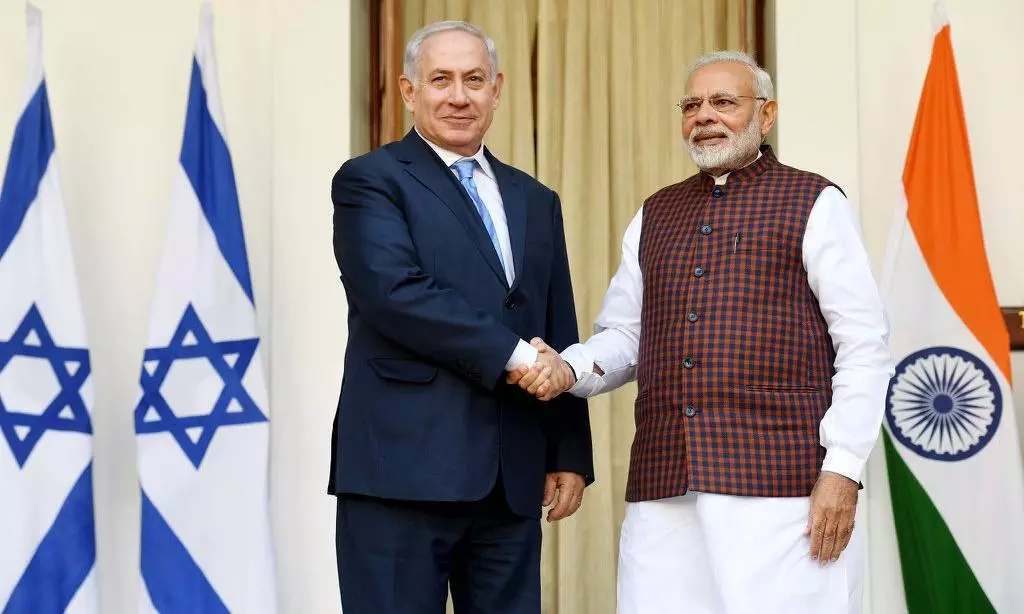
Fortunately, for New Delhi, its largely “please-all” but pro-Israel policy has not backfired because the Arab states themselves are in a disarray
India’s foreign policy of “running with the hare and hunting with the hound” is perfectly encapsulated in its relationship with Israel and Palestine.
In the context of Prime Minister Narendra Modi’s forthcoming visit to Israel on Wednesday, February 25, what is particularly glaring is India’s inability to clearly spell out its position vis a vis the decades old conflict, and recent Israeli assaults on the occupied Palestinian territories.
Also read: India signs UN statement condemning Israel’s West Bank actions
Two recent instances illustrate the dilemma, whenever India is called upon to state its position. The first was United States President Donald Trump’s invite to New Delhi to join the Board of Peace he has constituted for the so-called reconstruction of Gaza. Pakistan, Qatar and Saudi Arabia have already joined as members.
West Asia dilemma
The Modi government initially refused to oblige Trump. Eventually when a meeting was held recently, New Delhi sent an “observer” for the meeting. An observer, by definition is neither here nor there. India managed to keep Trump happy while signalling to the Palestinians they would not be fully onboard.
Last week, 85 nations first signed a letter criticising the Benjamin Netanyahu government’s attempt to frame rules that would enable Israel to enlarge its control and “legalise” Jewish settlements in Israeli-occupied Palestinian territory in the West Bank. India was not part of the original signatories. A day later, it joined the list.
Also read: India’s Israel embrace rooted in history, ideology, and arms deals, says S African author
The hesitation underscored New Delhi’s continuing dilemma on how it should respond to the fast-moving developments in West Asia (or the Middle-East, as it is known globally).
Away from policy and postures, the reality is the emergence of a powerful axis comprising the US, Israel and India. In the last 30 years, since full-fledged diplomatic relations were opened between India and the Israel, the two nations are in a close relationship – across defence purchases, military intelligence and overall trade.
India-Israel relationship
Since the Bharatiya Janata Party-led NDA government came to power in 2014 under Prime Minister Narendra Modi, the relationship has enlarged exponentially. Mutual trade (non defence) has expanded from around $4.52 billion in 2014 to around $7 billion now. As for military trade, it is estimated at $8.6 billion in 2026 – with Israel among India’s top four weaponry suppliers. And, India buying close to 40 per cent of Israeli military hardware.
The government’s Hindutva-centric outlook has turned it into a natural ally of Israel and the US, both of which view political Islam as an existential threat. In fact, Modi was the first Indian prime minister to travel to Israel, in 2017.
New Delhi, which earlier always supported pro-Palestinian resolutions in international forums, including at the UN, has increasingly abstained from taking a position when they have been critical of Israel.
Also read: Is India under US pressure to join Board of Peace? | Capital Beat
India was not among the several nations directly condemning Israel for its two-year genocidal assault on Gaza that resulted in the killing of around 70,000 Palestinians. New Delhi was more comfortable in taking a general position calling for peace and resolution of the conflict – without calling out Israel.
The Modi government has broadly called for an end to terrorism and Israel’s right to defend itself – while expressing support for a two-state solution that includes an independent nation of Palestine. New Delhi also supported a ceasefire, delivery of humanitarian aid and return of hostages. Incidentally, India was among the first nations to condemn the Hamas attack on Israel on October 7, 2023.
Why Israel matters to India
Modi’s visit comes at a time when India is facing a sobering reality in its neighbourhood.
Foremost is the looming presence of China and its enduring relationship with Pakistan that had a direct bearing on the limited conflict with India over the Pahalgam terror attacks. Trump’s repeated assertions, despite India’s denials, of its aircraft being shot down and the reported technical assistance Pakistan received from China in its conflict with India could be the reason why Modi is keen on Israeli military ware.
During the forthcoming trip, on the anvil is a deal to buy SPICE 1000 precision-guided bombs, Rampage air-to-surface missiles, Air LORA air-launched ballistic missiles, and the IceBreaker missile system. The idea is to upgrade India's air-defence capabilities, drone technology, and maritime systems.
Also read: Israel should learn from Modi’s response to Trump, says Jerusalem Post op-ed
Interestingly, there’s not much of an opposition from Arab states to the strong relationship India has built with Israel, quietly at first but now openly. Lest it be forgotten, India has huge stakes in maintaining a good relationship with the Arab nations given the millions of Indians who work there and the country’s reliance on the region for its petrol and allied fuel requirements.
Close watch on Modi’s visit
Fortunately, for New Delhi, its largely “please-all” but pro-Israel policy has not backfired so far because the Arab states themselves are in a disarray – politically, and militarily.
Many of them, including the UAE, Bahrain and Egypt are in a close relationship with Israel and the US. Saudi Arabia, considered the leader of the Sunni world, has been on the verge of opening up relations with Israel for sometime now as part of Trump’s Abrahamic accords.
Also read: Pahalgam revenge: Why India should not go for an Israel-like assault
Sectarian feud among the Muslim nations of the region have resulted in the isolation of Iran that is single-handedly fighting to stave off an imminent attack by the US. These largely existential issues have minimised the impact of India’s contentious pro-Israel role in the region.
Though there were reports about India’s reported moves in assisting Israel during the assault on Gaza, fortunately for New Delhi that did not gain much currency.
Notwithstanding the slew of troubles bothering the various nations in the region, Modi’s visit is sure to be watched especially for signs of an even closer relationship with Israel that could have a bigger impact on the region