Is India under US pressure to join Board of Peace? | Capital Beat
Former ambassador Meera Shankar on Trump's threats, tariffs, India's dilemma and the fast-changing world order

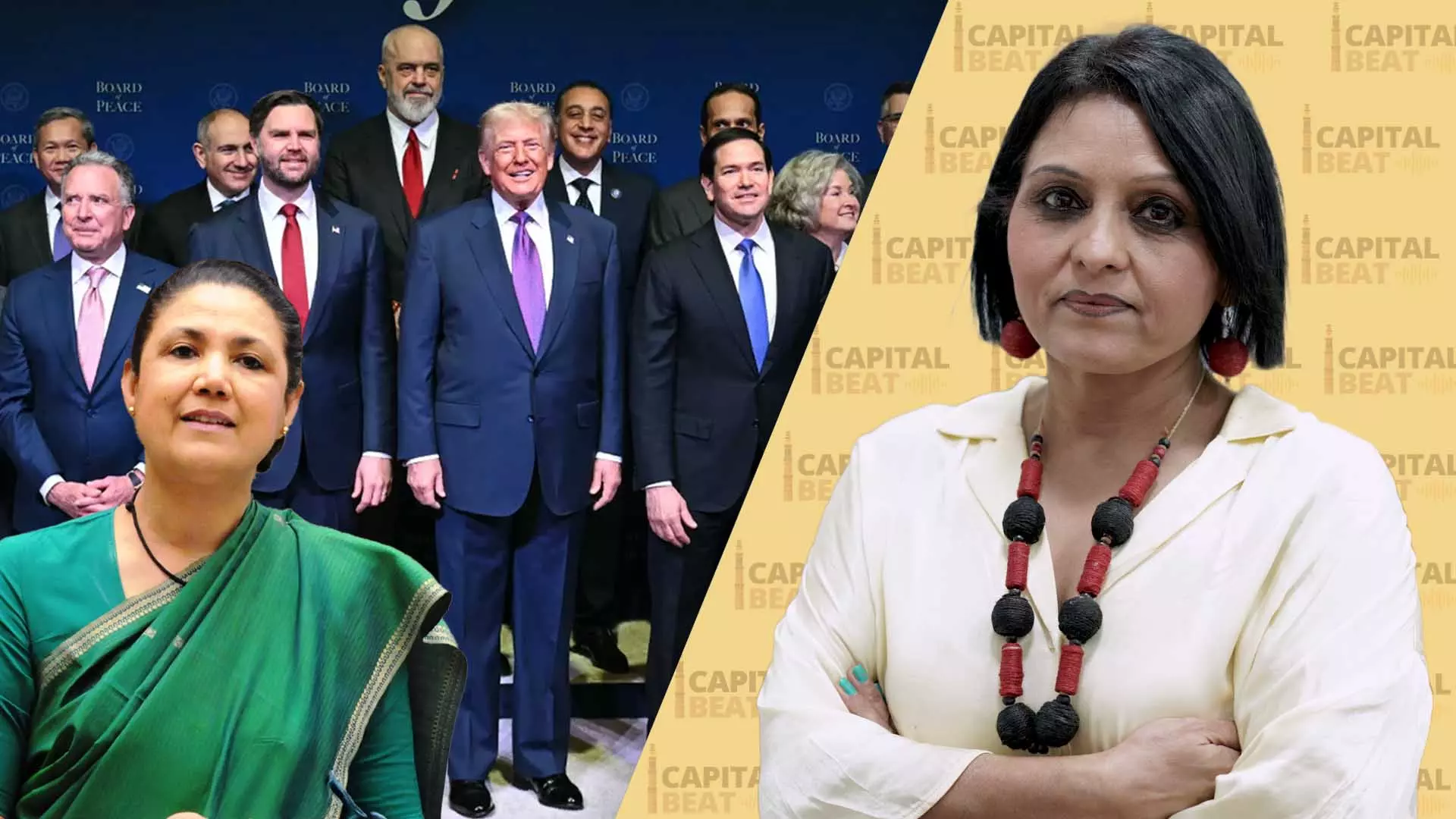
As debate grows over India’s participation as an observer in the proposed 'Board of Peace' initiative in Washington, strategic and diplomatic implications are coming into focus. In this Capital Beat episode, The Federal spoke to former ambassador Meera Shankar on whether US President Donald Trump is attempting to shape geopolitical outcomes through the forum and how India should respond.
Was India right in attending the Board of Peace meeting as an observer?
I think India tried to find a middle ground. Many European countries did not attend, and the concern has been that ideally a Board of Peace like this should have been constituted by the United Nations and should have got international approval.
In this case, the Board of Peace has been nominated by President Trump, and there are also financial contributions. Who is going to handle that nobody knows, because there is President Trump, his son-in-law, and his aide Steve Witkoff (US Special Envoy) and so on.
So there were concerns whether this forum or its constitution had the kind of international imprimatur that would give it legitimacy.
On the other hand, the peace plan which this Board of Peace is going to take forward and monitor is something which has been approved by the majority of countries and has been signed off by both parties to the conflict — Israel as well as the Palestinian territories — and most Arab countries.
If you look at the Board of Peace, most Arab countries have agreed to attend, and it is the only game in town as far as bringing about peace in the region is concerned.
It may not fulfill all the norms that people were looking for in a long-term political solution, particularly the two-state framework, but given the savagery of the conflict and the battering that people in Gaza Strip were subjected to, it is seen at least as bringing about some kind of winding down of the conflict.
India has a good equation with Israel — it has been a strategic partner — and it also has a good equation with the Palestinians, as we have seen in the recent Arab summit.
So India probably does not want to deal itself out of the process if it is moving forward. We have chosen a middle path. We have not attended as a full-fledged member but as an observer, so we can keep watch on what is happening without formally committing ourselves.
Should the government have discussed the decision in Parliament?
I think it is always good to build broad consensus and therefore to take these issues upin Parliament, explaining the rationale for the decision.
In international relations there are often no black-and-white decisions. Consultations on a broad basis are always desirable.
Could the move undermine the UN-led global order?
When you are an observer, it means you have not yet committed your position with regard to the Board of Peace. That will evolve depending on how it progresses.
But yes, the concern is valid that you do not want to undermine the UN system by having parallel processes operating outside the ambit of the UN Security Council.
Is Trump using tariffs and jet claims to pressure India?
President Trump’s narration of the US role in bringing about peace in the wake of Operation Sindoor keeps getting more and more embellished each time he refers to it.
We have seen in other cases, too, where claims made have been more impressionistic than factual.
If you look at India’s statements during that period, it was clear we were not seeking a broad-based military conflict. We were retaliating against terrorist camps, and after that, our military indicated that our mission had been completed.
Could India be forced into becoming a full member of the Board of Peace?
I think we take our own decision based on how the Board of Peace evolves. Israel may also be keen that India be represented, and we will look at how it evolves.
As far as President Trump is concerned, he is looking at Muslim nations to set up a stabilisation force. Indonesia has already committed some troops, and he may be putting pressure on Pakistan.
These forces may try to stabilise the situation and possibly undertake the disarmament of Hamas. We have to wait and see how the situation evolves.
Could the forum create complications for India on issues like Kashmir?
Theoretically, it could, and I am sure India will take all these factors into account. But India has made it clear that there is no question of third-party mediation.
Is joining global technology frameworks like the AI pact a risk to India’s strategic autonomy?
It is too early to say. India has not yet developed strong infrastructure for artificial intelligence. Even our semiconductor mission is still in its infancy.
At some level, there is a feeling that we need to collaborate with international partners. Even under Joe Biden, we explored cooperation in critical and emerging technologies.
How much negotiating space does India really have with the US?
Other than China, most countries are dealing very gingerly with President Trump because of the asymmetry of economic and military power.
If you see Europe, Vietnam, and others, many deals have been somewhat one-sided.
India held out for a considerable period but has now embraced pragmatism.
Has Trump disrupted the global trading system?
What President Trump has done has virtually destroyed the World Trade Organization framework, which was based on multilateral agreements and the principle of most-favoured nation treatment.
But the reality is that the US market is so important that most countries — apart from China and Russia — have accepted this disruption.
Is Trump balancing India and Pakistan strategically?
Pakistan has constantly praised its role in bringing about the ceasefire and even nominated it for the Nobel Peace Prize. Business deals linked to his family have also helped ingratiate Pakistan with him.
At the same time, Pakistan faces its own dilemmas if its troops are expected to play a role in Gaza. That will not be an easy position domestically.
(The content above has been transcribed using a fine-tuned AI model. To ensure accuracy, quality, and editorial integrity, we employ a Human-In-The-Loop (HITL) process. While AI assists in creating the initial draft, our experienced editorial team carefully reviews, edits, and refines the content before publication. At The Federal, we combine the efficiency of AI with the expertise of human editors to deliver reliable and insightful journalism.)