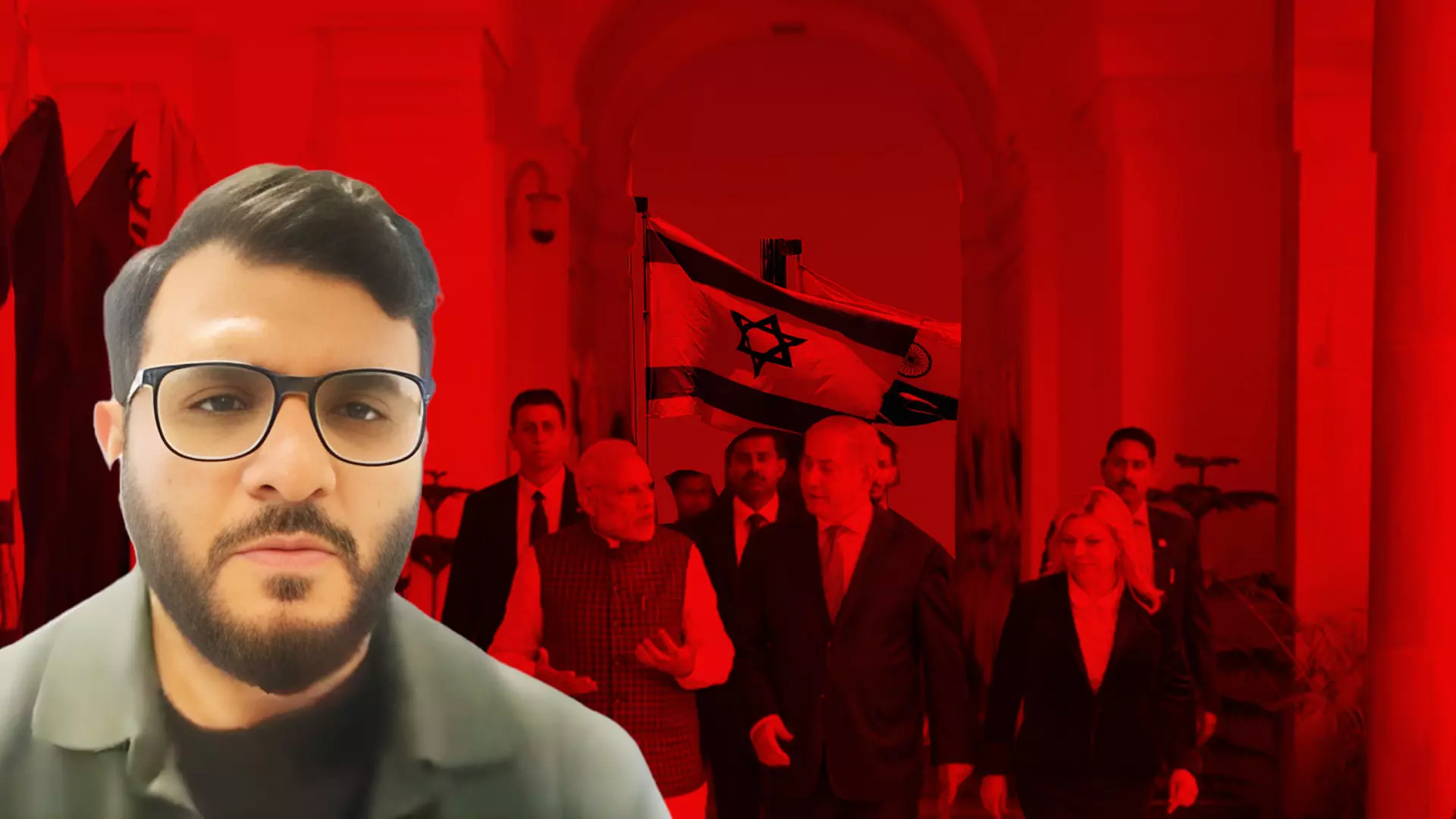
South African journalist and author of 'Hostile Homelands' explains how history, ideology, and geopolitics shaped New Delhi’s evolving stance on Israel, with implications for Kashmir, minority rights, and India’s democratic future
India’s Israel embrace rooted in history, ideology, and arms deals, says S African author
Once a strong sympathiser of Palestine, India today exhibits robust support for Israel in the Gaza War. What changed, if it really changed at all, and at what cost?

The Federal spoke to Azad Essa, a South African journalist and author of the book Hostile Homelands: The New Alliance Between India and Israel, to understand the deepening ties between New Delhi and Tel Aviv.
In a wide-ranging conversation, he unpacked how history, ideology, and geopolitics have shaped India’s evolving stance on Israel and its implications for domestic politics, Kashmir, and minority rights.
India’s support for Israel after October 2023 surprised many. Were you personally taken aback by New Delhi’s stance?
Yes, this is a great place to start because, as you noted, I wrote the book almost three years ago, and it tries to explain this new relationship between India and Israel and how they became closer over the past decade. It also shows how this relationship was built on scaffolding created by past governments in India.
When October 7 happened and the Hamas-led attack took place in southern Israel, I wasn’t surprised that India came out in support of Netanyahu and Israel. I was, however, a little surprised that India was reportedly the first major country to show such open support and condemn the attacks.
What really shocked me was how quickly India was willing to participate in the war. When I wrote the book, I never imagined that by late 2023 there would be reports that India had sent combat drones to Israel to assist in the war in Gaza, which we now know is a genocide.
Also read: Jaishankar meets Israeli PM Netanyahu, discusses deeper strategic ties
I was surprised by the callousness of the Indian state towards the devastation in Gaza and by the multi-pronged assistance — labour, diplomatic shielding, and military supplies. It’s one thing to buy weapons from Israel and become its biggest arms purchaser, but quite another to produce those weapons in your own country and then send them back to Israel to help sustain a war.
That was completely unexpected.
How has the India–Israel relationship evolved since diplomatic ties were established in 1992?
The story of India and Israel is very poorly understood. It’s often seen as a project of Narendra Modi alone, rather than part of a longer history of Indian foreign policy duplicity going back to 1947.
India publicly objected to the partition plan in Palestine and projected a pro-Palestinian stance. But by 1950, it allowed Israel to set up an immigration office in Mumbai. By the 1960s, it was secretly buying weapons from Israel, especially during wars with Pakistan in 1962, 1965, and 1971.
There was a sense that India might have chosen the wrong moral side by being so publicly pro-Palestinian, but that stance suited India at the time. It helped keep Arab states from moving closer to Pakistan and ensured access to energy resources.
At the same time, there was admiration within the Indian military for Israel as a small state that “stood up for itself.” This intensified in the late 1960s with Indira Gandhi establishing RAW and developing ties with Mossad. Over time, Israel came to be seen as a partner in modernisation, militarisation, and closer alignment with the US.
Also read: India, Israel plan two-phase FTA for early trade benefits
The bedrock of the relationship is the military-industrial complex. Israel was willing not just to sell weapons, but also to share technology and help India build its own defense manufacturing base. From the Israeli perspective, this was a long game — building dependency so that India’s foreign policy would eventually shift closer to Israel. That’s precisely what has happened.
Why did India maintain a pro-Palestine public posture while quietly engaging Israel?
This is one of the clearest examples of Indian foreign policy duplicity. Publicly, India projected itself as a leader of the global South and a bastion of anti-colonial thought. It wanted to be seen as pro-Palestinian and committed to the Non-Aligned Movement.
But underneath that, nationalism and strategic pragmatism were growing. India didn’t want to be overly dependent on the Soviet Union for weapons. Israel provided an alternative supplier and was willing to transfer technology.
So there was a public distance from Israel and a private closeness. The more publicly affectionate Indira Gandhi was towards Yasser Arafat, the more the military and security establishment quietly built ties with Israel.
From Israel’s side, they understood that India wouldn’t publicly back them, but they were working through a separate diplomatic channel. They were playing the long game.
Are there similarities between Zionism and Hindutva?
Zionism and Hindutva are not the same, and they developed in very different historical contexts.
Zionism emerged in the late 19th century to create a Jewish homeland in Palestine. Hindutva developed in the late 19th and early 20th centuries as a Hindu nationalist ideology defining India as primarily a Hindu civilization.
Also read: Indian firms complicit in Israel’s war crimes in Gaza, claims report
But there are strong structural similarities. Both emphasise a civilizational homeland, ancient roots, and sacred geography. Both have exclusionist and expansionist elements. Both invoke external enemies and internal threats to justify a permanent security state.
In both, loyalty to the state is tied to religious or cultural identity. There’s also the idea of the conditional citizen. Palestinians in Israel are not fully part of the nation. Muslims in India are often treated as not fully part of the Hindu nation unless they publicly conform to dominant nationalist expectations.
Even Jews in Israel who speak up strongly for Palestinian rights become targets. They may have more rights than Palestinians, but they are still treated differently.
Isn’t it paradoxical that Hindutva ideologues admired European fascism but later supported Zionism?
On the surface, it looks paradoxical, but when you think deeper, it actually makes sense.
Hindutva ideologues in the 1920s and 1930s admired European fascist movements for their nationalist revival, unity, and muscular nationalism. They looked at how Europeans treated Jews and saw a mirror for how they thought Muslims should be treated in India.
Later, when Zionists went to Palestine and used similar tactics—militias, discipline, force—against Palestinians, the Hindu right admired that too. They saw how Zionists created a “new Jew” who fought back, and they liked the methods.
So it’s not a contradiction. It’s about the transport of methodology—unity, physical training, readiness for violence, and youth mobilization—from one context to another.
Are there similarities between how India handles Kashmir and how Israel handles Palestinian territories?
The argument is not that they are identical, but that there are many similarities.
Both are disputes over land that emerged after partition and were taken to the United Nations. Both remain unresolved.
There is heavy militarisation. In Kashmir, there are half a million or more troops, which is extraordinary. There are special legal regimes like the Armed Forces Special Powers Act and the Public Safety Act in Kashmir, and similar administrative laws in Israel.
Both use surveillance, curfews, communication blockades, movement controls, and detention without trial. Both frame resistance as terrorism, especially after 9/11.
Also read: Israel-Hamas conflict: Why India’s pro-Israel tilt is a blunder
India has also imported Israeli tactics into Kashmir—fencing technologies, checkpoints, ambiguous free speech rules, and crackdowns on civil society and journalists.
India isn’t bombing Kashmir like Gaza, but the situation is closer to the West Bank, with constant military presence. In some ways, India’s approach to civil society and surveillance in Kashmir could even be worse than Israel’s in the West Bank.
Do you think India is becoming more like an ethnocratic or authoritarian state, similar to Israel?
It’s a very tough question because India is huge and diverse. Not all parts of the country or the public support this project of Hindutva or the BJP. There is resistance, even if it isn’t always loud.
That said, there are pockets of India that already resemble the Israeli model. Look at how Muslims are treated in Delhi or Uttar Pradesh, or how Christians have been attacked during Christmas.
India has acted brutally towards minorities in its own ways, independent of Israel. But the relationship with Israel seems to give India confidence to behave in a particular way.
Kashmir is a bellwether. The signs are not good. There are forced displays of loyalty, surveillance, and demographic engineering attempts. India feels like an authoritarian democracy, an ethnocracy in some ways, much like Israel, though it is far more diverse.
The future depends on how other regions of India react and resist. But we are moving quickly in that direction.
Any final reflections while writing about this subject?
Working on this topic has been difficult because it’s hard to break into spaces in India willing to talk about it. Students and some groups are interested, but much of the media is captured and aligned with state policies.
There is a strong private media, and there are many independent voices like yours. I hope more people will pick this up and engage with it.
The content above has been transcribed using a fine-tuned AI model. To ensure accuracy, quality, and editorial integrity, we employ a Human-In-The-Loop (HITL) process. While AI assists in creating the initial draft, our experienced editorial team carefully reviews, edits, and refines the content before publication. At The Federal, we combine the efficiency of AI with the expertise of human editors to deliver reliable and insightful journalism.