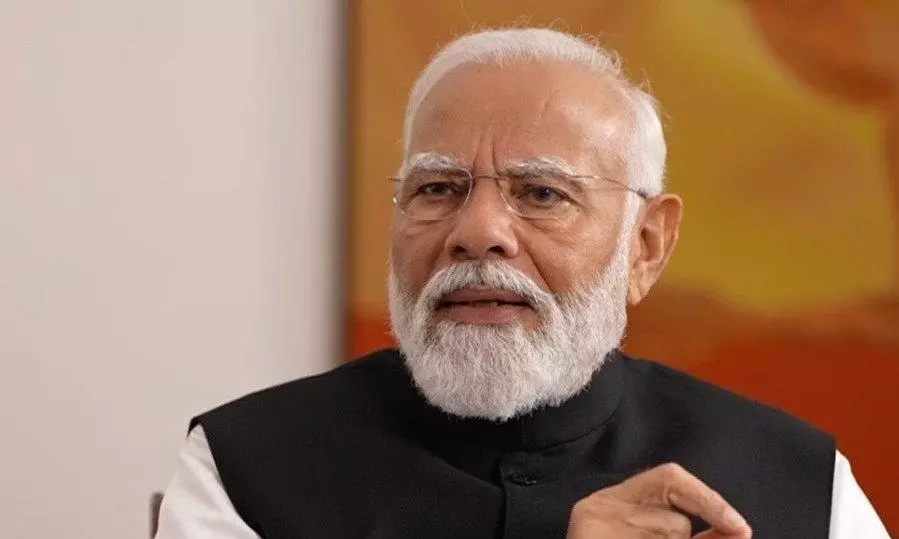
ANI's softball questions let the PM dodge scrutiny on job losses, serving up platitudes where evidence and a credible skilling plan should be
During the India AI Impact Summit 2026 held in New Delhi earlier this month, the Asian News International (ANI) released the text of a purported “interview” with Prime Minister Narendra Modi.
In social media releases, the news agency mounted a couple of videos headlined differently as “7 key moments from PM Modi’s vision for India’s AI future amid ongoing summit in interview with ANI” and “India among top 3: PM Modi’s AI vision”.
These were reposted from various handles of the Prime Minister and his Bharatiya Janata Party.
A purported interview
The videos used clips of Modi walking around the summit as primary visuals and, over these shots, various texts were mounted to convey what he said in the interview.
The likely impact of AI on jobs cannot be wished away with a few sentences aimed at building the confidence of the loyalists.
In at least one of these videos, there were a few still shots of the interviewer, Smita Prakash, Editor of ANI, sitting across Modi. The attires of the two are the same as in the interview she conducted with Modi prior to the 2024 Lok Sabha elections.
Watch/Read: India’s focus shifting from AI adoption to production: IIT Prof Ramakrishnan
However, this article is not about examining whether what has been recently passed off as an “interview” was an actuality or mere text provided by the Prime Minister’s Office.
The purported interview followed a familiar pattern — the lines attributed to ANI functioning less as questions than as springboards, inviting Modi to expound at length with no follow-up to speak of: "…What is the vision of this summit and why this motto (Sarvajan Hitae, Sarvajan Sukhaye, or Welfare for All, Happiness of All)?"
The burning question
However, one question caught the eye because its theme could have been utilised for a meaningful exchange — a query which has been at the centre of several non-technical conversations too — what will be the impact of AI on jobs?
History is replete with instances when jobs have disappeared with the advent of new technology.
The question was posed in a manner to provide an opening for the Prime Minister: “In some section (sic) of youth, there is fear that AI will take away their jobs. India’s demographic dividend will be difficult to harness if that is the case. How is the Government of India tackling this challenge?”
Also read: Trump lied. Repeatedly, confidently, grandiloquently
Because there was no effort to get the correct picture about the extent to which these fears were genuine, Modi got the opportunity to wax platitudes regarding the danger being unfounded and that the government has taken adequate steps. “I understand the concern of our youth about AI-driven disruptions in the job market. Preparation is the best antidote to fear...”
There, however, was a deathly silence on the preparatory steps that have been taken.
Lofty intentions, insufficient results
Nevertheless, a few assertions of the Prime Minister merit scrutiny. To begin with, he claimed that there was no real danger of AI-triggered job losses because “the government has launched one of the most ambitious skilling initiatives in the world”.
Very elementary scrutiny, however, reveals that the Skill India Mission, launched in 2015, may have improved youth employability to over 50 per cent in some sectors and boosted women’s participation in training programmes, but sub-30 per cent placement rates for short-term courses and a need for higher-quality training is a harsh reality.
This clearly means that while intentions may be lofty, when it comes to the primary yield, it is grossly inadequate. The elementary question is whether, after undergoing training, the youth are actually getting jobs. The answer is “no” or “negligible”.
Also read: India must take a sectoral approach to AI regulation: AI scientist
The Prime Minister further said in this section that “we’re not approaching this as a future problem but we’re treating it as a present imperative”. However, this is a hollow claim because it is not backed by any evidence.
History says otherwise
Modi also claims in the “interview” that “history has shown that work does not disappear due to technology. Its nature changes and new types of jobs are created”.
However, any student of history and employment trends knows that history is replete with instances when jobs have disappeared with the advent of new technology.
From the industrial revolution to AI, machines have been replacing human beings, the difference being in the nature of the machines or technology and the levels of skill that were becoming redundant. What we have witnessed in Asia in the past few years were first noticed in western markets and nations.
Grim outlook
In India itself, it is estimated that roughly 50,000 to 56,000 IT jobs were negatively impacted by AI-driven efficiency in 2024-25.
Over the past decade, especially in post-Covid India, the number of jobs has been declining at an unprecedented pace. As the use of AI becomes more widespread, it will have greater impact.
Also read: PM Modi calls for human-centric AI, cautions against 'directionless' use
Research has suggested that that by 2030, as much as 60 per cent of the current jobs may see significant changes at the task level due to AI and automation. Quite obviously, this will have a massive social impact and its extent and nature cannot be assessed at the moment.
But surely, the likely impact cannot be wished away with a few sentences aimed at building the confidence of the loyalists.
Problem with index
Peculiarly, Modi referred to an index prepared by Stanford University and claimed India’s third position in the Stanford Global AI Vibrancy Index is indication of strong growth in AI R&D, talent, and economy.
Modi said 'we’re not approaching this as a future problem but we’re treating it as a present imperative'. This is a hollow claim not backed by any evidence.
Two points arise from this. One, citing a survey prepared by a foreign institution is an instance of duplicity for a political leader who makes claims of leading India’s de-colonisation drive for the next 10 years. The reason behind referring to this Index is simple: India’s high-ranking in a global survey conducted by a foreign institution is the “ultimate” certification.
Also read: Sam Altman: ‘Listening to old people is biggest mistake’ for youth in AI era
Two, the survey does not take jobs—either losses or their addition—into account while preparing the index. The factors taken into account for the Index are R&D, Economy, Policy and Governance, Infrastructure, Responsible AI, Talent and Public Opinion.
Partial truths and hollow claims
In the course of his assertions, Modi also claimed that “history teaches us that whenever innovation happens, new opportunities emerge. The same will be true in the age of AI”.
While this is true, it also simultaneously undeniable that this process takes time and, for the interim period, the government of India does not have a plan because the Prime Minister does not accept that he has a challenge at hand. Unless, of course, an addition to the string of “charity” schemes is what the premier has in mind.
Also read: India AI Summit: 10 things that Google’s Sundar Pichai said
Importantly, Modi also asserted that by “combining innovation with inclusion, we are confident that AI will strengthen India’s workforce. With the right skills and preparation, our youth will lead the future of work…”
But if we probe into the factors behind such bluster, we will surely draw a blank. And, in what context has the word “inclusion” been used?
I drew a blank after racking my brains…
(The Federal seeks to present views and opinions from all sides of the spectrum. The information, ideas or opinions in the articles are of the author and do not necessarily reflect the views of The Federal.)