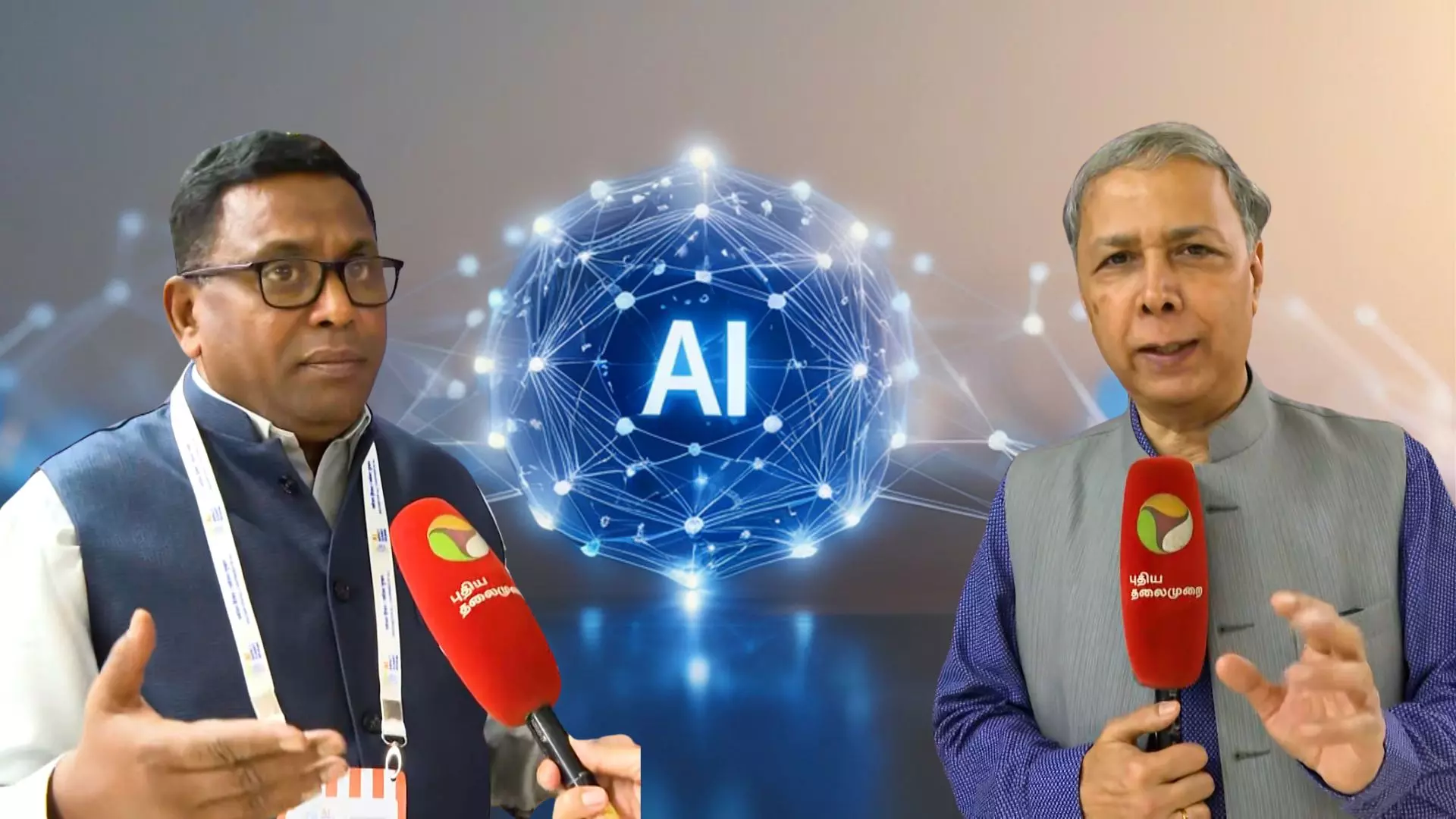
Dr Sivaramakrishnan, AI scientist
India must take a sectoral approach to AI regulation: AI scientist
Dr Sivaramakrishnan, member of UNESCO's AI ethics network, says there can't be a one-size-fits-all model for AI governance, calls for indigenous AI technolgies

India is no longer being viewed merely as a destination for outsourced technology work but as an emerging “innovation factory” in artificial intelligence (AI).
With billions in deals being announced and Indian startups showcasing live AI applications, the country stands at a potential turning point in both investment and employment.
At the India AI Impact Summit 2026 in New Delhi, The Federal spoke to Dr Sivaramakrishnan, AI scientist based in the UAE, and a member of UNESCO's AI Ethics Experts Without Borders (AIEB) network, about how India can convert momentum into jobs, deep-tech capability, and responsible AI governance.
What benefits can India derive from AI in terms of investment and employment?
If you look at the scale of big tech companies present at the summit and the billions of dollars’ worth of deals being announced, that itself is a major signal to investors that serious activity is underway in India. Such announcements create investor confidence in the market and indicate that AI development here is not theoretical but commercially active.
From a talent perspective, the exhibition floor tells its own story. A large number of Indian companies and startups are demonstrating AI applications. That gives end users confidence that these AI systems are safe to adopt. Increased trust naturally leads to higher adoption rates, which benefits the country.
For India, especially as a leading voice from the Global South, this momentum in AI adoption and investment is strategically important.
Also read: India AI Summit: 10 things that Google’s Sundar Pichai said
India has built a strong IT and software industry over decades. How will that help in AI creation and adoption?
India has already created a solid base through its Tier 1 and Tier 2 technology companies. Professionals who have worked for three decades building the IT services industry have laid a strong foundation.
According to global benchmarks such as the MIT index, India ranks among the top three economies in AI-related capabilities. This means the Indian talent pool is no longer associated only with cost arbitrage. It is not just about sending work to India at lower costs.
India is increasingly viewed as an innovation hub. The ecosystem built over three-and-a-half decades is now helping the country move towards the next level of innovation in AI and emerging technologies. That shift from service delivery to innovation is a significant paradigm change, and platforms like the AI Impact Summit help accelerate it.
Also read: Galgotias University forced to exit AI Summit after robot dog row over misrepresentation
What kind of retraining is necessary for IT professionals to transition into AI?
So far, India’s IT ecosystem has largely leveraged or consumed technologies developed elsewhere. That mindset must change.
The focus now should be on collaboration between academia and industry to create frontier AI models within India. Instead of relying primarily on external technologies, India should aim to build deep-tech capabilities that can be used globally.
This requires changes in academic curricula. Universities must adapt their programs to align with emerging AI needs, and industry must play a major role in shaping those curricula to ensure they are future-ready.
UPI was developed in India and has gained global recognition. Can India build similar AI-driven platforms?
The success of UPI demonstrates that India can build a world-class digital infrastructure. Across Europe and the Middle East, UPI is widely discussed as a successful model.
Based on extensive global travel and observation, it is clear that few systems match the scale and seamlessness of UPI. That example proves India has the capability to create transformative digital platforms.
AI can now play a similar role in redefining technologies and applications. The foundation exists; what remains is scaling AI-driven solutions with the same ambition and execution.
What about the risks of rapid AI adoption, including deepfakes and unethical use? How should India respond?
Regulation will be crucial. The Indian government must play a proactive role, and institutions such as the Ministry of Electronics and Information Technology and NITI Aayog are already working on initiatives and guidelines.
However, regulation must take a sectoral approach. There cannot be a one-size-fits-all model for AI governance.
Risk management in AI should be tailored to sectors. For example, BFSI is already a highly regulated industry and offers lessons in structured risk oversight. Similarly, healthcare, retail, and defence each require specific regulatory frameworks for AI deployment.
Cross-sector learning will also be important. Best practices from one sector should inform regulatory approaches in others to ensure consistency and robustness.
With policymakers, investors, startups, and global experts converging at the Sushma Swaraj Bhawan in New Delhi, the AI conversation in India is no longer abstract. The real challenge now is whether the country can convert confidence into capability — and innovation into responsible leadership.
(The content above has been transcribed from video using a fine-tuned AI model. To ensure accuracy, quality, and editorial integrity, we employ a Human-In-The-Loop (HITL) process. While AI assists in creating the initial draft, our experienced editorial team carefully reviews, edits, and refines the content before publication. At The Federal, we combine the efficiency of AI with the expertise of human editors to deliver reliable and insightful journalism.)