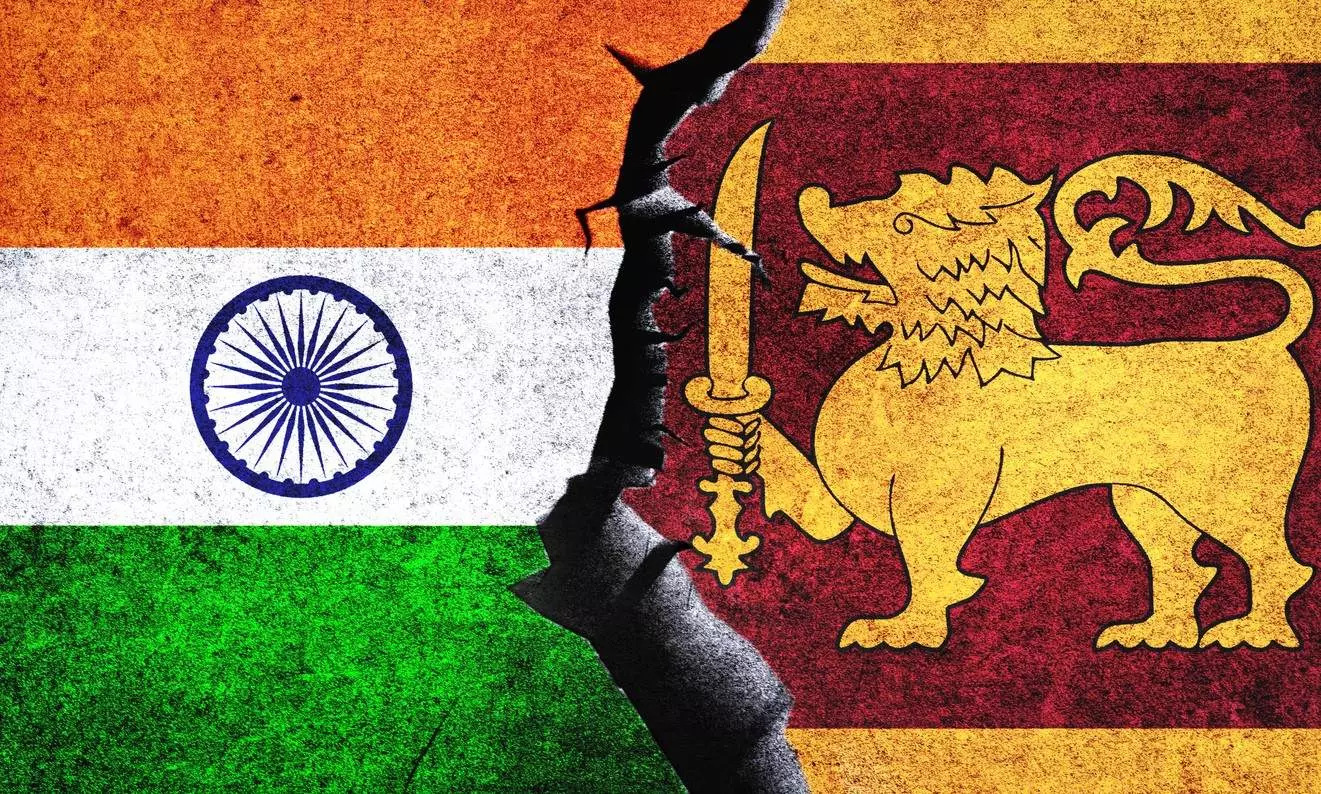
Defence Minister Rajnath Singh seeks respect for soldiers of Operation Pawan of 1987 as the Indian personnel paid a heavy price to maintain island-state's unity
I was walking along a desolate path in Vavuniya district in northern Sri Lanka in the summer of 1988 when I met a group of Indian soldiers coming from the opposite direction. My loud ‘Namaste’ to them in Delhi-accented Hindi surprised the column, whose members were hunting for Tamil Tiger guerrillas.
When some of the soldiers stopped to chat, I learnt they were dominantly from Haryana. Naturally, when they realised I was a journalist from Delhi, a couple of them wanted to know if Devi Lal would become the prime minister!
Also read: Sri Lanka placing roadblocks on Tamil refugees’ return from India
On my part, I flung a loaded question: What were they (soldiers) doing in Sri Lanka? I was surprised to hear the answer from one of the men.
'Two Tamil parties fighting each other'
In Haryanvi Hindi, the soldier said the Indian army’s mission was to protect Tamils in Sri Lanka. Unfortunately, he added, “There are two Tamil parties that are fighting against one another.” He called them the “LTT” (he swallowed the 'E') and “EPR” — his synonym for the Liberation Tigers of Tamil Eelam (LTTE) and the Eelam People’s Revolutionary Liberation Front (EPRLF), respectively.
One agrees with Defence Minister Rajnath Singh, who publicly stated recently that the veterans of the IPKF operation need to be honoured. “I believe the sacrifices made by our IPKF soldiers who participated in Operation Pawan should be respected.”
While the answer would not have enabled him to pass a competitive exam, I was impressed that he had got the basics right. Indeed, during the 32 long and bloody months the Indian Army was deployed in Sri Lanka’s north and east under a 1987 India-Sri Lanka pact, I repeatedly came across Indian soldiers who had a fair idea of the complex situation they were up against but were increasingly confused by the seemingly unending war with the LTTE.
Indian Army bears the brunt
The Indian Army was told to fight the Tamil Tigers, and they did that. After suffering extremely heavy casualties to begin with, the soldiers boxed in the bulk of LTTE fighters in the thickly forested Mullaitivu district until its leader Velupillai Prabhakaran shook hands with Colombo in a desperate bid to get rid of the Indian Peace Keeping Force (IPKF). By the time the soldiers came home, they had lost nearly 1,200 men, while over 3,000 were wounded, many maimed for life.
Also read: Stalin should stay away from Sri Lanka's fractured Tamil politics
For too long, successive Indian governments were coy in discussing the IPKF saga. While one can debate whether the army should have been sent to Sri Lanka in the first place without an adequate understanding of the LTTE, it is unfair to relegate the IPKF to a footnote in military history.
One is not even talking about the shameful conduct of then Tamil Nadu chief minister M Karunanidhi in refusing to formally receive the returning soldiers. Both in India and Sri Lanka, for different reasons, the IPKF was seen as a chapter that was best not spoken about. Tamil Nadu politics was of course, a factor.
Rajnath Singh recalls Operation Pawan
This is wrong. One agrees with Defence Minister Rajnath Singh, who publicly stated the other day that the veterans of the IPKF operation need to be honoured. “I believe the sacrifices made by our IPKF soldiers who participated in Operation Pawan should be respected.”
The fact is that the Indian Army was deployed in Sri Lanka in a bid to end Tamil separatism that threatened to break up the island-nation. As years roll after the LTTE’s rout, many uncomfortable facts have come to light that negate the popular belief that somehow India and its military were to blame for the bloodbath of 1987-90.
Also read: Sri Lanka’s ruling JVP party says it is no longer anti-India as Silva courts Tamil diaspora
A senior LTTE member who quit the outfit over Prabhakaran’s decision to take on the Indian Army has stated now that the Tigers were not formed to make an enemy of India. Prabhakaran himself admitted to an Indian journalist in mid-1987 that he would play such games with the IPKF that nobody would know it was he who triggered the war. Also, dubious links which LTTE operatives maintained with Western intelligence agencies during a tumultuous period are coming to light.
IPKF memorial came late in Sri Lanka, never came in India
So far, there has been no official commemoration of the IPKF deployment, although Prime Minister Narendra Modi visited a memorial near Colombo in honour of the soldiers in 2015 and again last year. (Few Indian tourists visit the lonely monument.) For some years, a group of IPKF veterans and their families have been quietly laying wreaths at the National War Memorial in New Delhi.
It took Sri Lanka nine years after crushing the LTTE in 2009 to erect the IPKF memorial. No such landmark exists in India.
Also read: Amid India-China aid race in Lanka, Tamils seek a diplomatic ‘help’ from Modi
Yes, as it happens in all armed conflicts, excesses were without doubt, committed by a section of the Indian soldiers. Many Tamil civilians were killed for being at the wrong place and at the wrong time. One Sikh soldier told me near the Vavuniya bus stand in late 1988 that he could not differentiate between a Tiger and a Tamil civilian.
Vellupillai Prabhakaran himself admitted to an Indian journalist in mid-1987 that he would play such games with the IPKF that nobody would know it was he who triggered the war.
I myself witnessed an incident of military high-handedness in northern Sri Lanka — and intervened to stop it. But all this does not take away the grim fact that the Indian soldiers paid a very high price to maintain Sri Lanka’s unity and integrity.
In an irony of fate, a former Sri Lankan president (Ranasinghe Premadasa), who had ordered the Indian troops to leave, was assassinated by the LTTE once he was deemed dispensable.
But if India is ready to publicly honour its soldiers who died in Sri Lanka, it must also extend similar courtesy to the numerous Tamils who stood by New Delhi at a difficult time. Many of them were brutally killed by the LTTE precisely for this reason. The one name which figures prominently in this list is the leader of the Tamil United Liberation Front, Appapillai Amirthalingam. That some of those from other Tamil groups who battled the LTTE were themselves accused of extra-judicial killings is another matter.
The bottom line is that no one in any country must be pushed to a corner where he feels ashamed for having sided with India at a certain period.
(The Federal seeks to present views and opinions from all sides of the spectrum. The information, ideas or opinions in the articles are of the author and do not necessarily reflect the views of The Federal)