Sri Lanka’s ruling JVP party says it is no longer anti-India as Silva courts Tamil diaspora
The ruling party's powerful general secretary says relations with India are a priority and calls on Tamils to move past the party’s confrontational history

A top leader of Sri Lanka’s dominant ruling party says he and his colleagues are no longer anti-India in principle and that the Tamil minority needs to shed decades of suspicion towards the Marxist-Sinhalese outfit.
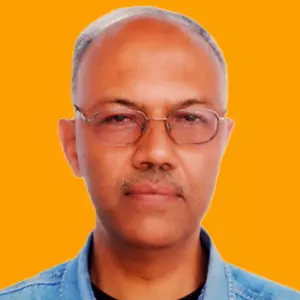
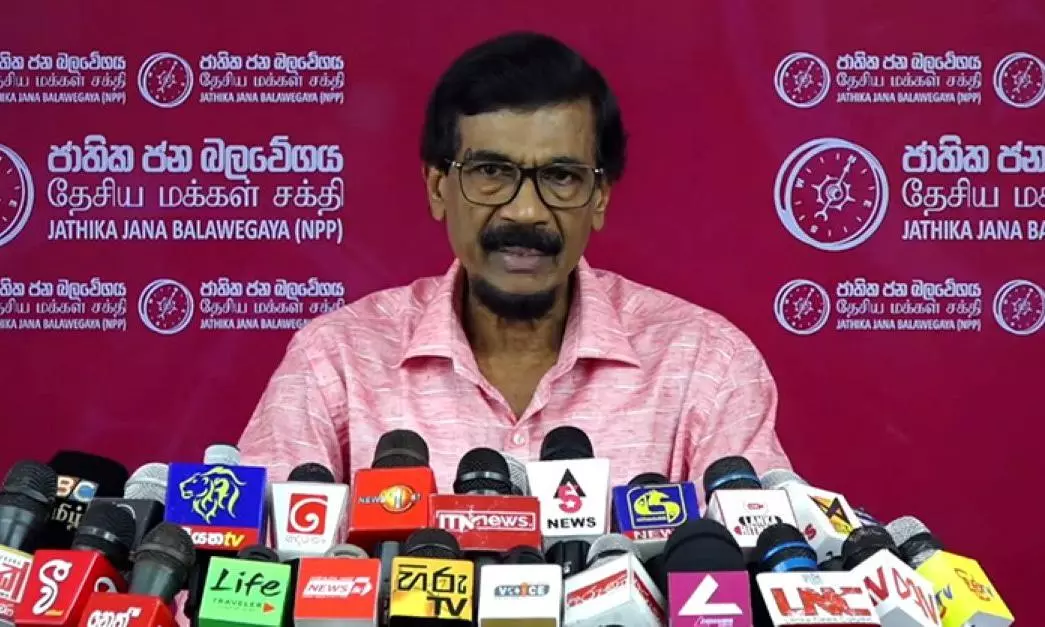
Tilvin Silva (71), General Secretary of the Janatha Vimukthi Peramuna (JVP) or People’s Liberation Front, made the categorical statements during a two-hour discussion with a Tamil diaspora delegation in London.
Also Read: Pakistani security forces foil yet another attack bid on Jaffar Express
“We have changed a lot, and we are now a responsible government,” Silva said, explaining the radical changes that he says have come about in the JVP’s core thinking since it took the reins of power in Sri Lanka at the head of a coalition.
A history of ideological hostility
For decades, the JVP, founded by the late Rohana Wijeweera, was passionately anti-India. Of the five important ideological lessons it taught its thousands of cadres, one was on “Indian expansionism”.
In 1987, when India and Sri Lanka signed a peace accord in a bid to end Tamil separatism, the JVP took to the streets denouncing the pact and heralding its second violent insurgency in an attempt to seize political power.
Also Read: Nepal PM Karki speaks with stakeholders, including Gen Z, on 2026 election
The JVP-led uprising was brutally put down by Colombo, leading to the deaths of thousands on both sides. The party is now led by some of the survivors of that period, including President Anura Dissanayake and Silva.
Silva's influence within JVP
Although Dissanayake is the best-known face of the JVP internationally, Silva is widely seen as the man who holds the real power in the cadre-based organisation and is often described as the real strength behind Dissanayake.
Veerahia Ramaraj, a Tamil of Sri Lankan origin who has resided in Britain for a long time, said of the meeting with Silva that the JVP leader sounded “frank and honest”.
Also Read: One lakh children under 5 yrs died in India due to growth failure in 2023: Lancet study
Three other diaspora Tamils participated in the discussions, alongside two Britain-based JVP leaders present at the November 25 meeting. Silva did not meet any other Tamils during his trip to London.
Resetting ties with India
“We have very good relations with India now,” Silva told the delegation, underlining one of the most significant changes that came about even as the JVP inched towards power in Colombo. He added that the JVP realised the need to forge sound and lasting relations with New Delhi for Sri Lanka’s own interests.
Silva said that while the JVP won't undermine its ties with other countries, including China, it recognised more than ever the importance of having India as a friend. “We will not do anything that hurts India.”
Also Read: Pakistan-born US student held with arsenal in alleged mass-shooting plot
Although President Dissanayake has also spoken on similar lines, Silva’s pledge is seen as significant since he has held the overarching power in the JVP organisation as its general secretary for decades.
Ramaraj, 66, a former Tamil militant who has known Silva for a long time, said he saw a “200 per cent change in the JVP” on the issue of India and Tamils.
According to him, the JVP, which heads Sri Lanka’s ruling NPP (National People’s Power) coalition, had realised the need to have India on its side, both to stabilise the Sri Lankan economy and to overcome international challenges.
JVP's outreach to Tamils
At the same time, Silva spoke about the need for the Tamil community in Sri Lanka to stop viewing the JVP based on its past and said the JVP was determined to mend fences with the Tamils and other minorities.
For too long, the JVP has acted as a Marxist group with a Sinhalese cloak. It was one of the strongest backers of the long war the military pursued against the Tamil Tigers, leading to the loss of tens of thousands of lives, mostly innocent civilians.
Also Read: Mass wedding in Gaza celebrates new life after 2 years of war and deaths
“Tamils should not see us suspiciously,” Silva said, speaking in Sinhalese even as he took questions in both Sinhalese and English.
He said Tamils had overwhelmingly voted for the JVP/NPP in the last parliamentary elections and that the JVP was determined not to betray the community’s trust.
Diaspora presses for elections
Silva was more than frank when the diaspora delegation pressed him on the need to hold provincial council elections across the country, including in the Tamil-majority north and the multi-racial eastern province.
He admitted that the JVP was not interested in principle in the provincial elections, but the government would nevertheless hold them since the provincial bodies were a part of Sri Lanka’s constitution in the wake of the 1987 India-Sri Lanka pact.
Also Read: 'Show us he’s alive': Imran Khan’s son seeks proof of father's life from Pak govt
The Tamil delegation made it clear to Silva that the small group of Tamils still enamoured of the Liberation Tigers of Tamil Eelam (LTTE), who staged a vocal protest against him in London, did not represent the Tamil diaspora majority in the United Kingdom.
Broader hopes among Tamil diaspora
On the contrary, most Tamils now in Britain and other countries where they live are interested both in Sri Lanka’s overall development and in seeing provincial council elections in the island nation. “Now everyone is talking about (the need to have) provincial elections in Tamil areas so that local development can take place,” Ramaraj said.
Also Read: US halts all visas for Afghan passport holders after DC shooting
Ramaraj added, “Silva spoke with conviction and came across as honest and genuine. We have no doubts that the JVP leadership has undergone radical changes. How far these changes have percolated to the cadres and how much time it will take for everyone to forget the past is something no one can say with precision.”