Amid India-China aid race in Lanka, Tamils seek a diplomatic ‘help’ from Modi
India pledges mega reconstruction package following Cyclone Ditwah as New Delhi and Beijing compete for influence, but Sri Lankan Tamils seek something more

In a bid to edge past China in an increasingly hostile South Asia, India has announced a nearly half-a-billion-dollar assistance to Sri Lanka as the island nation struggles to recover from a devastating cyclone even as the fallout of the earlier economic meltdown lingers on.
External Affairs Minister S Jaishankar declared on Tuesday (December 23), during a quick overnight visit to Colombo, that India will provide a $450-million reconstruction package to Sri Lanka to overcome the nationwide destruction caused by Cyclone Ditwah that killed more than 640 people in late November.
“As your closest neighbour and in line with our Neighbourhood First … policies, it was only natural that India step forward at a time when Sri Lanka faced a crisis,” said Jaishankar, who was an Indian diplomat in Colombo in the 1980s and whose visit now came as a special envoy of Prime Minister Narendra Modi.
Largest aid package
The latest aid, of course, does not match the $4-billion financing facilities India gave Sri Lanka after it entered sovereign default in April 2022 following a major economic crisis that triggered a political tsunami. But the $450 million is still the largest amount announced by any country after the cyclone.
Also read: Sri Lankan minister under radar after anti-India protest by JVP leader in Jaffna
A diplomat in Colombo observed that while the Indian largesse was no doubt a genuine act of friendship, it certainly had to do with China’s growing assertion in Sri Lanka — as in the rest of South Asia, which India has for decades considered its sole backyard.
But New Delhi’s traditional influence in the populous region is increasingly under threat, with anti-India sentiments raging in Bangladesh and Pakistan besides simmering tensions with Nepal. India is just about coming out of a recent tense past with the Maldives.
China right behind
As if to prove the India-China contention, a high-level Chinese delegation led by Wang Junzheng, a member of the central committee of the Communist Party of China (CPC), announced also on Tuesday in Colombo that Beijing was ready to extend all necessary assistance at all times under the “Rebuilding Sri Lanka” programme.
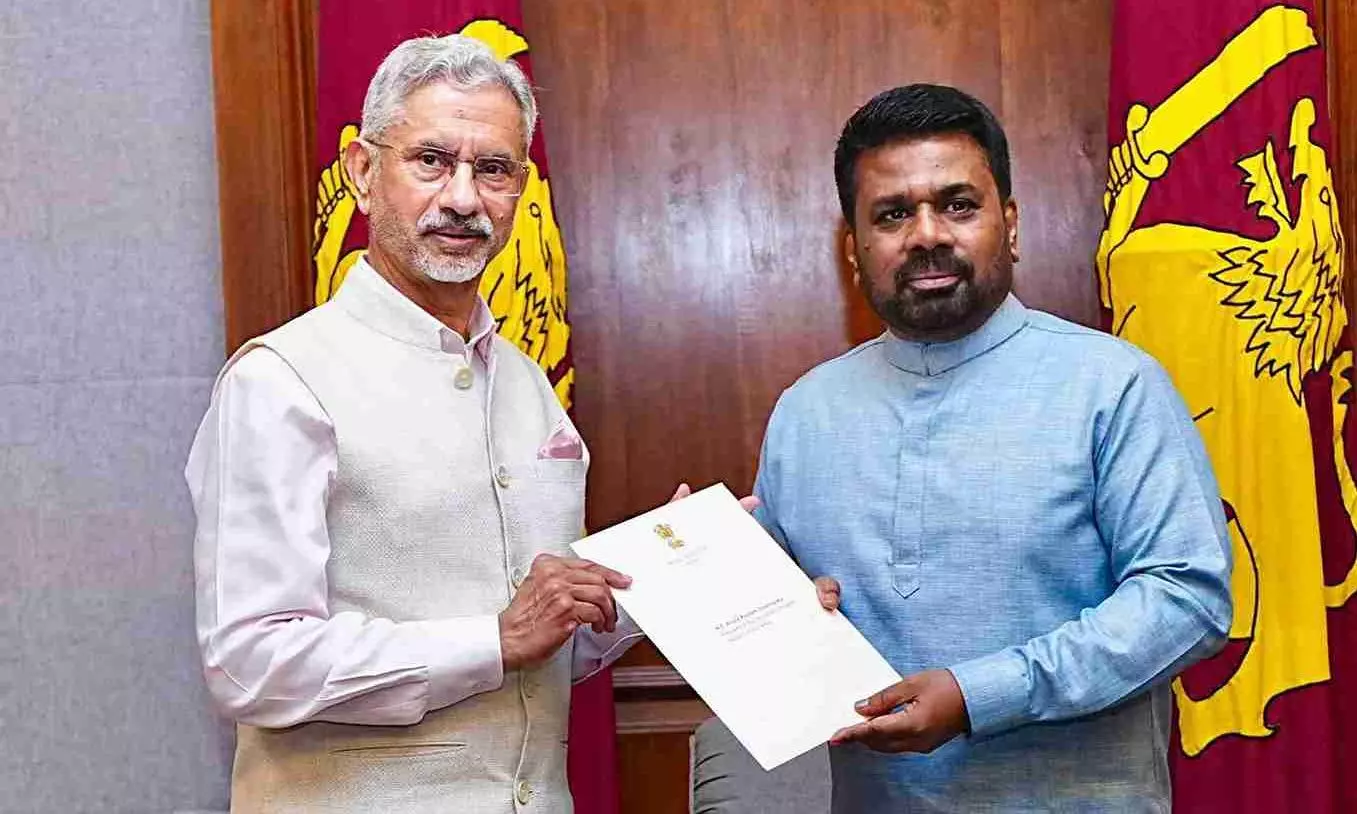
Wang stated this while meeting Sri Lankan president Anura Dissanayake, shortly after Jaishankar called on the latter. Dissanayake’s Marxist Janatha Vimukti Peramuna (JVP or People’s Liberation Front) has enjoyed close ties with the CPC while pursuing a fiercely anti-India line until recently.
Also read: Sri Lanka’s ruling JVP party says it is no longer anti-India as Silva courts Tamil diaspora
Experts say India’s extraordinary financial support to Sri Lanka after the economy collapsed in 2022 was both a move to display its ability to compete with China and improve bilateral ties with Colombo. At the same time, India did not want Sri Lanka—the two countries are separated by a narrow strip of sea—to implode.
Modi’s letter
At his meeting with president Dissanayake, Jaishankar handed over a letter from Prime Minister Modi which pledged: “As in the past, we will stand shoulder to shoulder with you in rebuilding lives and ensuring resilience in Sri Lanka.”
Indeed, on the very day Cyclone Ditwah made landfall, two Indian naval ships, including an aircraft carrier, reached Colombo and delivered relief material. The Indian Air Force deployed M-17 helicopters for two weeks in Sri Lanka.
Also read: Colombo permits LTTE remembrance as JVP–Tamil dialogue unfolds in London
Simultaneously, an 80-member Indian disaster response force conducted rescue and relief operations. The Indian Army set up a field hospital near Kandy, one of the places worst hit by the cyclone and the resultant floods, and provided emergency care to over 8,000 people within days.
On Tuesday, Jaishankar and Sri Lankan minister Vijitha Herath formally inaugurated a Bailey bridge transported by a C-17 aircraft at Killinochchi in the country’s north, a region which, for many years, was at the heart of a Tamil separatist campaign. Another Bailey bridge is under construction at Chilaw, about 80 km north of Colombo.
Help with infrastructure, health, education and more
Under Operation Sagar Bandhu, India has delivered more than 1,100 tonnes of relief material, including dry rations, tents, tarpaulins, hygiene kits, essential clothing and water purification kits. Another 14.5 tonnes of medicines as well as medical equipment were also given to Sri Lanka.
Jaishankar said the Indian assistance would cover restoration of road, railway and bridge connectivity, construction of destroyed and damaged houses, support for health and education systems, overcoming agricultural shortages and, equally important, working towards better disaster response.
Also read: EAM Jaishankar meets Lanka PM Amarasuriya, assures India's commitment to rebuilding
In response, Sri Lankan leaders, including Dissanayake, thanked India and China separately for coming to the aid of the country. Sri Lankan ministers admit they walk a tight rope between New Delhi and Beijing, knowing their rivalry.
The cyclone inflicted an estimated $4.1 billion in direct physical damage to buildings, agriculture, including tea estates, and critical infrastructure across Sri Lanka, equivalent to around 4 per cent of GDP, according to one study. Some two million people and 500,000 families were hit hard across all 25 districts.
Tamils seek diplomatic intervention
Coinciding with Jaishankar’s visit, Sri Lanka’s main Tamil political parties are said to have urged India to undertake a fresh diplomatic initiative to help create an effective framework for genuine and structured dialogue between Tamil political leadership and the government.
The appeal was reportedly made in a letter to Prime Minister Modi which the Tamil parties handed over to the India’s high commissioner in Colombo.
Also read: Testing time for India's foreign policy: Can Modi govt rise to the challenge?
Accusing the government of delaying the implementation of the 13th amendment to the constitution to devolve powers to provinces, including Tamil areas, and holding provincial elections despite promising to do so, the letter said this had caused grave disquiet in the Tamil community.
Fear of radicalisation
The letter is said to have warned that there was growing concern that a new generation of Tamil youth may become vulnerable to radicalisation by global Tamil nationalist groups, at times encouraged by regional actors whose geopolitical interests do not align with India’s security concerns.
The 13th amendment to the constitution, which is controversial in Sri Lanka, came about as a result of the 1987 India-Sri Lanka Accord that sought to end Tamil separatism. Under the pact, India deployed troops in the country’s north and east which ended up fighting a bloody war with the Tamil Tigers before withdrawing in March 1990 after losing nearly 1,200 men.
Also read: Sri Lankan Tamils formally acknowledge LTTE leader Prabhakaran's death
The joint letter to Modi was submitted by Tamil parties including the Ilankai Tamil Arasu Katchi or ITAK as well as leaders of the People’s Liberation Organisation of Tamil Eelam, the Tamil Eelam Liberation Organisation, and the Eelam People’s Revolutionary Liberation Front.