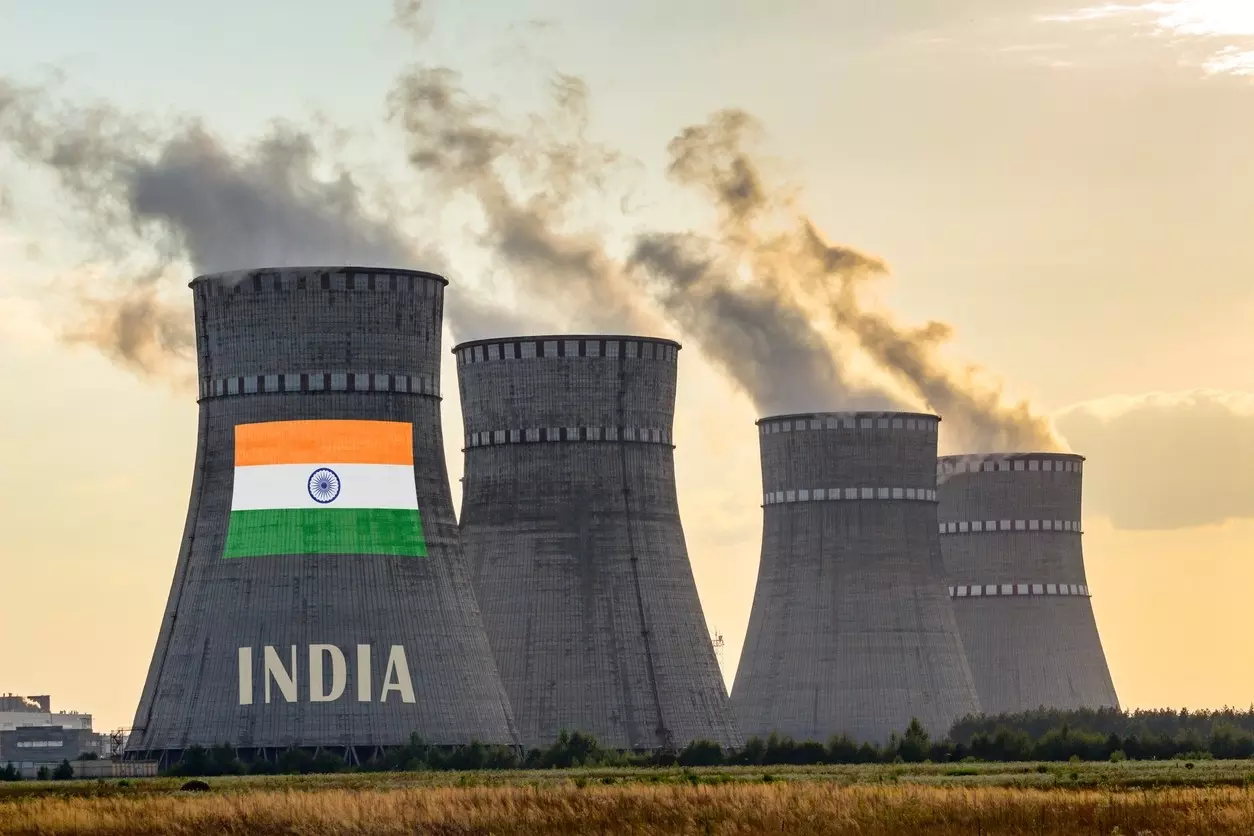
As India eyes a 100 GW nuclear future driven by private investment, a troubling cocktail of judicial overreach and legislative exemptions threatens to shield the civilian atomic sector from public scrutiny
India stands at the threshold of a nuclear renaissance. The government wants nuclear power to grow from less than 9 GW today to 100 GW by 2047, aided by private participation, foreign investment and new technologies.
The recent criticality of the Prototype Fast Breeder Reactor at Kalpakkam has brought India's long-term thorium future within sight. Policymakers increasingly recognise that nuclear power will have to become a central pillar of India's energy, industrial and climate strategy.
Two cases of concern
At precisely such a moment, however, two recent developments could end up undermining this nuclear renaissance while intending to do exactly the opposite.
Also read: Atomic Energy Bill 2025: Why India’s 100 GW nuclear mission is a distant dream | Interview
One is the Delhi High Court's recent judgment refusing disclosure of the Safety Analysis Report (SAR) of the Kudankulam Nuclear Power Plant (KNPP) under the Right to Information Act. The other is the transparency and accountability framework under the SHANTI Act, passed by Parliament in December 2025.
Together, they reveal a troubling screen of opacity being drawn around an expanding civilian nuclear sector that will increasingly involve private interests.
An India building 100 GW of reactors, breeder reactors, reprocessing facilities and private operators will attract far greater scrutiny than it does today. Transparency will then be imposed on India by external forces if it fails to incorporate it as a democratic virtue and trust-generating asset.
The Delhi High Court's judgment deserves careful reading. It is legally defensible within the existing structure of the RTI Act. The more interesting question is not whether the Court could find an exemption. It is whether it gave sufficient weight to the democratic and strategic rationale for transparency in a civilian nuclear programme.
The Court overturned a 2012 order of the Central Information Commission (CIC) directing disclosure of the Kudankulam SAR after redacting proprietary design and technical details.
Fourteen years later, it held that disclosure was exempt on two grounds. First, under Section 8(1)(e) of the RTI Act, NPCIL (Nuclear Power Corporation of India Limited) held the report in a fiduciary capacity vis-à-vis Russia, which supplied the reactor technology. Second, under Section 8(1)(a), disclosure could affect India's scientific and strategic interests and its relations with a foreign State.
The Court further observed that the Supreme Court had already examined safety concerns relating to KNPP and permitted the project to proceed, thereby weakening the case for disclosure in the larger public interest.
These are not frivolous concerns. Governments must protect genuinely sensitive information. No serious advocate of transparency is asking for reactor blueprints, security protocols or classified technical data to be placed in the public domain.
Yet, the central question raised by the judgment is not whether some information should remain confidential. It is whether safety information concerning a civilian nuclear facility should be treated as an indivisible secret.
NPCIL's obligations
In reaching its conclusions, the Court essentially asked: What are NPCIL's obligations to Russia?
The prior question should have been: What are NPCIL's obligations to the people of India? This is not an argument for disregarding international agreements. India must honour its contractual and diplomatic obligations. But the hierarchy of obligations matters.
The primary duty of the Indian State, its public sector enterprises and its courts is to the Indian citizens. Public safety, public accountability and democratic transparency must come before contractual sensitivities.
The fiduciary argument deserves particular scrutiny because it is increasingly invoked to deny access to information of public importance. Fiduciary relationships arise when one party entrusts information to another in circumstances of confidence and dependence—a doctor and patient, a lawyer and client, a trustee and beneficiary. NPCIL is none of these things. It is the operator of a civilian nuclear facility situated on Indian soil and ultimately accountable to the Indian public.
Also read: Atomic Energy Bill: What it means to allow private firms into India’s nuclear sector
To elevate its duty of confidentiality towards a foreign supplier above its obligation of transparency towards Indian citizens is a troubling proposition.
The Court's foreign-relations argument is stronger. States should protect information whose disclosure could affect sensitive international relationships. Yet even here, the question is not whether all information should be disclosed but whether all information should be withheld. The CIC's 2012 order offered a sensible balance: redact proprietary design information and genuinely sensitive technical details but disclose the broader safety case.
Instead, the Delhi High Court has effectively treated a safety report as a single indivisible secret, conflating safety with security in the process.
A Safety Analysis Report exists primarily to demonstrate that a reactor is safe. It is not, by itself, a security document. Portions of it may contain proprietary design information whose disclosure would be inappropriate. Such information should remain protected.
But it does not follow that the entire report must be treated as a secret. Many advanced nuclear countries have long adopted a different balance. They publish substantial portions of safety assessments, licensing documents and incident reports while withholding genuinely sensitive information.
The objective is to allow citizens to understand why a facility has been deemed safe without compromising security. Otherwise, the public is simply being asked to trust the authorities and the foreign vendor. That is unacceptable in mature democracies.
Supreme Court's judgment
The Court's reliance on the Supreme Court's earlier judgment upholding Kudankulam is also problematic. Transparency and safety are different questions. Even if the Supreme Court was satisfied that the plant could proceed, citizens still have a legitimate interest in understanding the underlying safety case for themselves.
The Supreme Court's examination occurs at a particular moment, on the basis of the material placed before it. A nuclear power plant, however, operates for several decades. Public confidence must therefore be sustained over the entire operational life of the reactor, not merely at the point when judicial approval is granted.
Most importantly, the issue before an RTI regime is not whether judges are satisfied with a project's safety. The issue is whether disclosure serves public accountability. There’s a sound and straightforward democratic principle to apply in such cases: any information that can be shared with Parliament in an unclassified form should presumptively be available to the public.
Also read: India’s nuclear push comes with a catch: Absurdly low liability, unlimited public risk
This becomes compelling when one considers the role of the nuclear regulator. The SHANTI Act corrects a long-standing institutional weakness by finally giving statutory status to the Atomic Energy Regulatory Board (AERB). It is now required to report to Parliament, table safety assessments and publish inspection findings, incident reports, license conditions and responses to public objections.
Its mandate also includes public outreach and emergency preparedness. Can such a regulator credibly claim that safety assessments cannot be disclosed because an operator owes contractual obligations to a reactor supplier?
The Kudankulam judgment would have been important even if India's civilian nuclear programme were not about to change fundamentally. But because it coincides with the largest restructuring of the sector since Independence, its implications extend well beyond one RTI application.
Indeed, in RBI vs Jayantilal Mistry (2015), when the Reserve Bank of India refused to disclose bank inspection reports on the ground that it held information supplied by banks in a fiduciary capacity, the Supreme Court rejected that argument. It held that the RBI, as regulator, owed its primary duty to the public rather than to the entities it regulated.
That principle is highly relevant here.
By the time the Delhi High Court delivered its judgment, the Kudankulam Safety Analysis Report would necessarily have been before the AERB in some form as part of the licensing and regulatory process.
The Court might therefore have considered whether the disclosure obligations of an independent statutory regulator stood on a different footing from those of NPCIL. Even if NPCIL owed contractual obligations to Rosatom, AERB does not. That possibility deserved examination.
A regulator earns legitimacy by making its reasoning visible. A regulator that cannot explain why a reactor is safe is effectively asking the public for faith rather than confidence.
A dangerous cocktail
The Kudankulam judgment would have been important even if India's civilian nuclear programme were not about to change fundamentally. But because it coincides with the largest restructuring of the sector since Independence, its implications extend well beyond one RTI application.
It now becomes part of the legal and institutional framework within which India proposes to build a vastly larger civilian nuclear industry.
The judgment is also of a piece with an older institutional instinct within India's atomic establishment. Since 1974, India's nuclear programme has had to survive under hostile external conditions — technology-denial regimes, sanctions, warnings and threats. It survived by cultivating an elite technocratic culture in which secrecy was often indispensable.
That mindset was understandable when the primary challenge was building and protecting a strategic capability. But India's civilian nuclear sector has entered a different phase. It was largely delinked from the weapons programme under the India-US civil nuclear agreement.
Today, India is discussing large-scale expansion, private participation, foreign investment and 100 GW of nuclear power within two decades.
Also read: SHANTI Bill 2025: Who pays in case of a nuclear disaster?
A handful of reactors can be governed through elite consensus on maintaining secrecy. One hundred gigawatts cannot. At that scale, land acquisition disputes, environmental concerns, labour issues, operational incidents and local political movements become inevitable.
Such a system requires social legitimacy. And social legitimacy cannot be sustained through secrecy.
These issues become even more important in light of the SHANTI Act. The government wants a vastly larger civilian nuclear industry driven by private participation and foreign investment. Yet, it also appears determined to preserve a transparency and accountability regime designed for a State monopoly.
Those two ideas do not go together.
Indeed, the government's own political rhetoric suggested precisely the opposite. During the parliamentary debate on the SHANTI Bill, the Minister of State for Atomic Energy, Jitendra Singh, argued that the legislation would open up a sector that had "traditionally operated behind a veil of secrecy."
Yet Section 39 of the Act empowers the government to classify information relating to “the theory, design, siting, construction and operation of nuclear power plants” as "restricted information" if its disclosure is considered prejudicial to national security or, somewhat ironically, even to "public interest."
This is an overbroad provision under which almost any aspect of a civilian nuclear project can be put beyond public scrutiny.
Worse, this erosion of transparency is occurring at precisely the same time that the SHANTI framework reduces the scope for supplier liability, caps operator liability, and leaves the ultimate responsibility for responding to a nuclear incident with the government — and therefore with the taxpayer.
Together, these conditions create a dangerous cocktail. The lack of transparency weakens accountability. So, do reduced supplier liability and capped operator liability. And read along with Section 35 of the Act, which empowers the government to take over the rights and liabilities of any contractor in the nuclear sector, these provisions together create conditions for mischief by private entities.
If that’s not alarming enough, this erosion of transparency and accountability is happening just as the government is considering, under corporate pressure, reducing the exclusion zone around nuclear power plants, making land acquisition for projects easier, and removing siting restrictions.
For a country that needs a major expansion of nuclear power, that would be a profound strategic mistake.
India desperately needs a large civilian nuclear power sector. But it will not be built without democratic consent and social legitimacy.
The Kudankulam judgment and the transparency framework embedded in the SHANTI Act do not create the conditions for public confidence. They risk creating the conditions for future protests, project delays and confrontation between the State and its citizens.
The Bhopal disaster
The legacy of the Bhopal gas tragedy — not merely as an industrial disaster but as one of sovereign and institutional failure to deliver justice to its victims — should weigh heavily on policymakers, regulators and judges contemplating the future of nuclear governance.
There is another reason why India should think carefully about transparency. India occupies a unique ‘trishankhu’ position in the global nuclear order. It is a nuclear-weapons State outside the Nuclear Non-Proliferation Treaty, while simultaneously operating a safeguarded civilian nuclear programme.
An India building 100 GW of reactors, breeder reactors, reprocessing facilities and private operators will attract far greater scrutiny than it does today. Transparency will then be imposed on India by external forces if it fails to incorporate it as a democratic virtue and trust-generating asset.
Needed: A civilian nuclear transparency doctrine
What India needs, therefore, is a civilian nuclear transparency doctrine built upon a bright-line distinction between the strategic and civilian domains.
The strategic programme — weapons design, fissile-material inventories, naval reactors, military fuel cycles, weapons-related reprocessing and strategic intelligence — should continue to be protected by maximum secrecy.
Also read: India’s nuclear triad goes deep as INS Aridhaman inducted but missiles yet to catch up
The civilian programme — safety analyses, environmental assessments, inspection findings, incident reports, regulatory decisions, emergency preparedness plans, waste-management strategies and decommissioning plans — should be governed by maximum transparency.
The CIC's 2012 order pointed towards the right balance: disclose what can safely be disclosed and protect what genuinely must remain secret.
The Delhi High Court's judgment and Section 39 of the SHANTI Act point in the opposite direction, applying the governance logic of a strategic programme to a future civilian industry that requires a completely different social contract.
If that logic becomes embedded in India's nuclear governance architecture, it may achieve precisely the opposite of what its proponents intend. It will not protect India's nuclear renaissance. It will undermine it.
The time to take corrective steps to build in transparency and accountability is now — before the government notifies the rules and regulations under the SHANTI Act.
(The Federal seeks to present views and opinions from all sides of the spectrum. The information, ideas or opinions in the articles are of the author and do not necessarily reflect the views of The Federal.)