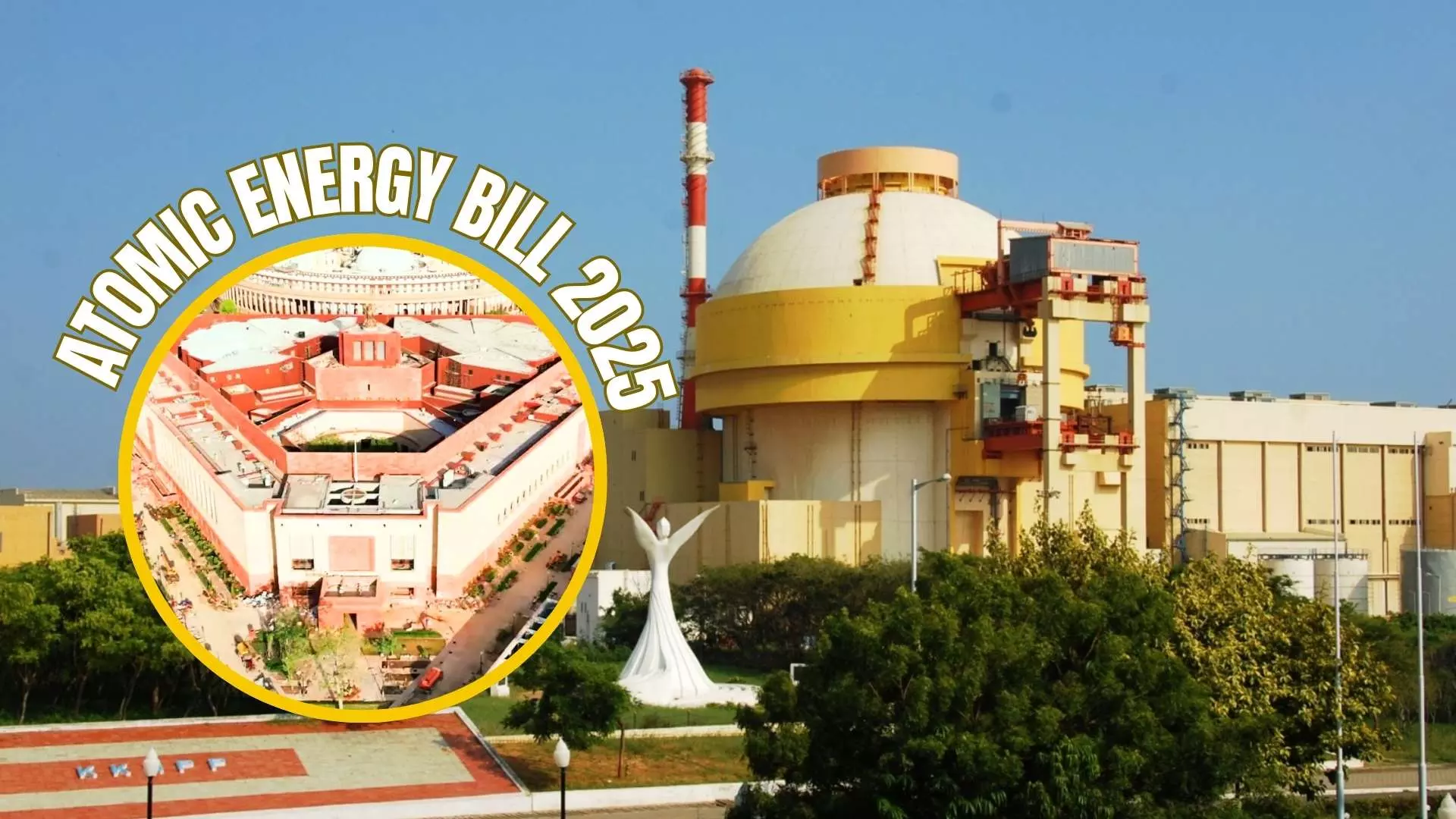
Atomic Energy Bill: What it means to allow private firms into India’s nuclear sector
During the ongoing winter session, Parliament is set to debate Atomic Energy Bill 2025, which will allow private firms to build and run nuclear plants. Can this reform bridge the nation’s massive power gap?

India is preparing for a pivotal debate in the winter session of Parliament as the government introduces the Atomic Energy Bill 2025, a reform that could open nuclear power generation to private companies for the first time. The legislation aims to boost capacity and address long-standing structural issues that have kept India from reaching its nuclear energy targets.
At present, all of India’s more than 20 operational reactors are run exclusively by the Nuclear Power Corporation of India Limited (NPCIL). But as the country seeks to expand its nuclear capacity from 8.8 GW today to 22 GW by 2032 and eventually 100 GW by 2047, the government argues that NPCIL alone cannot meet the scale, speed, or investment required. NPCIL lacks sufficient capital, manpower, supply chain depth, and construction capacity, prompting policymakers to push for private-sector involvement that may bring greater funding, engineering strength, and global project management expertise.
India’s nuclear targets
Reaching 100 GW by 2047 will demand investment of nearly Rs 15-18 lakh crore, based on NITI Aayog’s 2023 energy modelling study and Central Electricity Authority of India (CEA) projections. Yet, nuclear energy received only Rs 20,000 crore in the 2025-26 Budget, far below what is needed to drive rapid expansion. Since nuclear reactors require extremely high upfront investment — often up to five times more than solar, wind, or hydropower — the government believes that private capital is essential to sustain India’s long-term nuclear ambitions. The challenge, however, lies in developing the workforce and expertise for an industry that has never had a private operator before.
Also read: Modi-Putin meet: Top quotes from joint press conference
India’s nuclear history has been marked by slow project execution. The Kudankulam project in Tamil Nadu, particularly Units 3 to 6, has faced years of delays due to procurement bottlenecks, construction challenges, and administrative hurdles. Beyond technical and bureaucratic issues, prolonged public opposition has significantly affected progress. For nearly a decade, residents, fisherfolk, and activists protested around the plant, driven by fears of radiation, environmental damage, and loss of livelihood. These protests led to FIRs, police action, and even sedition charges, demonstrating how strongly local communities react to perceived nuclear risks.
Public resistance
Resistance is widespread across India. Concerns include radioactive waste, hot water discharge into marine ecosystems, displacement threats, and the spectre of catastrophic accidents like Fukushima, Japan. Many communities complain about the lack of transparent consultation and prefer investment in renewable energy over nuclear power. Although the government argues that private players could streamline supply chains and improve project execution, resistance is expected to remain one of the biggest barriers for any future operator.
Innovation push
The proposed Bill also signals a shift towards nuclear innovation. Through the Nuclear Energy Mission announced in the 2025-26 Budget, the government plans to accelerate small modular reactor (SMR) development. India aims to build five indigenous SMRs by 2033 and advance designs such as the Bharat Small Reactor, molten salt reactor, and high-temperature gas-cooled reactor. Allowing private companies into research, design, and manufacturing is expected to speed up the development and commercial deployment of these advanced technologies.
India’s uranium reserves — around 76,000 tonnes — are only enough to fuel roughly 10,000 MW of nuclear capacity for 30 years, making it a small fraction of future demand. Since uranium mining, import, and processing are currently controlled solely by the government, private-sector participation in parts of the fuel cycle could help build strategic reserves and secure long-term supply, provided strong safeguards remain in place.
Liability barriers
A major challenge for private investment has been India’s stringent liability regime. Under the Civil Liability for Nuclear Damage Act of 2010, Section 17(b) allows operators to sue suppliers after an accident, raising insurance costs and deterring both manufacturers and private operators.
The Atomic Energy Bill 2025 aims to ease many of these barriers by amending the Atomic Energy Act to allow private participation, enabling joint ventures and Public-Private-Partnership (PPP) models, revising liability rules in line with international norms, streamlining multi-layered clearances, supporting research into SMRs and thorium reactors, and expanding India’s domestic nuclear manufacturing ecosystem. If enacted, it would represent the most significant change in India’s nuclear policy in six decades.
Safety fears and trust deficit
Public safety remains at the heart of the debate. After the Fukushima disaster, communities in Jaitapur, Kovvada, and other proposed nuclear sites have consistently raised concerns over radiation risks, inadequate evacuation planning, potential environmental damage, and the lack of independent safety audits. Many protests have resulted in police action, injuries, and long court battles, deepening mistrust. Critics warn that the entry of large corporate players could intensify suspicion in regions where confidence in regulatory oversight is already low. Experts argue that for the Bill to succeed, reforms must balance India’s energy needs, private-sector capacity, and — most importantly — public trust and safety.
(The content above has been transcribed from video using a fine-tuned AI model. To ensure accuracy, quality, and editorial integrity, we employ a Human-In-The-Loop (HITL) process. While AI assists in creating the initial draft, our experienced editorial team carefully reviews, edits, and refines the content before publication. At The Federal, we combine the efficiency of AI with the expertise of human editors to deliver reliable and insightful journalism.)