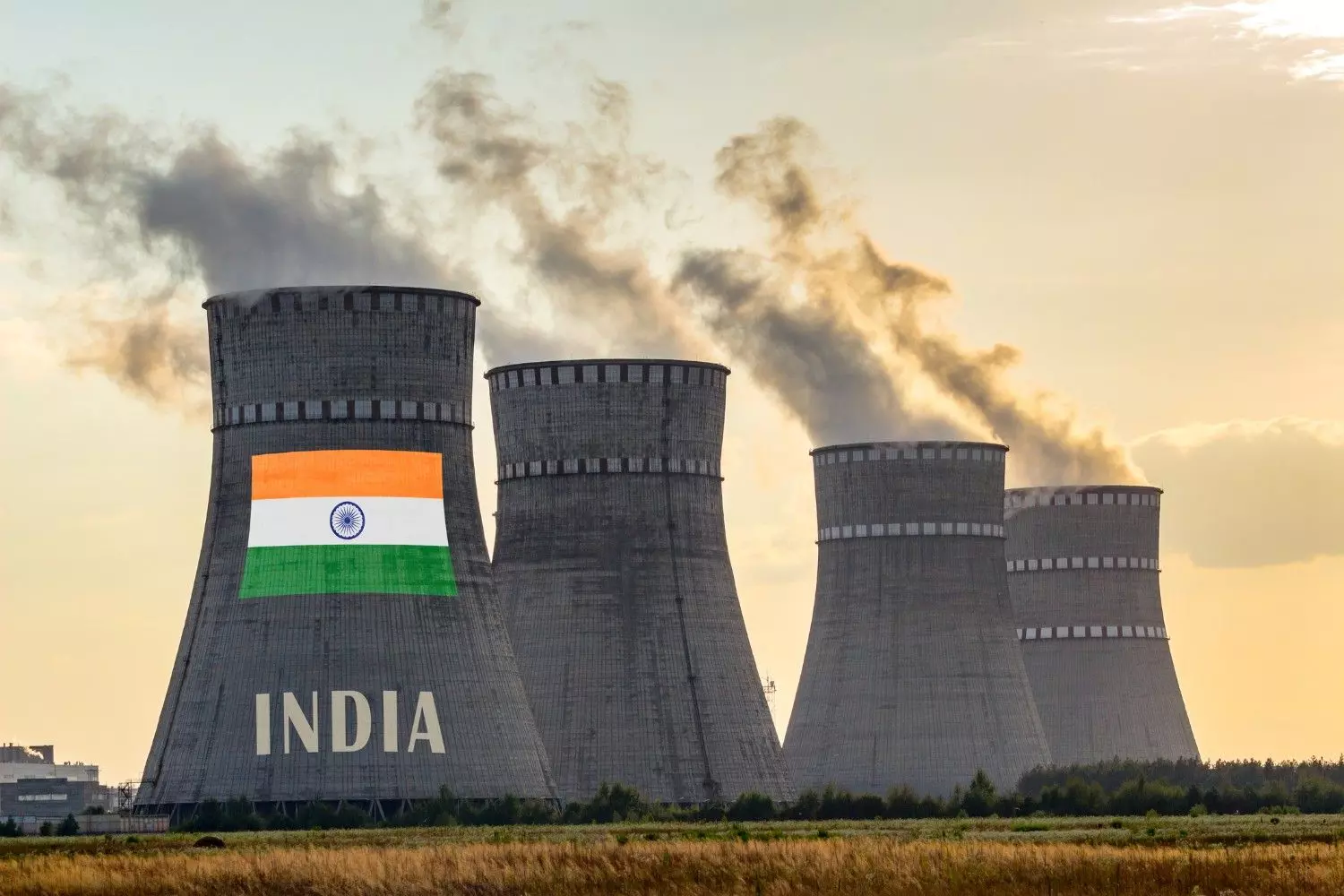
The Sustainable Harnessing and Advancement of Nuclear Energy for Transforming India Bill of 2025 allows private operators to run nuclear facilities in India and sets absurdly low liability thresholds in case of disasters. Representative Image: iStock
India’s nuclear push comes with a catch: Absurdly low liability, unlimited public risk
New bill sets maximum liability at USD 410 million in case of nuclear disaster; for operator, it is Rs 3,000 crore with a provision for complete waiver in undefined 'public interest'

As was expected, the Sustainable Harnessing and Advancement of Nuclear Energy for Transforming India (SHANTI) Bill of 2025, introduced in the Lok Sabha on Monday (December 15), not only allows private operators to run nuclear facilities in India but sets absurdly low liability thresholds in case of disasters.
Liability for nuclear disaster is USD 410m
Firstly, it keeps the maximum liability in case of a nuclear accident at 300 million Special Drawing Rights (SDR), as per Clause 13. This limit was fixed in the Civil Liability for Nuclear Damage Act of 2010, set 15 years ago. Not even inflation has been considered.
Also read: Atomic Energy Bill 2025: Why India’s 100 GW nuclear mission is a distant dream | Interview
At the December 2025 value of SDR at USD 1.36682 (International Monetary Fund), 300 million SDR translates out to USD 410 million or Rs 3,690 crore (at 90 per USD).
The SDR is determined by the IMF by summing the values in USD based on market exchange rates of a basket of major currencies — the USD, Euro, Yen, Pound Sterling and Renminbi.
The absurdity can be assessed by the simple fact that in the 1984 Bhopal gas leak at the pesticide plant of Union Carbide, which killed over 3,000 people, a compensation of USD 470 million was paid in 1989, against the Central government’s claim of USD 3.3 billion.
The liability provision was absurd in the 2010 law — and so is the case now.
Maximum operator liability at Rs 100-3,000 cr
Second, the maximum liability of an operator in case of accidents is between Rs 100 to Rs 3,000 crore, depending on the nuclear reactor being operated (Second Schedule).
Also read: Atomic Energy Bill: What it means to allow private firms into India’s nuclear sector
That is, reactors having thermal power up to 150 MW will be liable to pay Rs 100 crore, which goes up progressively to Rs 3,000 crore for a reactor producing thermal power of 3,600 MW or over.
The 2010 law had set the maximum liability for an operator at Rs 1,500 crore for a nuclear reactor with “thermal power equal to or above ten MW”.
In this count too, it is lower than what the 2010 law set.
But wait, there is more.
Centre arrogates power to let off private operators
Clause 14 of the Bill says “The Central government shall be liable” for the damage (i) if “the liability exceeds the amount of liability of an operator specified in the Second Schedule” (to the extent such liability exceeds the liability of the operator) and (ii) if the Central Government, by notification, assume full liability “in the public interest” and for this purpose it would set up a fund.
That is, if the damage is assessed to be far more than what the Second Schedule has fixed, the Central government will pay the rest — from the Indian taxpayers’ money.
Also read: India’s nuclear energy push: Will it be high on promises but low in delivery?
And what is the “public interest” that allows the Central government to waive off the liability of a private operator after a nuclear disaster and pay itself, from the taxpayers’ money?
That “public interest” is not defined in the Bill — the same was the case with the 2010 law. In 2010, the then Central government had sneaked in Section 7 for this undefined “public interest” while the Bill was in the process of being passed in Parliament.
In short, the Centre empowers itself to make Indian taxpayers pay for the mistakes of a private nuclear reactor operator — for killing their fellow Indians.
What is the logic for lowering the liabilities and/or passing the burden to Indian taxpayers?
It is that the 2010 law had imposed high liability and hence, no private nuclear operator was investing in India — even though that liability was lower than what a pesticide plant (Union Carbide) had paid in 1989. A nuclear disaster can be far more devastating for life and the environment than the gas leak from a pesticide plant.
Why India needs to bring private nuclear operators?
The Bill’s Statement of Objects and Reasons says the Centre has decided to achieve 100 GW of nuclear power capacity by 2047 — to make India 'Viksit Bharat' by using nuclear power “to address clean energy needs” (mentioned in the first few paragraphs of the Bill).
Also read: Fake BARC scientist held for trying to sell nuclear design to Iran
But this argument is less than convincing because India has already achieved over 50 per cent of green energy capacity, but the actual electricity generated from it is just 24 per cent, because of low evacuation infrastructure and storage capacity.
It would have made more sense to focus on utilising the existing green energy, rather than keep adding more.
Another question that begs an answer is: Why has this Bill been introduced without prior consultations with stakeholders such as domain experts, Opposition political parties and the people of India — the real sovereign under the Constitution of India in whose name the Central government functions.
More so since the Bill is not about small modular reactors (SMRs) but for even the large-capacity nuclear reactors.