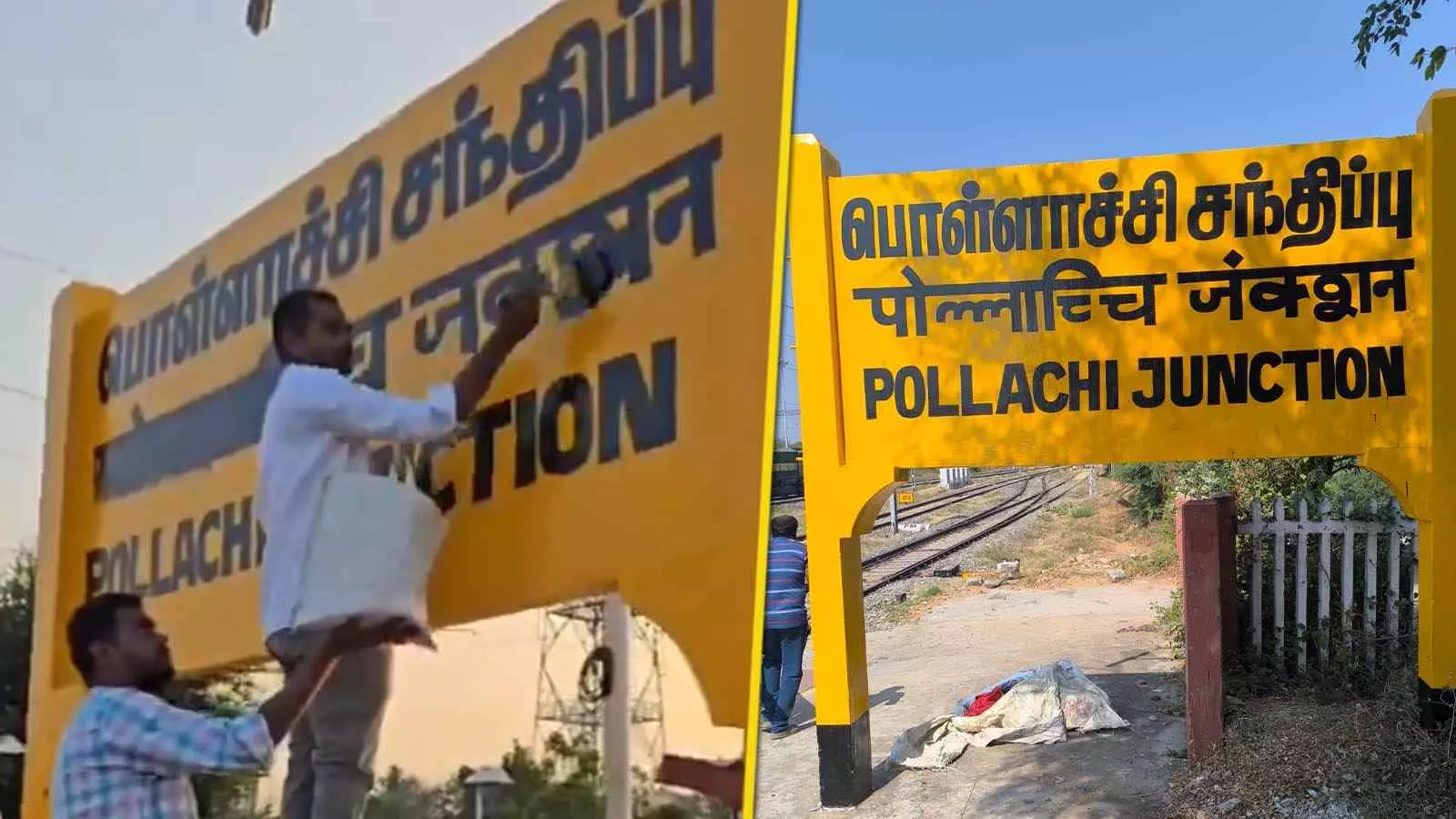
Tamil-Hindi friction has always dominated Tamil Nadu politics (File picture)
Despite L Murugan's claims, TN has long embraced Hindi through Dakshin Bharat Hindi Prachar Sabha, migration, and pop culture; objection is to forceful imposition
When I visited Chennai for the first time in 1986, some friends insisted on making it to the city’s once notorious Burma Bazaar, which for decades was a paradise for foreign-made electronic goods, perfumes and more that were not easily available in semi-socialist India.
What surprised me was the proficiency in Hindi that the shopkeepers showed while talking to us. When I interjected in Tamil to ask how they had mastered Hindi, one of them shot back: “Sir, we speak the language that helps us earn money!”
Also Read: English and Hindi weakening children’s talent: Karnataka CM Siddaramaiah
The traders at Burma Bazaar may have embraced Hindi as part of the enterprising spirit they showed after fleeing Myanmar in the 1960s to start life anew, but tens of thousands of more sanguine Tamils too learnt Hindi as they made Delhi, Mumbai and other cities in the north their home from the 1920s onwards.
Gandhi's mission
Many of the Tamils who made the national capital their home from the time the British still ruled India and after independence in 1947 came with a minimum knowledge of Hindi, acquired thanks to the Dakshin Bharat Hindi Prachar Sabha, an organisation Mahatma Gandhi set up in Madras in 1918.
Inaugurated by Annie Besant in June that year, the pioneering institute produced 80 students in 1919; since then, hundreds of thousands from southern India have graduated.
Whatever Hindi my now late parents could speak when they came to Delhi in 1948 was due to the Prachar Sabha, whose mission, as outlined by Mahatma Gandhi, was to propagate Hindi among the non-Hindi-speaking population in the country’s south.
Also Read: All Indian languages are national languages: RSS amid Hindi imposition row
This was also true for thousands of other Tamils, whose migration to northern India accelerated in the aftermath of independence, as the growing bureaucracy required those with knowledge of shorthand, typing, and English to fill its ranks.
Anti-Hindi protests
The 1960s saw a widespread anti-Hindi movement spearheaded by Dravidian political forces. But once its intensity waned, the throbbing Hindi film industry became, by default, a bigger and more effective propagator of the language than the Prachar Sabha.
Also Read: 'Let North Indians learn Tamil too': Kanimozhi hits back at Amit Shah
India’s decision to liberalise its economy in an unprecedented manner in 1991 led to a proliferation of jobs in the private sector in different parts of India. Once it became apparent that knowing Hindi would be an asset in other parts of India, there was a natural incentive to learn the language.
BJP minister's claim
This is why I was surprised and shocked to hear the claim made by the Union minister L Murugan of the Bharatiya Janata Party (BJP) at the Kashi Tamil Sangamam in Varanasi that he had been unable to learn Hindi in Tamil Nadu because of the state’s Dravidian legacy. It was obviously a statement made for political expediency rather than based on facts.
Whatever Hindi he knows, the minister told the audience, he learnt after moving to Delhi.
“Why am I being denied the opportunity to learn Hindi?” he asked in a self-righteous tone. “I will learn Hindi, it is my right. But there are no opportunities there (Tamil Nadu),” he quipped.
Murugan’s comments are a perfect example of the lies that are spread over the language issue, particularly when it comes to the never-ending Hindi-versus-Tamil dispute.
Also Read: No imposition of Hindi in Maharashtra, says CM Fadnavis
As we showed above, the Dakshin Bharat Hindi Prachar Sabha had already spent almost 60 long years teaching Hindi to hundreds of thousands of south Indians, a large number of them Tamils, when Murugan was born in May 1977.
Said to be fluent in Tamil, Telugu and English, Murugan, if he was really interested, could have easily learnt Hindi in Chennai. And like so many others in Tamil Nadu, he could have built on his Hindi by watching Hindi movies as well, since he is no Tamil chauvinist.
Migration and films
The government schools in Tamil Nadu may or may not have taught Hindi at some period, but that did not deter tens of thousands from learning Hindi. After all, schools across India also do not teach several subjects like architecture, journalism or civil aviation, but that does not prevent people from taking to these professions with aplomb.
A section of hardcore Dravidian politicians in Tamil Nadu may want nothing to do with Hindi. It is their right. Some may also not believe in God. That too is their privilege. But the fact remains that while the numbers proficient in Hindi in Tamil Nadu may be small compared to other states, Hindi is getting increasing traction in the state.
Also Read: Why Odisha bristles at Bangla, but embraces Hindi
One reason is migration – both ways. Tamils work outside Tamil Nadu in large numbers; non-Tamils, particularly from Hindi-speaking states and the north-east, also find employment in the state besides establishing small, medium and large businesses. In all cases, a minimum knowledge of Hindi is essential. Employment opportunities brighten up when one has a working knowledge, if not mastery, of Hindi.
The love for Hindi movies in Tamil Nadu is increasingly matched by a growing hunger for south Indian movies in Hindi-speaking areas, thanks to the use of subtitles or even dubbing.
Hindi imposition
The real objection to Hindi in Tamil Nadu is not about Hindi per se but about its imposition on other language speakers. And this fear is not imaginary.
Having been born and raised in Delhi, I have absolute command over spoken Hindi. I can speak the language for hours together without any discomfort. Indeed, I love Hindi. But I get put off when I come across instances of authorities trying to impose Hindi. So, I can well imagine the feelings in Tamil Nadu.
Also Read: Take a cue from Tamil Nadu: Top Kannada body proposes two-language formula in Karnataka
Those who spearheaded the anti-Hindi agitation in Tamil Nadu may have been clouded by politics. They might have committed mistakes and or indulged in excesses. They may have employed falsehood on occasions. But I strongly believe that but for those protests, Hindi would have been forcibly imposed on the country – with disastrous consequences.
One needs to live in the Hindi-speaking belt, including in supposedly cosmopolitan Delhi, to know that Hindi zealots reveal their fangs at the slightest opportunity. This is not a disease that should be associated only with the BJP and RSS. Hindi fanatics have existed for decades.
Hindi hegemony
Many years ago, there was an uproar when a Delhi government hospital issued a circular asking its predominantly Malayalam-speaking nurses to converse in Hindi rather than in their mother tongue.
A family friend who worked in the Defence Ministry and is now retired was taken aback when he was told to sign in Hindi during a customary “Hindi Fortnight”!
I frequently come across local bills and forms exclusively in Hindi compared to the Hindi and English used earlier. Government schemes and offices are named in Hindi or a cocktail of Hindi and Sanskrit.
In its zealous approach to making Hindi the only official language, the Union government sent a long letter to the Kerala government in Hindi, only to get back a detailed response in Malayalam.
Also Read: Language row: BJP starts counter-campaign in Tamil Nadu
Politicians like Murugan will serve both Hindi and Tamil better if they keep away from the language row. Hindi has the potential to grow slowly and steadily on its own strength. But, more importantly, anyone who wants to learn Hindi in Tamil Nadu can very well do so. Minister Murugan is mischievously wrong on this issue.
(The Federal seeks to present views and opinions from all sides of the spectrum. The information, ideas or opinions in the articles are of the author and do not reflect the views of The Federal.)