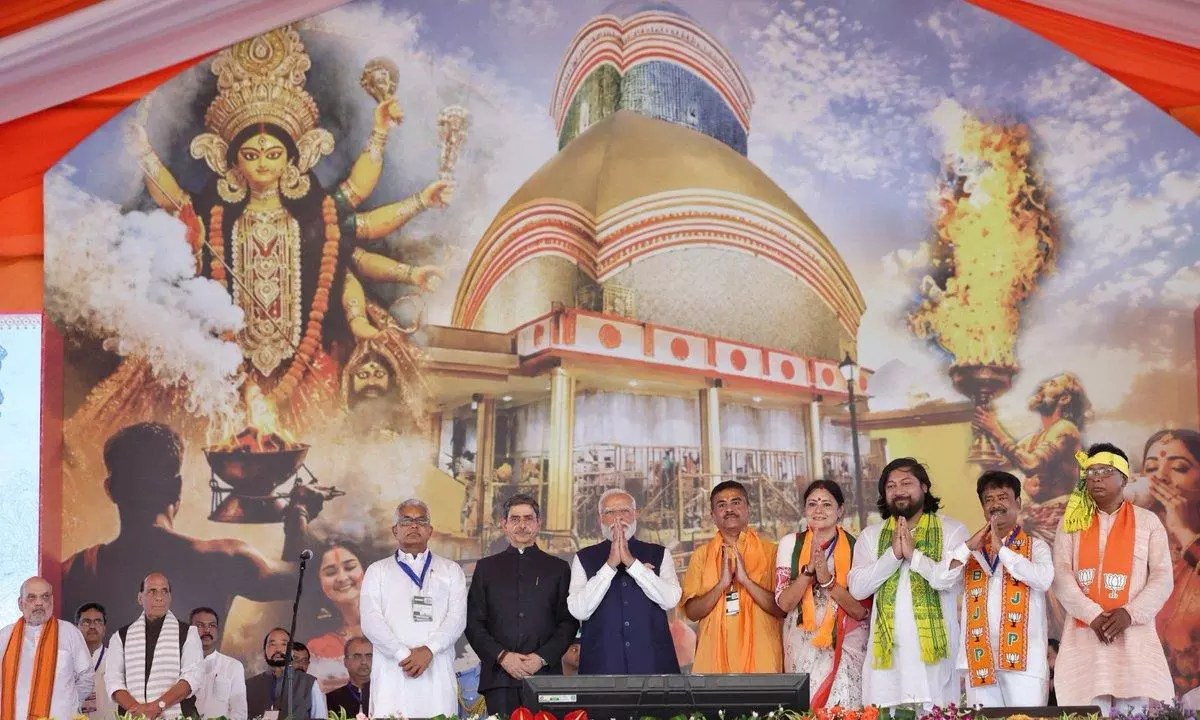
The BJP’s victory in West Bengal was presented as a triumph of democratic expansion. In reality, it exposed how electoral engineering, institutional capture, and Hindu majoritarian politics are remaking India into an electoral-authoritarian state where votes increasingly matter less than who is allowed to cast them.
The BJP's sweeping victory in West Bengal will undoubtedly enter the official mythology of Narendra Modi’s “New India” as proof that no political frontier remains unconquerable. For decades, Bengal stood outside the ideological geography of Hindutva. It was a state shaped by anti-colonial radicalism, labour movements, peasant uprisings, refugee politics, literary modernism, and a deeply embedded culture of secular political consciousness.
Even when the BJP expanded dramatically across northern and western India, Bengal remained resistant. That resistance has now been broken.
Transformational moment
The BJP’s capture of Bengal is not merely an electoral event. It represents a decisive stage in the transformation of Indian democracy itself — from an imperfect but competitive constitutional order into a system increasingly defined by institutional manipulation, majoritarian nationalism, and what can only be described as managed elections.
The scale of the BJP’s victory immediately generated celebration within corporate media and business circles eager to portray Modi as politically invincible once again after the party’s weakened parliamentary performance in 2024. Yet beneath the spectacle of triumph lies a profoundly disturbing political reality: millions of voters were either deleted, disputed, or trapped within bureaucratic limbo before polling day through the Election Commission’s controversial Special Intensive Revision (SIR) of electoral rolls.
The election was not simply fought. It was administratively engineered.
Manufacturing disenfranchisement
Officially, the SIR process was introduced to remove duplicate or “illegal” voters. In practice, it became one of the most sweeping voter-verification drives in independent India’s history. More than nine million names in Bengal alone were reportedly flagged, scrutinised, suspended, or removed during the exercise.
For the first time since India adopted universal adult franchise after independence, the burden of proving voting eligibility shifted from the state onto ordinary citizens themselves.
This is the deeper significance of Bengal. The election normalised a dangerous democratic rupture: the idea that governments can selectively redefine who constitutes the electorate.
This shift was not politically neutral. Migrant workers, poor women, elderly citizens, Muslims, and people dependent on the informal economy were disproportionately affected. Millions of Bengali and Bihari migrant labourers working in distant Indian cities could not return within the narrow verification windows. Others faced discrepancies between Aadhaar cards, ration cards, voter IDs, or land documents.
Women who changed surnames after marriage faced additional scrutiny. Muslims were especially vulnerable because AI-assisted verification systems reportedly flagged “discrepancies” in Urdu, Bengali, and English transliterations of names. The result was bureaucratic disenfranchisement on a massive scale.
Margin of victory
In several constituencies won by the BJP, the number of deleted or disputed voters reportedly exceeded the final margin of victory. That fact alone fundamentally undermines the moral legitimacy of the verdict.
The BJP defended the exercise through its familiar rhetoric of “illegal infiltration” from Bangladesh. But in Bengal, the language of infiltration has long operated as a communal political weapon directed overwhelmingly against Bengali-speaking Muslims. Citizenship itself becomes conditional under such a framework — less a constitutional right than an identity subject to state suspicion.
This is the deeper significance of Bengal. The election normalised a dangerous democratic rupture: the idea that governments can selectively redefine who constitutes the electorate.
Crisis of constitutional neutrality
India’s Election Commission was once internationally celebrated as one of the strongest electoral institutions in the post-colonial world. That credibility now stands gravely damaged.
Throughout the SIR controversy, Opposition parties repeatedly accused the Commission of opacity, selective enforcement, and political bias. Those accusations gained further force after the appointment of Manoj Agarwal, who was the Chief Electoral Officer during the just concluded elections, as chief secretary, and Subrata Gupta — one of the most prominent faces associated with the Election Commission’s controversial revision process — as advisor to Bengal’s new BJP Chief Minister, Suvendu Adhikari.
The symbolism was devastating.
The appointments reinforced public suspicion that sections of the EC had ceased functioning as independent constitutional authorities and instead operated in close political alignment with the ruling establishment. In any functioning liberal democracy, such a development would provoke a constitutional crisis. In contemporary India, it barely produced institutional outrage.
Democratic systems do not collapse only through coups or dictatorship. They erode when institutions gradually lose autonomy while continuing to preserve the outward rituals of legality.
The judiciary’s response proved equally alarming. Millions reportedly filed appeals after discovering their names missing from voter rolls. Yet more than 3.4 million appeals remained unresolved before polling. The Supreme Court ultimately allowed the election to proceed while ruling that citizens whose appeals were pending would still be unable to vote.
That judgment effectively legitimised disenfranchisement first and due process later.
Democratic systems do not collapse only through coups or dictatorship. They erode when institutions gradually lose autonomy while continuing to preserve the outward rituals of legality. Elections still occur. Courts still function. Opposition parties still exist formally. Yet, the terrain becomes structurally tilted toward permanent ruling-party dominance.
India is moving rapidly toward precisely such an electoral-authoritarian order.
Hindutva and remaking of India
The BJP’s Bengal victory must also be understood within the broader ideological project of Hindutva.
After losing its outright parliamentary majority in 2024, Modi’s government intensified efforts to consolidate long-term political hegemony. Bengal became the laboratory for that transition.
One mechanism is delimitation — the planned redrawing of parliamentary and assembly constituencies likely to increase the political influence of northern Hindi-speaking and Hindu-majority regions while weakening Opposition-governed and minority-heavy states. Similar exercises in Assam already diluted Muslim electoral representation.
Another mechanism is the nationwide expansion of voter-verification drives like the SIR. Once normalised, such procedures institutionalise permanent uncertainty around voting rights for millions of precarious citizens.
Political project
The third mechanism is “One Nation, One Election”, the BJP’s proposal to synchronise all state and national elections under a centralised electoral framework. Presented as administrative efficiency, the proposal would further weaken federalism while concentrating political discourse around Modi’s national leadership.
Taken together, these measures reveal a coherent political project: the conversion of India from a plural constitutional republic into a centralised Hindu-majoritarian state.
The BJP’s ideological success lies partly in transforming structural economic anxieties into communal fear. Unemployment, agrarian distress, inflation, privatization, and inequality are no longer addressed politically as failures of neoliberal capitalism. Instead, they are reframed culturally as consequences of demographic threat, “appeasement,” or Muslim infiltration.
Hindutva thereby performs the classic historical function of authoritarian nationalism: redirecting class anger away from concentrated wealth and toward vulnerable minorities. Corporate capital has largely accommodated this transformation. Big business benefits from centralised authority, weakened labour resistance, privatisation, deregulation, and the suppression of Oppositional politics.
In return, the ruling establishment receives extraordinary financial support and media amplification. The erosion of democracy is therefore not accidental to India’s political economy. It is increasingly integral to it.
Bengal as a warning
What happened in West Bengal matters far beyond Bengal itself. The election exposed how democratic procedures can be manipulated without formally abolishing democracy. Mass disenfranchisement can now occur through paperwork rather than open repression. Institutional capture proceeds through appointments rather than military intervention. Electoral legitimacy survives as spectacle even while political equality erodes beneath it.
This is the real significance of the BJP’s victory.
The Indian Republic was founded after Partition on an extraordinary constitutional promise: that every citizen — regardless of religion, caste, class, or literacy — possessed equal sovereignty through the vote. Bengal’s election revealed how fragile that promise has become.
When millions fear deletion from electoral rolls, citizenship itself becomes precarious. When constitutional bodies lose public trust, elections cease to function as democratic guarantees. And when communal nationalism merges with institutional power, democracy gradually survives only in procedural form.
Bengal was once considered one of the final barriers to the BJP’s hegemonic ambitions. Its fall now signals the emergence of a new political order in India — one where elections continue, but democracy itself steadily disappears.
(The Federal seeks to present views and opinions from all sides of the spectrum. The information, ideas or opinions in the articles are of the author and do not necessarily reflect the views of The Federal.)