On the eve of the Assembly poll in West Bengal, the electoral exercise gives the appearance of being a full-scale military operation launched under the aegis of the Election Commission of India, which is not quite one may expect.
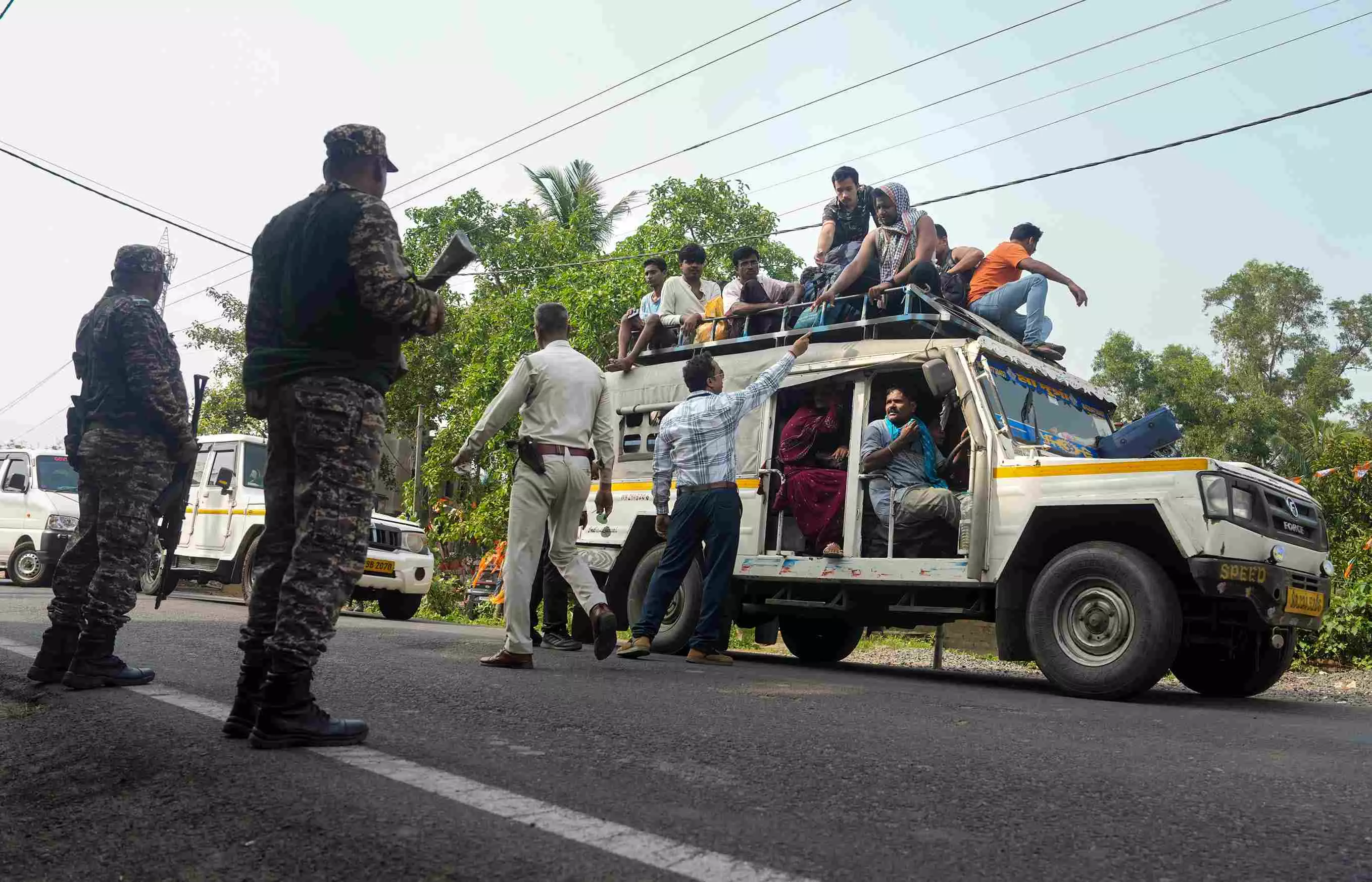
There seem to be more soldiers about than mobilised voters in the rural tracts of the state. Fear-inducing videos of Armoured Personnel Carrier (APC) vehicles carrying troopers in rural settings, guns at the ready, are doing the rounds.
Are these meant to keep certain kinds of voters at bay, especially given the full-throttle operation of the Special Intensive Revision (SIR) of voter rolls that have made appeals to the Supreme Court an almost daily affair, eliciting from the Chief Justice of India the droll comment that at this rate the top court may have to position a special bench to deal with West Bengal poll matters.
Not a 'festival of people'
Was this warranted? After all, 91 lakh people, who were permitted to vote as recently as in the last Lok Sabha poll of 2024, were struck of the rolls initially, and under freshly minted EC category such as “logical discrepancy”, and others, calling for adjudication by judicial officers imported from other states in order to meet a personnel crunch, a very large body of potentially eligible voters may never get to cast their vote.
An old concept concerning democracy and elections – wherein the idea of periodic voting to elect the representatives of the people in a democracy used to be seen as a “festival of the people”, and in its more recent pop avatara as the “dance of democracy” – seems such a quaint notion nowadays.
In countries lying to the west of India, stretching to parts of West Asia and the Caucasus region, elections are sometimes held in the shadow of the gun, at times with international observers present. This is also true of other parts of the world in which endemic violence has endured.
In such contexts, the fear of an unfair power grab by an armed faction might produce a government but not usually political stability, with dissatisfied rival groups, factions or parties, engaging in constant quasi-military takeover bids, creating circumstances for instability in sensitive geographies.
India has escaped this ignominy but since the latter part of the 1960s or the early 70s, some parts of the country, West Bengal among them, have been wracked by violence, including at election time. This state had developed a culture of violence even in the absence of elections where parties would hurl bombs at one another instead of settling arguments through even prickly dialogue.
In the election season the CRPF, a central government force reporting to the Union home ministry, would typically be deployed to act as a deterrent and polls would be scheduled in multiple phases so that soldiers could be moved around.
Unprecedented troops
But the election in West Bengal this year seems very different. The first of the two-phase polling is on April 23, and the second and last phase on April 29. The security deployment of the Central forces, ordered by the EC, is as many as 3,000 companies, meaning three lakh troopers. This is frightening- and quite unprecedented.
In the state polls in Bihar late last year, evidently a little over one lakh central forces had been deployed.
It is hard to call this state of affairs “a festival of the people”. Even in Jammu and Kashmir on the border with Pakistan, where terrorist violence has been a recurring motif for more than three decades, forces deployment of a comparable magnitude is not seen in the normal course of things.
Has West Bengal at election time in 2026 come to equal an abnormal situation in strife-torn J&K? What’s the message of such a massive deployment to voters in the state when seen alongside the extraordinary exclusion of voters in the shadow of the SIR programme of the Election Commission?
This exclusion works out to approximately 11 per cent of the total electorate of the state, with a disproportionately high percentage of women voters and those of the principal religious minority, who form about 30 per cent of the state’s population. On the whole, both categories have been seen to be loyal voters of the Trinamool Congress, the party of Chief Minister Mamata Banerjee, who has been in the saddle for 15 years.
For several years, the EC has been accused by BJP’s opponents, across states as well as at the Centre, of being a partisan body, a charge which it denies. Nevertheless, the accusation has grown louder under the stewardship of its present chief as the idea of neutrality and even-handedness is widely thought to have taken a back seat.
Reduced democracy?
The Chief Election Commissioner, many believe, presents itself as a political entity, rather than as the head of a body charged under the Constitution with the smooth conduct of impartial elections. The CEC tends to use strong language, not worthy of a facilitator of clean, straightforward, elections. Recently, a delegation of the ruling party in West Bengal was asked “to get lost!”.
The BJP, the ruling party at the Centre, gives the impression of being determined to make every effort, political as well as extra-political, and using all means available, to storm its way to power in West Bengal, ousting Ms Banerjee. At election time, administrative and security arrangements become the domain of the EC. However, the extraordinarily high deployment of the paramilitary is causing the question to be raised: Is this an independent decision based on concrete and objective requirements?
Or, are we now a reduced democracy with key institutions unable to play the role expected of them?
(The Federal seeks to present views and opinions from all sides of the spectrum. The information, ideas or opinions in the articles are of the author and do not necessarily reflect the views of The Federal.)