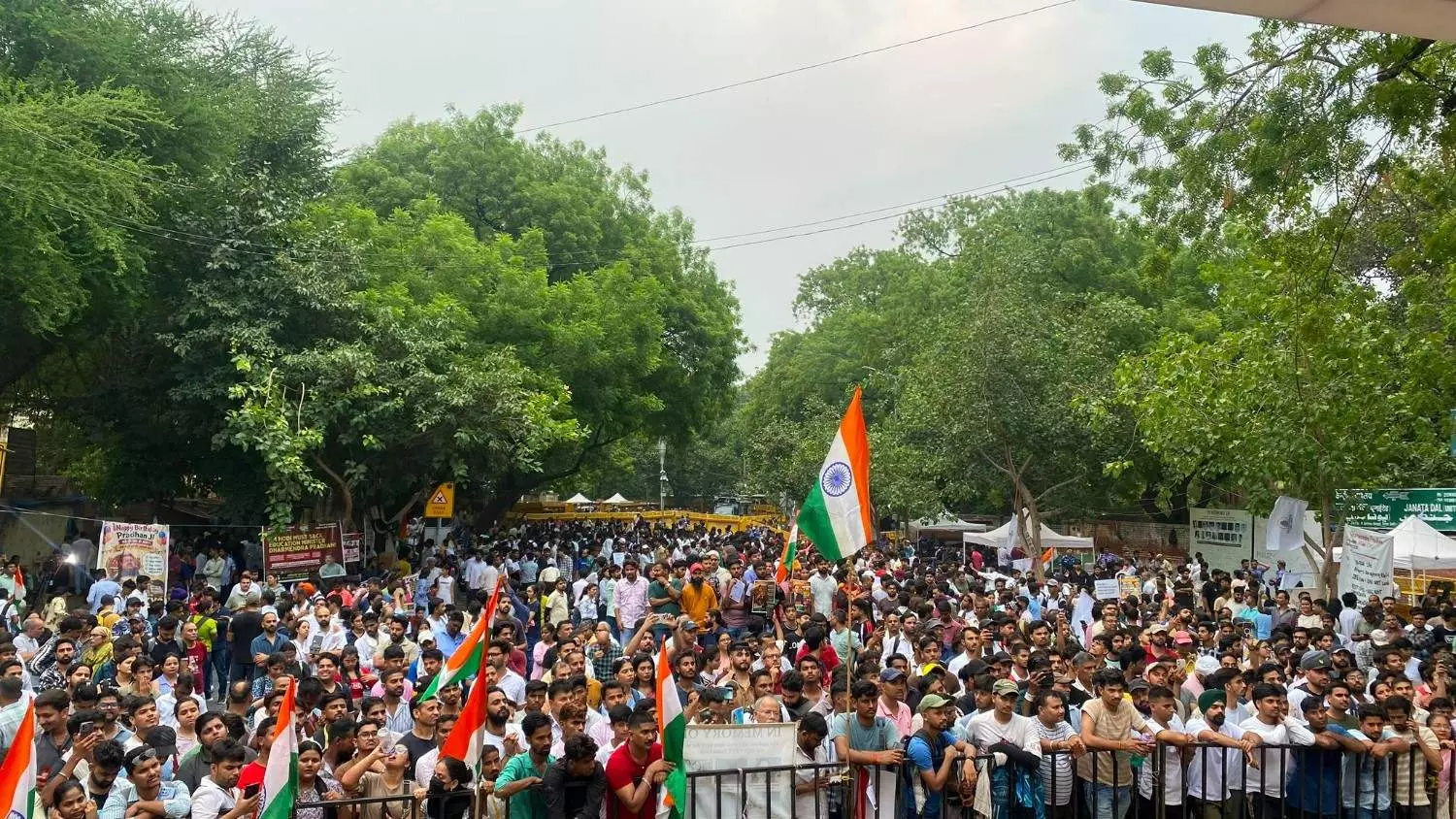
Students are encouraged to question, analyse, debate, and engage with public issues; when they did exactly that, universities put out 'advisories' against it
The recent NEET-UG protests at Delhi’s Jantar Mantar exposed an uncomfortable contradiction in higher education.
Universities repeatedly claim that they develop critical thinking, collaboration, civic responsibility, and constitutional values among students. Students are encouraged to question, analyse, debate, and engage with public issues. However, when students collectively acted on those very principles over an issue that directly affected higher education, several universities advised them not to participate.
The episode raises an important question: should universities encourage democratic participation only inside classrooms, or should they also support these values when students put them into practice?
An issue that matters
Recently, the Association of Indian Universities (AIU), Delhi University, Jawaharlal Nehru University (JNU), Jamia Millia Islamia, IIT-Roorkee, and IIT-Madras issued advisories urging students to stay away from the NEET demonstrations. They cited personal safety, restrictions on public assembly, and the need to avoid misinformation on social media.
JNU’s advisory, for instance, asked students to “refrain from participating in or visiting gatherings at or around Jantar Mantar”, invoking the Supreme Court’s directions on public demonstrations as its basis.
Also read: What 2026 NEET protests reveal about Tamil Nadu’s changing politics
Universities have every right to advise caution and ensure that academic activities continue without disruption. However, the students at Jantar Mantar were not protesting over an issue external to universities.
They were questioning the integrity of India’s examination system that determines entry into higher education for lakhs of students. They demanded accountability for alleged irregularities in examinations conducted by the National Testing Agency (NTA) and sought reforms to restore confidence in a system that had faced repeated controversies.
Universities did not have to endorse the protests or support every demand, nor were they expected to take political positions. But neutrality does not require silence on issues that directly affect higher education
Today’s students are well aware that the credibility of admissions directly affects universities as it shapes who enters their classrooms and influences public trust in higher education.
Detached observation, a poor option
Universities, therefore, cannot be detached observers. Their responsibility extends beyond commenting on curriculum reform, accreditation, research funding, and higher education policy. In fact, the integrity of the admissions process deserves the same attention, if not more.
There is another irony here. The students were demanding reforms that would actually strengthen the credibility of the very system on which universities depend. Greater transparency, stronger accountability, and a more reliable examination process would reinforce public confidence in higher education.
However, sadly, by discouraging participation without expressing similar concern about the issues raised by the protesters, universities appeared, at least by omission, reluctant to publicly champion reforms that would ultimately have served their own institutional interests.
Neutrality does not require silence
This is where the advisories fell short. They focused almost entirely on student conduct rather than institutional failure. Students were asked to avoid demonstrations, remain focused on their studies, and refrain from sharing misinformation on social media. They were also reminded of possible disciplinary and legal consequences.
None of the advisories reviewed for this piece publicly acknowledged concerns about examination integrity or called for greater transparency, an independent inquiry, or institutional accountability.
Also read: The unmaking of Brand Modi: How ‘56-inch chested’ PM bowed to youth power
Universities did not have to endorse the protests or support every demand, nor were they expected to take political positions. But neutrality does not require silence on issues that directly affect higher education.
The demonstrations were not merely an expression of dissent; they were also an exercise in civic learning. But, universities chose to respond rather cautiously
A university can advise restraint while also recognising that concerns over examination integrity deserve serious public attention. It can call for a credible investigation without prejudging its outcome. That would have reinforced public confidence in both the admission process and the universities’ own commitment to academic integrity.
Sharp contrasts
Another notable feature was the similarity of the advisories issued by institutions with very different administrative structures and academic cultures. Their language closely followed the AIU’s earlier appeal, hinting at some degree of coordination among institutions, though the exact nature of that coordination is not publicly known.
The AIU had asked Vice-Chancellors to counsel students to stay focused on their studies and retain faith in the examination system, a framing that surfaces in JNU’s call for students to “uphold the values of academic responsibility”, and in similar phrasing across the other advisories.
However, quite ironically, the same collective voice was absent when it came to demanding greater transparency or accountability in a matter that directly affected higher education. The contrast was difficult to overlook.
Integrity of the system
This episode has also revealed a deeper inconsistency in the way universities understand their educational role. Across policy documents, curriculum frameworks, and institutional vision statements, universities emphasise critical thinking, creativity, collaboration, civic engagement, and constitutional values as essential learning outcomes. Lofty ambitions, indeed. These are presented as competencies required for responsible citizenship in the 21st century.
Also read: Why CJP’s protest stands apart from previous mass movements
The NEET protests actually offered students an opportunity to practise those very competencies. So, they organised themselves, worked across institutions, examined public policy, evaluated competing claims, and participated peacefully in democratic action.
The protest site became an extension of the classroom where ideas discussed in lectures were tested in public life. The demonstrations were not merely an expression of dissent; they were also an exercise in civic learning.
But, universities chose to respond rather cautiously. They cannot claim to prepare students for democratic participation while discouraging them from participating democratically in issues that directly affect higher education. If civic engagement is presented as a learning outcome, students must also be trusted to exercise it responsibly beyond the classroom.
Test for universities
Of course, this does not mean universities should become centres of political mobilisation. Clearly, their responsibility is different. They are expected to defend the integrity of the academic system on which their own credibility rests. Universities need not endorse every protest or every slogan. However, they should be prepared to affirm the principles behind them.
So, the significance of the NEET protests, from a higher education perspective, is that they tested whether universities would stand only for administrative order or also for the academic values they claim to uphold. Sadly, the outcome has been disappointing.
Advising caution, perhaps, was acceptable. But they fell short of defending the integrity of the system that their own students sought to improve. It would do well for university leaders to remember that higher education derives its legitimacy not only from teaching democratic values but also from demonstrating confidence in students who choose to practise them.
(The Federal seeks to present views and opinions from all sides of the spectrum. The information, ideas, or opinions in the articles are of the author and do not necessarily reflect the views of The Federal.)