







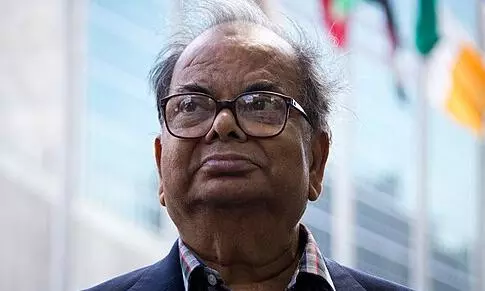
A recipient of the Sahitya Akademi Award, Shankar was widely associated with his landmark novel 'Chowringhee'. Photo: @me_locket
Mani Shankar Mukherjee, Sahitya Akademi awardee author of ‘Chowringhee’, dies at 92
The renowned author, whose novels inspired Satyajit Ray’s Calcutta trilogy and reshaped modern Bengali urban fiction, passed away after an age-related illness

Mani Shankar Mukherjee, the distinguished Bengali writer who published under the name ‘Shankar’ and turned the everyday pulse of city life into enduring fiction, later adapted for the screen by Oscar-winning filmmaker Satyajit Ray, passed away on Friday (February 20) at the age of 92.
He had been undergoing treatment at a private hospital for age-related ailments. He is survived by his two daughters.
Sahitya Akademi awardee
A recipient of the Sahitya Akademi Award, Shankar was widely associated with his landmark novel 'Chowringhee' and with a broader body of work that traced the ambitions, insecurities and ethical conflicts of urban India. He had been unwell for some time.
Also Read: Ajit Pawar obituary: A perpetual CM-in-waiting, a leader Maharashtra loved to fear
West Bengal Chief Minister Mamata Banerjee expressed grief at his passing, describing him as “one of the brightest stars in Bengali literature” and saying his death was an “irreparable loss” to the cultural sphere.
Writing on X, she said his enduring works — from Chowringhee and Kato Ajanare to Seemabaddha and Jana Aranya — had captivated readers across generations while portraying the lives and struggles of ordinary people.
Earliy life and career
Born on December 7, 1933, in what is now Bangladesh's Jessore district, Mukherjee grew up in Howrah after his family moved to Kolkata before World War II. The son of a lawyer, his early life was shaped by modest means and a restless curiosity about the human condition, traits that would later define his fiction.
Also Read: EA Siddiq obituary: A man whose arduous basmati rice research turbocharged exports
Before becoming a full-time writer, he worked as a clerk to Noel Barwell, the last English barrister practising at the Calcutta High Court. Barwell's death left a deep imprint on the young Mukherjee.
Wanting to honour his mentor but lacking the means to commission a statue or painting, he chose instead to write a book. That decision led to 'Kato Ajanare' (So Much Unknown), first serialised in Desh magazine in the early 1960s, and marked the birth of "Shankar".
A household name with 'Chowringhee'
If that book announced his arrival, 'Chowringhee' made him a household name.
Conceived, as he would later recount, on a rain-soaked day at a waterlogged Kolkata crossing when he gazed at the neon lights of the Grand Hotel, the novel opened the doors of the fictional Shahjahan Hotel to readers.
Also Read: Mark Tully obit: The journalist who taught India to the BBC
Through unforgettable characters like the suave manager Marco Polo and receptionist Sata Bose, Shankar offered an insider's view of the city's elite culture, its business intrigues and hidden heartbreaks.
The novel was adapted into a blockbuster Bengali film in 1968 and attained cult status. It was translated into multiple Indian and foreign languages, expanding Shankar's readership far beyond Bengal.
Works inspired Ray's Calcutta trilogy
Two of his other major works, 'Seemabaddha' and 'Jana Aranya', formed part of Satyajit Ray's acclaimed Calcutta trilogy.
Ray, known for his global cinematic legacy, had personally called the young writer after reading 'Seemabaddha' in a Puja annual, asking him not to sell the film rights before informing him. The resulting films brought Shankar's sharply observed corporate and middle-class narratives to national and international audiences, with 'Seemabaddha' (Company Limited) and 'Jana Aranya' (The Middleman) winning accolades at international festivals.
Novel adapted into Hindi film
Another of his novels, 'Man Samman', was adapted into the Hindi film 'Sheesha' by Basu Chatterjee, while filmmakers like Ritwik Ghatak also attempted cinematic interpretations of his novel 'Kato Ajanare'. Over time, Shankar became one of the rare Bengali authors whose fiction travelled seamlessly from page to screen.
Also Read: Madhav Gadgil obit: An ecologist who refused easy binaries
Yet, despite his popularity, he occupied a distinct literary space during decades dominated by stalwarts such as Sunil Gangopadhyay, Shirshendu Mukhopadhyay and Samaresh Majumdar.
His contemporaries often noted his discipline, wit and generosity towards writers across generations.
Shirshendu Mukhopadhyay described him as a prolific author with a sharp sense of humour and deep respect for fellow litterateurs.
Not limited to urban dramas
Shankar's oeuvre was not limited to urban dramas. He wrote extensively for younger readers and produced bestselling memoirs that blended nostalgia with social commentary.
Also Read: Khaleda Zia obituary: Bangladesh’s accidental PM with a lasting legacy
His later works included deeply researched writings on Swami Vivekananda, notably exploring both the spiritual and human dimensions of the monk's life.
When some critics objected to his portrayal of Vivekananda's everyday habits, his love for tea, music and cooking, senior monks of the Ramakrishna Mission defended his approach, praising him for showing a human side of the towering figure, he had once said.
Sahitya Akademi Award for 'Eka Eka Ekashi'
In 2021, he was conferred with the Sahitya Akademi Award for his autobiographical work 'Eka Eka Ekashi'. His books have been translated into English, Hindi, Malayalam, Gujarati, French and Spanish, ensuring his voice reached readers across linguistic boundaries.
Shankar remained an acute observer of ambition and vulnerability: of the clerk who dreams, the executive who compromises, the receptionist who survives, the monk who doubts.
Also Read: Vinod Kumar Shukla obit: A writer who illuminated ordinariness of the ordinary
With his passing, Bengal loses not merely a bestselling novelist but a chronicler of its post-Independence urban soul, one who turned rain-drenched pavements, hotel lobbies and corporate boardrooms into enduring literature.
His death marks the end of an era, but the neon lights of Chowringhee and the moral crossroads of Jana Aranya will continue to glow in the imagination of readers across India and beyond.
(With agency inputs)