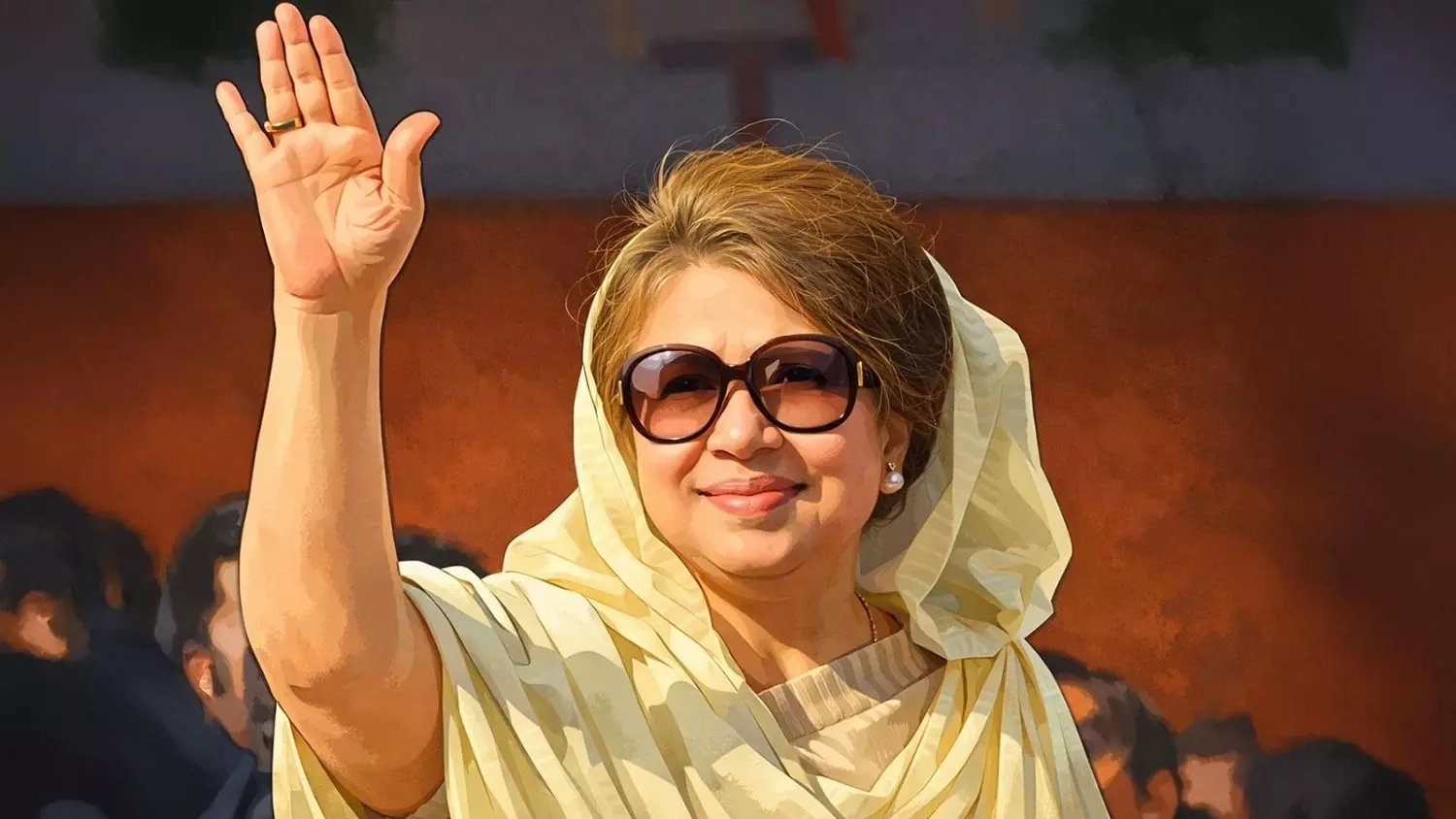
Khaleda Zia obituary: Bangladesh’s accidental PM with a lasting legacy
From reluctant political heir to two-time Prime Minister, she reshaped Bangladesh’s power balance and led BNP through its fiercest contests with Sheikh Hasina

Manmohan Singh's branding by critics as "accidental Prime Minister" perhaps suits Bangladesh's Khaleda Zia and her archrival Sheikh Hasina better.
Khaleda would likely not have been in politics had her late husband General Ziaur Rahman been alive. The same applied to Hasina — if her father Sheikh Mujibur Rahman had not been assassinated with almost his entire family, including her brother Sheikh Kamal.
Also Read: Yunus, Hasina, Modi offer condolences as Bangladesh ex-PM Khaleda Zia dies
But unlike Hasina, who had grown up with her father's long politics of agitation for Bengali self-rule and had some exposure in student politics, Khaleda was an archetypal military officer's wife, forced into politics by her husband’s assassination and the growing national impatience with General Ershad's military rule.
Leading BNP to surprise win
Both Khaleda and Hasina fought for restoration of democracy in a dramatic struggle against authoritarianism after they had been put at the helm of their parties by the unanimous choice of top leaders and those at the grassroots.
But once Ershad was ousted, Khaleda surprised all by leading her BNP party to victory, defeating the Awami League in the first election since the restoration of democracy.
In that election campaign which I closely followed after my honeymoon in Bangladesh's famous Cox's Bazar beach town, I saw Khaleda emerge as automatic choice as Prime Minister during the campaign because she was seen as the only one who could hold together competing factions in the BNP – a party born in the barracks and mid-wifed by a general who had pulled in diverse groups from right and left to build a national alternative to the formidable Awami League. She was an average orator but a courageous woman who didn't shy away in adversity.
Same league as Indira
BNP was always more of a platform than a party, which drew in hardline Islamists who had collaborated with Pakistan (PM Shah Azizur Rahman) and left-wing elements, as well as some freedom fighters who revered Ziaur for his role as a Sector Commander of the Mukti Bahini in the 1971 Liberation War.
Also Read: Khaleda Zia’s death marks the end of an era in Bangladesh politics
Begum Khaleda skillfully held the party together and led it to victory not once but twice (in 1991 and 2001), emerging as Bangladesh’s first female Prime Minister in the process. That puts her in the same league as Indira Gandhi, Sirimavo Bandaranaike, Benazir Bhutto and her archrival Hasina.
Many would credit her for consolidating Ziaur’s legacy in providing Bangladesh with a political alternative to the Awami League which had spearheaded the long struggle for Bengali self-rule and then led the country's independence war against the brutal Pakistan military junta.
Pandering to anti-India sentiments
To cement BNP as Awami League's political alternative, Khaleda carried forward and sought to institutionalise Zia's "Bangladeshi nationalism" that sought to accommodate an Islamic identity in a territory-driven nationalism drawing inspiration from undivided Bengal's pre-British medieval history dominated by Muslim ruling dynasties.
In this brand of nationalism, Bangladesh was less a product of secular, linguistic and culture-driven nationalism that had grown from the 1952 Bengali language movement, found form in the agitation for East Pakistan's autonomy in the 1960s, and finally culminated in the 1971 Liberation War against Pakistan.
Rather, it would be more of a modern incarnation of Nawabi Bengal, the antithesis of the Spirit of 1971.
Also Read: Not 'anger' or 'revenge' but 'love and peace' will rebuild Bangladesh: Khaleda Zia
If Zia, whose claim to fame rests on his Liberation War exploits, paved the way for re-legitimising the pro-Pakistan Jamaat-e-Islami, Khaleda drew BNP closer to the Jamaat-e-Islami, as the challenge from the Awami League grew stronger. In her second term as Prime Minister, the Jamaat-e-Islami joined her coalition government as a junior partner.
In the process, Khaleda drew considerable succour from the anti-India sentiments and carefully pandered to them. India tried to befriend her in 2001, when she led BNP to power a second time in a decade. The Vajpayee government rolled out a red carpet for her son Tarique Rahman and senior industrialists gave him audience to discuss investment proposals.
Son Tarique's big task ahead
But the seizure of 10 truckloads of weapons in Chittagong port in April 2004, much of it meant for the ULFA, ended India's brief bonhomie with the Khaleda government. The shock reverberated through the Indian security set-up and ended chances of a meaningful relationship.
Later, Khaleda’s refusal to meet senior Congress minister Pranab Mukherjee in Dhaka ahead of the controversial 2014 polls came to be seen as the lowest point of BNP's relations with India. Many feel Khaleda saw good relations with Pakistan and China as necessary to counter India's backing for the Awami League.
Also Read: Why unrest in Bangladesh matters to India | Talking Sense With Srini
In a way, Khaleda can be credited with consolidating the legacy of her late husband Ziaur, rather than leaving behind a legacy uniquely her own. Like a successful matriarch holding together a big joint family, Khaleda can be credited for not only holding together the Bangladesh Nationalist Party, founded by her husband, but also leading it to electoral victory in two elections.
Until her very end, she did that job wonderfully through thick and thin.
As her mantle passes on to son Tarique, one would wonder whether the dynast will be able to lead the party as successfully as she did. The 2026 parliament polls will be his first acid test.