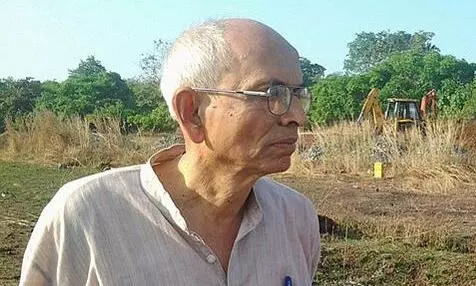
Madhav Gadgil: May 24, 1942 to January 8, 2026
Madhav Gadgil obit: An ecologist who refused easy binaries
From opposing the Wildlife Protection Act to the Western Ghats report, Gadgil centred people and democracy in environmental debates shaping policy discourse

The last time this reporter spoke to Prof Madhav Gadgil, it was a very different experience from what many would have expected. The conversation was about the escalating human–wildlife conflict in Kerala, where people were losing their lives to animal attacks, even as environmentalists in the state were firmly opposed to demands from settler farmers and the government to cull problem animals.
Anyone assuming that he would instinctively oppose the culling of animals or the declaration of certain species as vermin would have been surprised.
Critic of Wildlife Protection Act
Gadgil had a clear, uncompromising stand. Animals, including under specific circumstances tigers and elephants, needed to be culled or hunted, and wild meat should be legalised. A fierce critic of the Wildlife (Protection) Act of 1972, he argued vehemently for its repeal, insisting that conservation laws in India had drifted dangerously away from constitutional principles and lived realities.
Also Read: Vinod Kumar Shukla obit: A writer who illuminated ordinariness of the ordinary
“First of all, the Wildlife Protection Act of 1972 is in direct contravention of the Constitution of India,” he told this reporter while discussing human–wildlife conflict. “Under the WLPA, people are not free to defend themselves against marauding animals, as even driving them out of their homes and crop fields needs official permission. Yet the Indian Penal Code, Sections 100 and 103, gives everyone the right to private defence of body and property. Wild pigs have, on occasion, killed people. They regularly trespass on farmers’ properties and rob them of their produce. Elephants do the same, and tigers kill people and rob farmers of their livestock and dogs. Friends in law enforcement and the judiciary have told me that the WLPA is clearly not valid constitutionally. Put in simple terms, if a tiger is attacking you and your family, don’t you have the right to defend and retaliate? These people are not encroaching on forests. They have been living there for several centuries. Now tigers encroach into farmers’ property because there are too many of them in the forest.”
Essence of Madhav Gadgil
That exchange captured the essence of Madhav Gadgil, an ecologist unwilling to fit into comforting binaries of pro-conservation or anti-development, and a thinker who consistently foregrounded people, especially forest-dwelling and farming communities, in environmental debates. His positions often unsettled conservation orthodoxy and political power alike, but they were rooted in decades of scientific work and a deep commitment to democratic decision-making.
Also Read: Sreenivasan’s legacy: Four decades of laughter, satire, and social insight
Born in 1942, Gadgil emerged as one of India’s most influential ecologists, with seminal contributions to population biology, biodiversity conservation, and ecological history. As a founder-member of the Centre for Ecological Sciences at the Indian Institute of Science, Bengaluru, he helped build an institution that shaped generations of Indian ecologists. Long before community-based conservation became policy language, Gadgil argued that local communities were not threats to biodiversity but its most consistent custodians, possessing ecological knowledge refined over centuries.
Gadgil Report – landmark document
This philosophy found its most consequential expression in the Western Ghats Ecology Expert Panel (WGEEP), which he chaired in 2010–11. Constituted by the Union Ministry of Environment and Forests to assess the ecological status of the Western Ghats, one of the world’s most significant biodiversity hotspots, the panel produced what came to be known as the Gadgil Report. It was a landmark document that combined scientific rigour with political clarity and social concern.
Also Read: Dharmendra obit: Hindi cinema’s first-generation superstar, icon of Indian masculinity
The report recommended that the Western Ghats be treated as a single ecological entity and classified into three Ecologically Sensitive Zones based on ecological fragility. It called for strict regulation of mining, large dams, thermal power plants, and highly-polluting industries in the most sensitive areas. At the same time, it explicitly protected existing settlements and traditional livelihoods. Equally important was its insistence on democratic decentralisation. Gram sabhas and local institutions, not distant bureaucracies, were to play a central role in environmental governance.
Backlash in Kerala
The backlash was swift and intense, particularly in Kerala. Political parties, church institutions, quarry and plantation lobbies, and sections of the media portrayed the report as anti-people and anti-development. Misinformation spread widely, with fears stoked about eviction and loss of land. Gadgil himself was personally vilified and often caricatured as an academic disconnected from ground realities. The report was eventually set aside and replaced by a diluted framework under the Kasturirangan committee.
Also Read: S L Bhyrappa obit: Prolific Kannada novelist who retold Ramayana in Sita’s voice
Critics argued that the Gadgil Report’s zoning framework, shaped partly by ecological idealism, did not sufficiently factor in Kerala’s unique history of land reforms, smallholder agriculture, and near-continuous human presence across the Ghats. In a state where villages, farms, quarries, churches, and roads are deeply interwoven with hills and forests, even well-intentioned regulatory prescriptions risked generating anxiety and resistance.
Redeemed by subsequent events
Subsequent events, like recurrent floods and landslides in the Western Ghats region, especially in Kerala, however, repeatedly underlined the prescience of the WGEEP’s warnings. Many of the high-risk zones identified after these disasters overlapped with areas the Gadgil Report had flagged as ecologically sensitive. What was once dismissed as alarmism began to look like foresight.
Gadgil remained unsparing in his critique of both the dilution of the Western Ghats recommendations and the broader trajectory of Indian conservation law. His opposition to the Wildlife Protection Act stemmed not from hostility to wildlife, but from his belief that exclusionary conservation was socially unjust and ecologically counterproductive. For him, sustainability required constitutional rights, local consent, and adaptive management, even when that meant taking deeply uncomfortable positions on hunting and culling.
Deep faith in democratic processes
Personally austere, intellectually rigorous, and often combative in public debate, Madhav Gadgil nevertheless retained a deep faith in democratic processes. He believed ecological crises could become opportunities for course correction if citizens demanded accountability and evidence-based policy.
Also Read: Zubeen Garg obit: The voice that carried Assam’s love, longing and loss in its timbre
With his passing, India loses not just a distinguished ecologist, but a rare public intellectual who insisted that environmentalism must be truthful, participatory, and humane. The Gadgil Report remains his most visible legacy, but his deeper contribution lies in the questions he forced the country to confront about power, knowledge, nature, and justice.